
Read the spec sheet.
Then read the warranty.
A composite deck comes with a warranty booklet and a separate fade and stain warranty, plus a code report an inspector can ask for and an installation guide the warranty depends on. Treated lumber comes with a tag stapled to the end. None of it is hard. All of it is written to be skimmed. Here is how to read it slowly.
Five numbers that are the whole board.
The span rating is the one an inspector checks. Composite is not lumber, so a code report tested to ICC-ES AC174 says how far apart the joists can be at a given load. Trex's report gives Transcend 16 inches at 100 pounds per square foot with boards straight across, 12 at 45 degrees, 8 at 30. MoistureShield's gives 16 at 100 and 12 at 150. Read the angle and the load, not just the 16.
Flame spread (ASTM E84) runs 0 to 200. Slip is a static friction number, wet and dry, on the tech sheet; MoistureShield prints its wet numbers by line. Termite and fungus resistance are pass ratings on the tech sheet and in the code report. Water absorption is a percent after a soak; the makers we sell publish under 1.5 percent, most under 1.
Then the listing. A rating with a report number behind it is a spec. A rating with a brand word in front of it is a claim.
Which code report covers this board, and what is the span at the angle I am laying it. What is the flame spread index. What are the wet slip numbers. Show me the tech sheet, not the brochure.
| Rating | Test or standard | What it tells you | Look for |
|---|---|---|---|
| Span rating | ICC-ES AC174 / ASTM D7032 | Max joist spacing at a load, by board angle | 16 inches at 100 psf straight; the angled number if you lay diagonal |
| Code report | ICC-ES ESR, or PFS TECO / Intertek report | The listing an inspector accepts | Trex ESR-3168; MoistureShield BPER-0110; a report number for whatever you buy |
| Flame spread | ASTM E84 | Surface burning, 0 to 200 | Class A is 25 or under; Class C is 76 to 200. MoistureShield publishes 110 to 120; TimberTech Advanced PVC publishes Class A |
| Slip | ASTM D2394 static friction | Grip wet and dry | The wet number; MoistureShield publishes 0.39 to 0.77 wet depending on line and direction |
| Fade | Delta E (CIE), in the warranty | How much color shift is covered | 5 Delta E, and the years it holds |
| Treated lumber | AWPA use category, retention in pcf, on the end tag | What the wood is rated for | Ground Contact for joists, beams, posts; Above Ground for decking and rail |
If the salesman cannot say which report number covers the board, he has not read it. We keep the reports in the binder and will print the page.
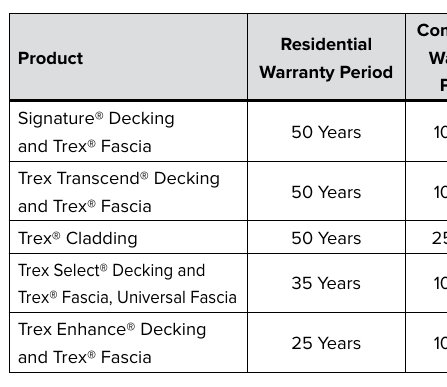
"50-year" has a table. Read the table.
Here is Trex's warranty, read from the document, as an example of how every composite warranty is built. Table I gives the years by line: Signature and Transcend 50, Select 35, Enhance 25 for a home; 10 for a commercial deck. Coverage is physical integrity: no splitting, splintering, rot, or structural damage from termites or fungal decay.
Fade is a separate promise in the same document: no more than 5 Delta E of color change for 25 years, and no more than 15 for the rest of the term. Stain covers food and drink, and mold, provided you clean it with soap and water within one week. Both are on the walking surface only.
Proration starts at year eleven. Table II pays 90 percent of the boards or the purchase price at year eleven on a 50-year line, 80 percent on Select and Enhance, and steps down to 10 percent in the last years. Labor to remove and reinstall is never covered; the refund excludes installation.
Transfer is once, within five years of the original purchase. Conditions that void it: not installed to the guide, including gapping; contact with heat over 275 degrees; a punctured surface, including a metal snow shovel; paint or stain applied. Exclusions: railing, fasteners, and lighting have their own warranties.
None of that is a criticism. It is a good warranty, typical of the category, and the other makers' are built the same way with different numbers. The point is that "50-year" on the sample board and "prorated from year eleven, transfer once in five, cleaned in a week" are the same document, and the table is the one that pays.
Which line, and which row of the table. When does proration start and what is the schedule. Is labor covered. What is the transfer window. Then ask the installer whether the joist spacing and gapping on the quote match the guide, because that is what keeps the table in force.
Same shape, different numbers.
| Line | Product term | Fade and stain | Read for |
|---|---|---|---|
| Trex Signature, Transcend | 50 years residential | 5 Delta E for 25 years, then 15 | Proration from year 11; transfer once in 5 years |
| Trex Select / Enhance | 35 / 25 years | Same fade terms | Same schedule, 80 percent at year 11 |
| TimberTech Advanced PVC | Limited lifetime residential | 50 years (2025 Source Book) | 5 Delta E; one-week cleaning; transfer once in 5 years |
| TimberTech composite, four-sided cap | 30 years | 30 years | Proration years 11 to 13 at 80 percent, stepping to 10 percent by year 23; no labor |
| TimberTech composite, three-sided cap | 25 years | 25 years | Same structure, shorter term |
| MoistureShield Vision / Meridian / Elevate | 50-year structural, transferable | 50 / 40 / 30 years | Fade to 5 Delta E on the cut sheet; ground, in-ground, and underwater install covered |
| MoistureShield Vantage (uncapped) | 50-year structural, transferable | None; it weathers by design | Structure only. Know that going in |
| Eva-Last Eclipse (US warranty) | 30 years residential, 15 commercial | 30 years, 5 Delta E | 100 percent through year 15, then prorated to 25 percent in years 25 to 30; transfer once in 5 years |
| Wolmanized treated (UTD) | As long as the original homeowner owns the house | None; weathering, checking, and warping are excluded in print | Not transferable; Ground Contact required for joists and beams; keep the end tags and treat every cut |
Warranty terms change with the printing. Ask for the current document for the line on the quote, not the summary on the sample card, and read the table in it. We will pull the PDF while you wait.
Treated lumber has one spec sheet, and it is stapled on.
The tag on a treated board names who treated it and who inspects them, then gives preservative, retention level, proper use, and often an ESR number of its own. Retention is pounds of preservative per cubic foot; the number depends on the chemistry, so compare like to like. UTD's sample tag reads 0.15 pcf MCA for Ground Contact General Use.
Proper use is the line that matters: Above Ground for decking, rail, and trim that dries; Ground Contact for posts, for anything within six inches of the ground or that stays wet, and, per the Wolmanized warranty, for deck joists and beams. Industry use categories run UC3B for above-ground exterior wood, UC4A for general ground contact, UC4B for heavy duty.
The Wolmanized warranty asks for the tags at claim time and requires end-cut preservative on every cut. It covers decay and termites for as long as the original owner keeps the house, does not transfer, and does not cover the weathering that the sealing schedule is for.
Above Ground or Ground Contact, on each part of the frame. KDAT or not. Which end-cut product the crew is using. And keep the tags in the folder with the warranty.
Before You Price a Deck
Know what you are standing on.
Three short reads on composite and treated decks. Written for the builder who has to answer to the money, and for the money.
Frequently Asked
Deck ratings and warranties, answered.
What does a 50-year composite decking warranty actually cover?
What is Delta E in a decking fade warranty?
Is a composite decking warranty transferable when I sell the house?
What is an ICC-ES ESR number for decking and why would an inspector ask for it?
What do the numbers on a pressure-treated lumber tag mean?
Is composite decking fire rated?
Come See It
Put your hands on it first.
Specs only tell you so much. Come walk the yard and the showroom.
119 Cumberland St, Ashland City. The coffee’s on.