
What you are paying for
in a deck.
A deck lives in full sun, full rain, and foot traffic, with nothing over it. Two decks can look the same the week they are built and be twenty years apart in when they come out. The difference is in the board and its shell, in the frame under it, and in the screw that holds it. All of it you can check on a sample.
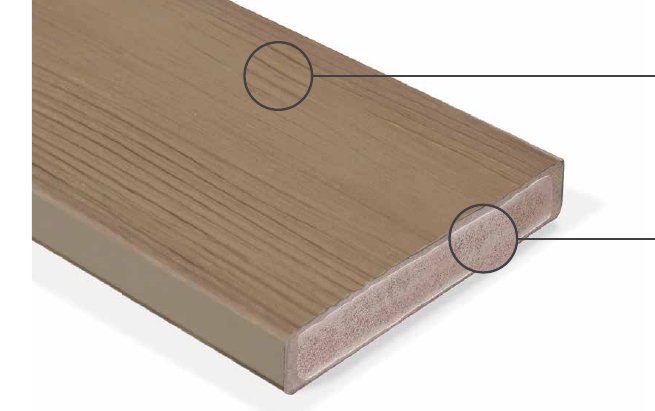
What is inside, and how much of it is wrapped.
A composite board is a core of wood or bamboo fiber mixed with plastic, extruded into a plank. Trex publishes its core as roughly half wood fiber and half polyethylene. Eva-Last uses bamboo fiber in a foamed PVC core with glass fiber for stiffness. MoistureShield encapsulates each wood fiber in plastic, which is why it is the composite the maker rates for the ground and underwater.
A capped board has a second, harder polymer shell bonded over that core during extrusion. The cap is what fades slowly, sheds a wine spill, and takes a chair leg. Every premium line Midway sells is capped. An uncapped board is bare core all the way through; it weathers and lightens like wood and its warranty covers structure, not color.
PVC (capped polymer) has no wood fiber at all. TimberTech Advanced PVC is the line: cellular PVC core, polymer cap, the longest fade and stain terms in the catalog, and the maker's published claims for cooler touch and better wet slip. It is also the most expensive board on the floor.
Then the profile. A solid board is full thickness edge to edge. A scalloped board has arches cut out of the underside, which saves material and weight; Trex Enhance, TimberTech Prime and Prime+, and MoistureShield Elevate are scalloped. Scalloped boards are capped on three sides, top and edges, with the underside bare. Four-sided boards, TimberTech Legacy, Reserve, and Terrain among them, are wrapped all the way around, grooves included.
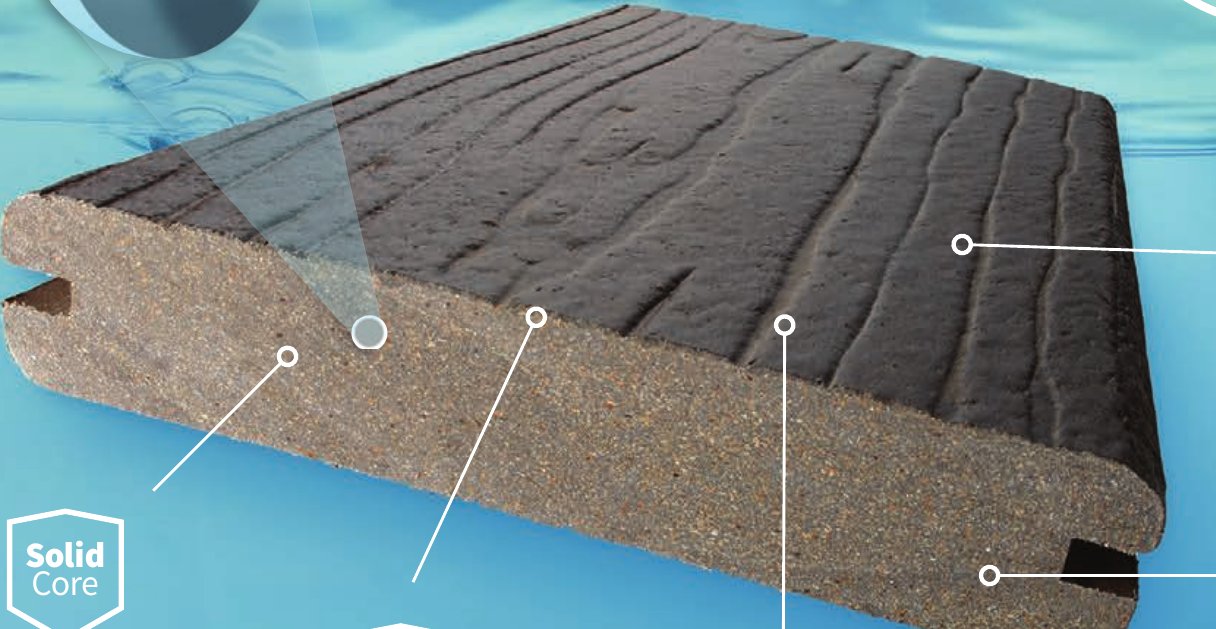
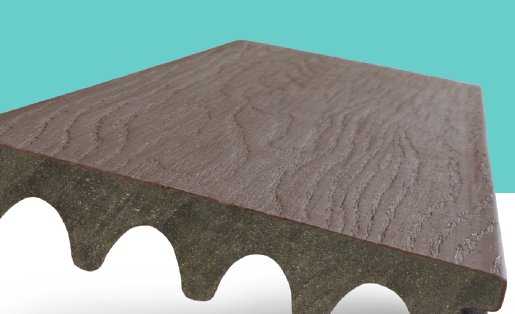
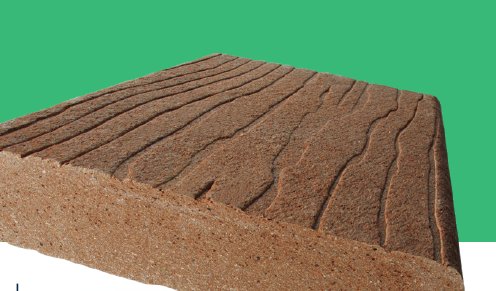
Turn the board over. If you can see arches, it is scalloped and the cap stops at the edges. Look at a cut end: the cap is a thin, glossier band around the core, and you can see whether it runs across the bottom. Then ask what is in the core: wood fiber, bamboo, or no fiber at all. Feel the weight of a 1x6 Transcend against a 1x6 Enhance; the difference is the scallop.
The shell does the work the wood used to need you for.
Fade. The cap carries the color and the UV protection, and the makers put a number on it. Trex, TimberTech, and Eva-Last all warrant color change of no more than 5 Delta E, a lab measure of color shift, for the fade term. Lesson 2 reads that term. The cap on a capped board is why the number exists; an uncapped board has no fade number at all.
Stain. The same shell is why ketchup and red wine wipe off. Read the condition: every stain warranty we sell requires the spill be cleaned with soap and water within a week. It is a real warranty, and it assumes you own a hose.
Scratch. Caps differ in hardness. MoistureShield names its hardest cap DiamondDefense; TimberTech and Trex publish scratch resistance on their premium lines. Drag a key across two samples and you will feel the difference before anyone explains it.
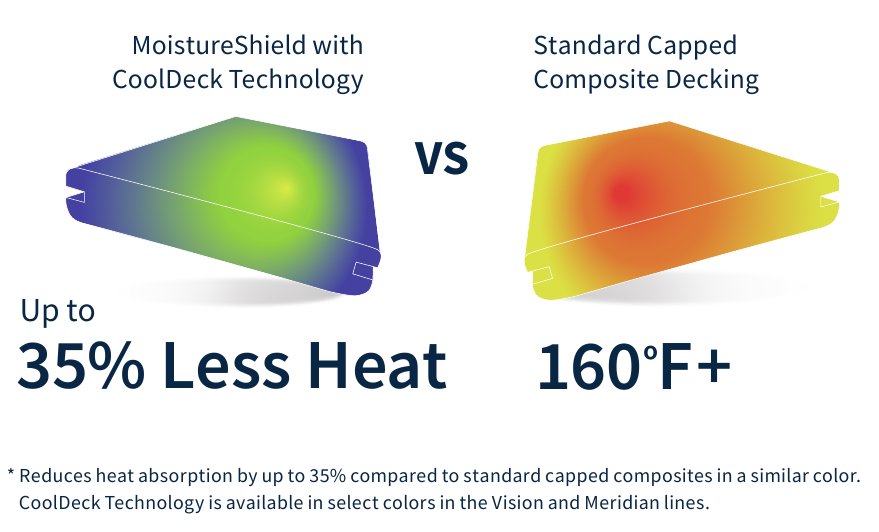
Heat. Every maker's installation guide says the same thing in plain words: composite gets hot in the sun, and the darker the color, the hotter. Trex tells hot-climate buyers to pick a lighter color. TimberTech publishes its Advanced PVC as cooler to the touch than composite, and MoistureShield publishes its CoolDeck colors at up to 35 percent less heat absorption. Middle Tennessee in August is a hot climate. A near-black board on a west-facing deck with no shade is a choice you make with your bare feet.
Ask to see two colors of the same line side by side in the sun outside the showroom door. Ask which colors in the line carry the maker's cooler-cap technology. Then ask for the fade number in Delta E and the years it runs. If the answer is a brand word instead of a number, the number is in the warranty, and we will pull it.
The frame outlives the deck, or kills it.
Under every composite deck is a treated lumber frame, and the frame is where the money gets quietly saved. A 50-year board on a frame that rots at year 18 is an 18-year deck. Three things decide it.
Joist spacing. Composite needs closer support than a treated 5/4 board. Trex, TimberTech, and MoistureShield all publish 16 inches on center for boards running straight across the joists and 12 inches for boards at an angle or on commercial decks. TimberTech's guide says never exceed 16 and suggests 12 for a stiffer feel. Trex's code report cuts the span to 12 inches at 45 degrees and 8 inches at 30. A frame laid out for wood at 24 inches cannot take composite without new joists.
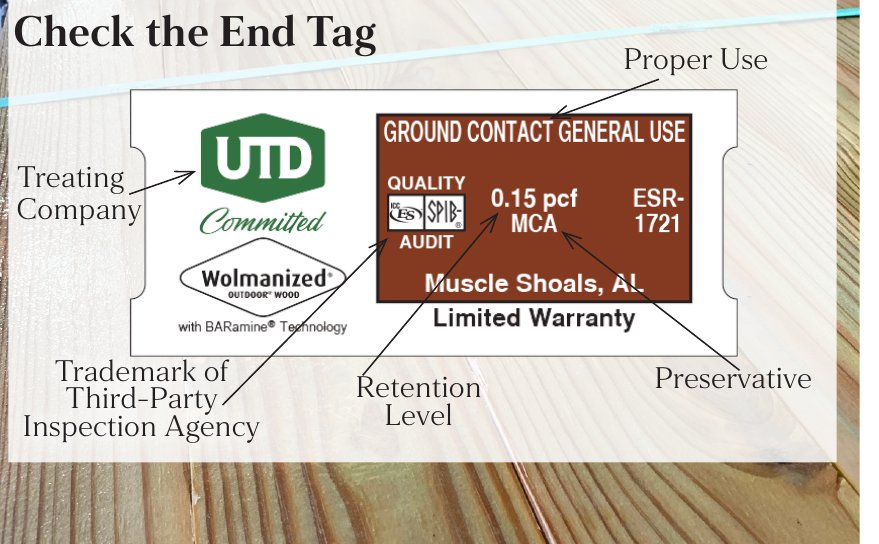
The treatment rating. Joists, beams, and posts should be Ground Contact, not Above Ground. The Wolmanized warranty that Midway's UTD lumber carries says it plainly: Ground Contact is required for wood within six inches of grade, wood that cannot dry, and for deck joists and beams because they are critical and hard to replace. The end tag says which one you have.
Tape, ledger, and flashing. Trex's installation guide calls for joist and beam tape on the top of joists, rim joists, and the ledger to help prevent rot. The ledger, the board bolted to the house, is where decks fail hardest; it needs flashing behind it and lag bolts or structural screws into the house frame, per code. Every cut end of treated lumber gets end-cut preservative, which the Wolmanized warranty requires.
Joists at 16 on center, or 12 if boards run diagonal. Joists and beams tagged Ground Contact. Joist tape, ledger flashing, and end-cut treatment as line items, not "by others." If the frame is priced by someone else, hand them this page.
Clips in the groove, or screws through the face.
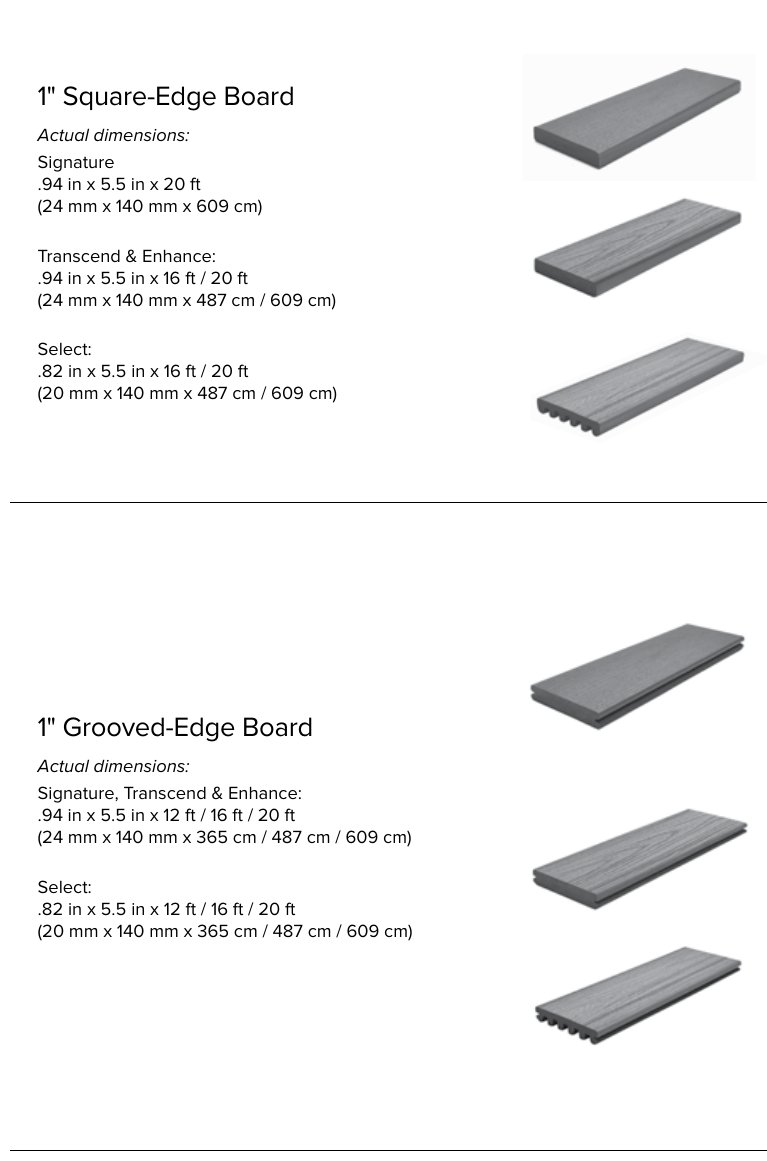
A grooved-edge board takes a hidden clip that sits in the groove and screws to the joist; no screw head shows on the surface and the clip sets the gap between boards. A square-edge board takes a face screw straight down, either a color-matched composite screw or a screw-and-plug system that hides the head with a plug cut from the same board. Both are in the makers' guides. The first and last board and stair treads are usually face-screwed either way.
Every maker requires two screws per joist on face-screwed boards. Trex and MoistureShield both specify stainless screws near water, and MoistureShield's code report calls for two #7 by 2-1/4 inch stainless deck screws per joist. A deck screw is a small line on the quote and the only thing between the board and the wind.
Composite moves with temperature, not moisture, so the gap is a spec. Trex publishes 3/16 inch between board edges at any temperature, and 1/8 inch end to end above 40 degrees, 3/16 below. Improper gapping is the first exclusion in the warranty.
Ask to see the clip that goes with the board you are pricing, and the screw. Ask whether the quote is grooved or square-edge, and how the picture-frame border and stairs will be fastened. Then ask what gap the installer will set and how.
The parts that get priced last and seen first.
Railing is the part of the deck people touch and photograph, and it is a system of its own: posts, post sleeves or mounts, top and bottom rail, balusters, caps, and the hardware to tie it to the frame. Composite, aluminum, cable, and glass infill each come from the makers we carry and each carries a separate warranty from the decking. Trex's decking warranty says so in print: railing is excluded and has its own.
Low-voltage lighting in post caps, risers, and rail is cheap to run when the wiring goes in before the boards. Trex's guide says it in one line: install wiring before decking and railing. It is a painful retrofit.
Fascia, riser boards, and skirting close the deck in and should come from the same line and color as the deck; the makers publish them as matched parts.
Is railing a line, or "TBD"? Which system, and does it match the deck color or contrast on purpose? Is lighting wired now or never? Is fascia from the same line?
Real wood, lower first cost, and a schedule.
A pressure-treated deck is a good deck. Midway's treated lumber comes from UTD: Southern Yellow Pine treated with micronized copper azole under the Wolmanized name, inspected by a third-party agency, with Above Ground and Ground Contact options and kiln-dried-after-treatment (KDAT) stock that is drier and straighter on the day it is delivered.
What you are buying is the wood, the chemistry, and a job: a treated surface needs to be cleaned and sealed or stained on a schedule to keep water out of the checks and the color even. The Wolmanized warranty covers termites and fungal decay for as long as the original homeowner owns the house; it does not cover weathering, checking, splitting, or warping, and says so. That is the honest trade. Lesson 3 puts the schedule into dollars.
Read the end tag: preservative (MCA), retention level, Above Ground or Ground Contact, and the inspection agency mark. Ask for KDAT on deck boards and rails. Ask what end-cut treatment the crew will use on every cut.
This is the checklist.
| Feature | What a lasting deck has | What to ask |
|---|---|---|
| Board | Capped composite or PVC; solid profile where the budget allows; you know what is in the core | Capped or not? Three sides or four? Scalloped? |
| Cap | A fade number in Delta E and a stain term in years; a color chosen for the sun it gets | Fade number and years? Which colors run cooler? |
| Frame | Joists 16 on center (12 diagonal), Ground Contact joists and beams, joist tape, flashed ledger, end cuts treated | Spacing? Tag rating? Tape and flashing on the quote? |
| Fastening | The maker's clip or screw, two per joist, stainless near water, the published gap | Which clip or screw? Who sets the gap? |
| Rail and light | A named railing system with its own warranty; wiring in before boards; fascia from the same line | Which rail? Lights now or never? |
| Treated | Wolmanized MCA with an end tag you can read; KDAT where it shows; a sealing schedule you will keep | Show me the tag. Above Ground or Ground Contact? |
Bring the checklist. We keep boards from every line on the floor, with the clips and screws that go with them, and the treated stock is on the yard with the tags still on.
Before You Price a Deck
Know what you are standing on.
Three short reads on composite and treated decks. Written for the builder who has to answer to the money, and for the money.
Frequently Asked
Deck construction, answered.
What is the difference between capped and uncapped composite decking?
What does a cap on three sides versus four sides mean on a deck board?
What is the difference between PVC decking and composite decking?
How far apart should joists be for composite decking?
Do you need joist tape under composite decking?
What does ground contact mean on pressure-treated lumber?
Come See It
Put your hands on it first.
Specs only tell you so much. Come walk the yard and the showroom.
119 Cumberland St, Ashland City. The coffee’s on.