
Read the stamp.
Then read the tag and the table.
Lumber does not come with a spec sheet. It comes with a stamp on every piece, a trademark on every panel, and a plastic tag on every treated board, plus a span table and code report for anything engineered. That is the spec. It is written for the inspector, and it is short. Here is how to read each one, with the standards bodies' own drawings.
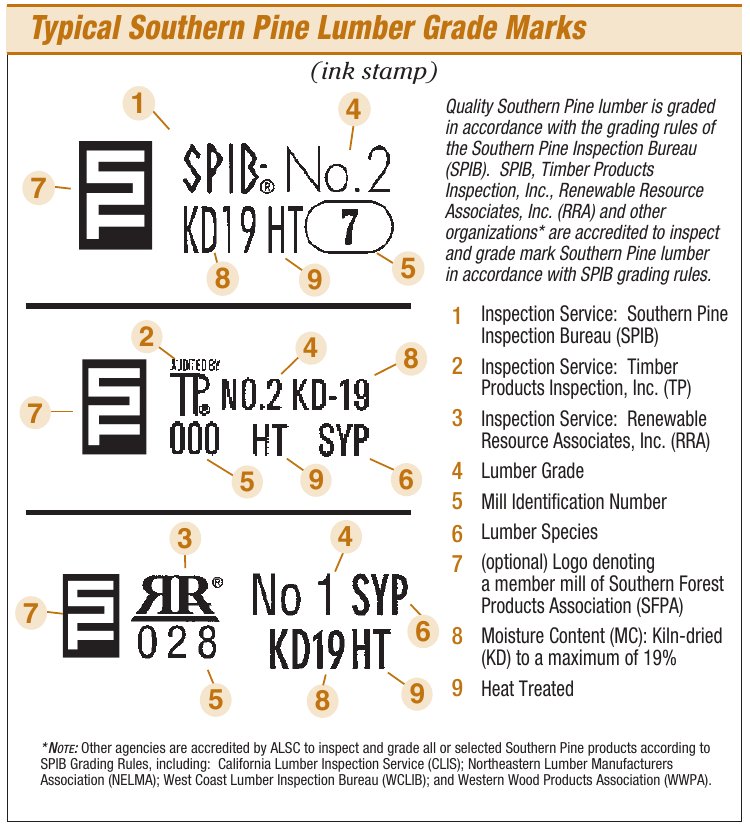
Five marks, one rule book, one mill.
Start with the agency. The logo says whose rule book the piece was graded under and who sends inspectors to the mill. SPIB is the Southern Pine Inspection Bureau; TP and RRA are two other agencies that grade Southern Pine under SPIB rules. WWPA and WCLIB cover western species, NLGA covers Canadian SPF. The SFPA guide says every agency should be accredited by the American Lumber Standard Committee, which is the board the Department of Commerce set up under Product Standard PS 20. That is the whole chain: a federal standard, a committee, an agency, a mill, a stamp.
The mill number is the audit trail. Each mill has its own, and if a bunk is ever challenged, the agency can trace it to the line that cut it. The grade is the strength claim: SEL STR, No. 1, No. 2, No. 3, STUD, or a machine-rated grade written as a bending value and stiffness, like 2400f-2.0E. Southern Pine adds Dense and Non-Dense to the top three grades. The species is a group: SYP, SPF, DF-L, H-F. The SFPA design tables and the span tables are written by grade and species, so these two marks together are what the plans mean when they say "No. 2 SPF."
The moisture mark is the line that decides whether the wall stays straight, and the WWPA prints the key: MC-15 or KD-15 is 15 percent or less; S-DRY or KD is 19 percent or less; S-GRN is over 19 percent, unseasoned. Southern Pine stamps it as KD19 and adds HT for heat treated. The SFPA guide says the grading rules restrict 2-inch Southern Pine to 19 percent, and that a certified grade mark is evidence the wood was properly seasoned. That is the one word on the stamp that is a promise about the future of the piece rather than its past.
Which agency. Which grade, and is it dense. Which species. Is it KD19 or S-DRY. If the quote line says "2x10x16" and nothing else, ask for the grade and species to be written on it.
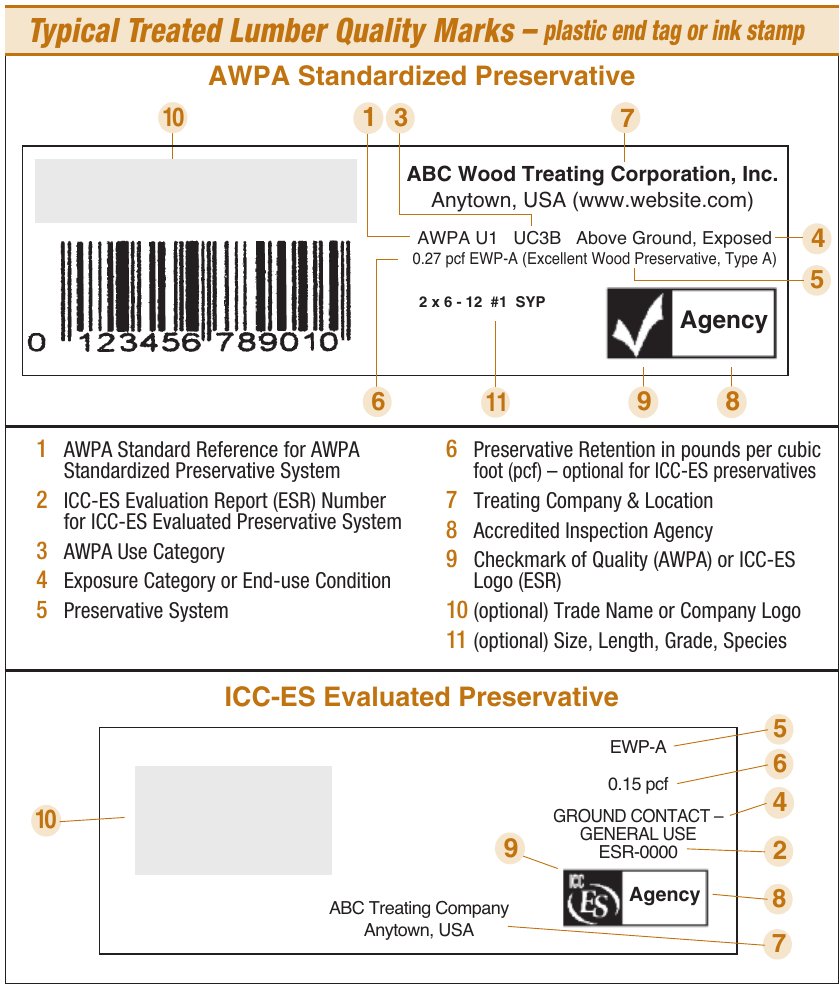
Sheathing has a trademark. Treated wood has a tag.
Every structural panel carries the APA trademark, and the APA's guide numbers the parts. Panel grade: Rated Sheathing for walls and roofs, Rated Sturd-I-Floor for a single-layer floor. Span rating: two numbers on sheathing, 24/16 or 32/16 or 48/24, the first for the widest roof support spacing, the second for floor; one number on Sturd-I-Floor, 20 oc or 24 oc. Bond class: Exposure 1 for panels that will see rain during construction, Exterior for panels that stay wet and dry over and over. Performance category for thickness: 7/16, 15/32, 19/32, 23/32. The mill number, and the standard, PS 2 or PS 1. The guide says the same grade and span rating can be made as OSB or plywood, which is why the stamp, not the material, is the spec. It also says something worth remembering on a floor: Sturd-I-Floor's rating is for joists, and the floor tables from the I-joist makers assume 23/32 at 24 inches or 19/32 at 19.2 and closer, glued.
Treated lumber carries a plastic end tag or ink stamp, and the SFPA drawing of it has eleven callouts. Read these: the standard, AWPA U1, or an ICC-ES report number for a preservative evaluated that way. The use category, UC3B, and its plain-words twin, "Above Ground, Exposed," or the ground contact category with "Ground Contact, General Use" beside it. The preservative and its retention in pounds per cubic foot. The treating company and its location. And the accredited inspection agency with its check mark. UTD's catalog draws the same tag with five labels and the words "check the end tag," and says its wood is SPIB tested. The inspector reads the use category against the joist, the post, or the sill it is about to become. So does the warranty: the Wolmanized document says coverage depends on using the wood inside the use category on its tag, and it needs the tags back for a claim.
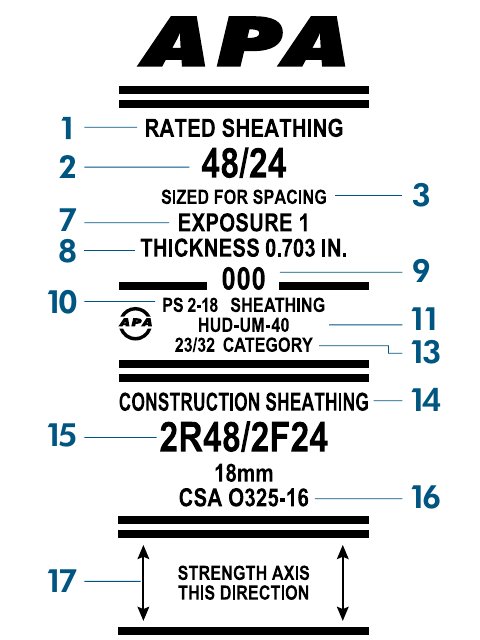
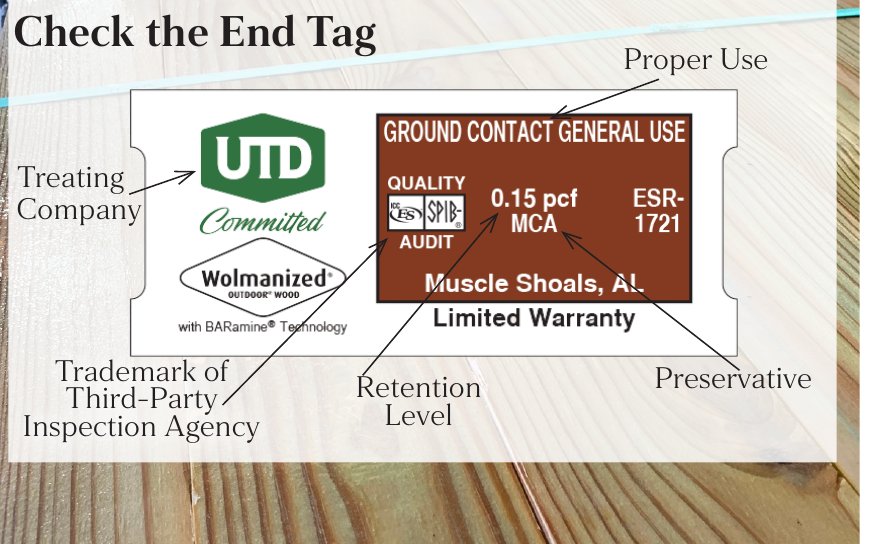
What span rating and bond class is on the sheathing line. Which use category is on the treated line, and does it match where the wood is going. Is the inspection agency mark on the tag. Who is keeping the tags.
Engineered wood is specified by a number and a table.
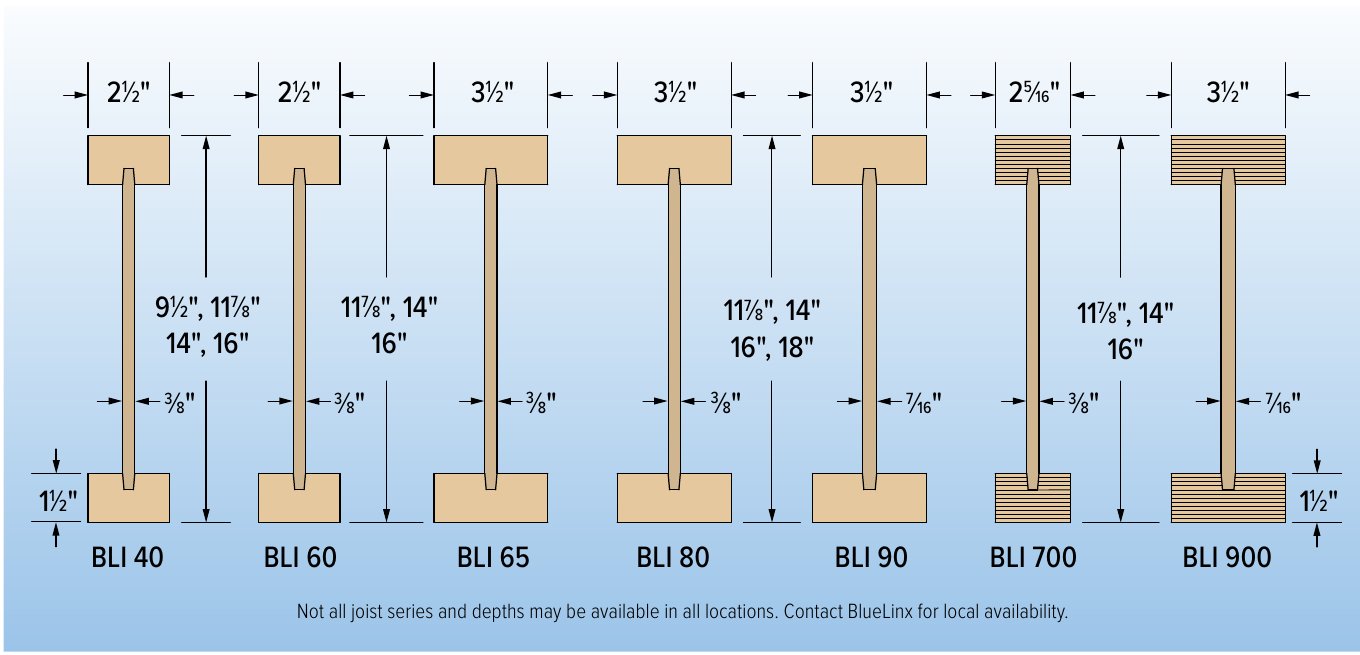
An I-joist has no grade stamp. What it has is a code evaluation report and the maker's tables, and together they are what the inspector accepts in place of an engineer's letter on every house. Roseburg prints its report index on the back page: RFPI joists are ICC-ES ESR-1251, RigidLam LVL and RigidRim rim board are ESR-1210, with APA product reports PR-L259 and PR-L289 beside them. onCENTER products are made under APA-EWS third-party inspection, and its rim board capacities reference APA EWS Y250. The report number is the line to ask for. It fixes what the trades can and cannot do to the product, and it is the reason a span table has standing.
The span table reads the same from every maker. Series and depth down the left, spacing across the top, and the number in the cell is either the clear span or the load per foot at that span. Two lines under the table matter more than the numbers in it. The first is the deflection limit: onCENTER and Roseburg both print their floor tables at L/480 for live load, one third stiffer than the code's L/360, and both explain why in the same words: a floor designed to the code minimum may not meet what the occupant expects. The second is the subfloor: the tables assume a glued and nailed APA panel, 19/32 or 23/32 by spacing, and onCENTER says to take 12 inches off the span if the glue is skipped. There are also rules for multiple spans (an end span at least 40 percent of the next), minimum bearing (1-3/4 inches at the end, 3-1/2 in the middle), and when a bearing stiffener is required.
The hole chart is the page the plumber needs. It gives, for each depth and clear span, how far from the support a hole of each diameter has to be, and it says in red not to cut or drill the flanges. The storage rules are the page the site super needs: keep the factory wrap on, keep it 6 inches off the ground, do not store I-joists flat, do not lift them by the top flange, and never stack building materials on unsheathed joists. Roseburg puts it bluntly: improper storage, ignoring the span rating, and holes outside the chart can cause serious accidents, and its warranty steps aside for them.
For a beam, LVL or glulam, the table is a load table by depth and span, and the two things to check are the bearing length at each end and the fastening if it is more than one ply. onCENTER's LVL is stamped 2.1E, its stiffness, and the design values and the multi-ply nailing patterns are in the same guide. A beam quote should come with the table row it was sized from.
What is the report number for this joist and this beam. Which table row and which deflection line was the floor sized from. Is the subfloor glue on the order. Is the hole chart going to the plumber. Where does the package get stored until it goes up.
| Mark | Where it is | What it tells you | Who checks it |
|---|---|---|---|
| Grade stamp | Ink stamp near the end of every piece of dimension lumber | Agency, mill number, grade, species, moisture mark (KD19, S-DRY, S-GRN), HT on Southern Pine | The agency's inspectors at the mill; the building inspector on site; ALSC over the agencies |
| APA trademark | On the back or edge of every structural panel | Panel grade, span rating (24/16, 24 oc), bond class (Exposure 1, Exterior), performance category, mill, PS 2 or PS 1 | APA at the mill; the inspector reads the span rating against the framing spacing |
| Treated tag | Plastic end tag or ink stamp on every treated piece | AWPA U1 or ICC-ES number, use category (UC3B above ground, ground contact), preservative and retention, treater, inspection agency | The accredited agency samples retention; the inspector reads the use category; the warranty needs the tag |
| Web stamp | Printed on the web of every I-joist | Maker, series, depth, plant, and date; the two numbers the span table is read from | APA-EWS or the maker's third-party inspector at the plant |
| Code report | ICC-ES ESR or APA PR number in the maker's guide | The product was tested to a standard; how it can be used; the rules for holes, bearing, and nailing | The evaluation service; the inspector accepts the table because of it |
| Span table | The maker's design guide, by series, depth, and spacing | Clear span or load per foot, at a stated deflection limit and subfloor | The maker publishes it; the designer picks the row; the inspector reads the row |
A mark with an agency behind it is a spec. "Kiln dried" on an invoice with S-GRN on the stamp is not. "Treated" with no use category is not. "I-joist" with no report number and no table row is not. Ask for the mark.
"Lifetime" on treated lumber has a paragraph. Here is Wolmanized's.
The UTD lumber on our yard carries the Wolmanized Residential Wood Limited Warranty, a one-page document that is a fair example of how treated-wood warranties are written. It covers termites and fungal decay that leave the wood structurally unfit for its permitted use, and it runs for as long as the original homeowner owns the property. It is not transferable; coverage ends when the house sells. That is the "lifetime."
The remedy is new Wolmanized wood or the reasonable cost of it. The document says plainly that Arch, the chemistry maker behind the brand, is not responsible for labor, removal, disposal, delivery, or installation of the replacement. So the warranty buys the board, not the deck.
The conditions are the part to read twice. The wood has to be used within its AWPA use category, which is on the end tag. Ground Contact is required wherever the wood touches soil, sits fewer than 6 inches above grade, cannot dry out, touches older wood with decay in it, or is "critical to the performance and safety of the structure and difficult to maintain, repair, or replace," and the warranty names deck joists and beams as examples. Posts holding up a house, garage, or barn have to be Ground Contact Heavy Duty. Cut ends may not go in the ground, and every cut or hole has to be brushed with an end-cut preservative with a stated copper content. The structure has to meet code. And the homeowner has to keep the end tags and the invoice, enough tags to cover the amount of wood in the claim.
The exclusions are the honest part. Not covered: mold, blue stain, weathering, graying, splitting, cracking, checking, warping, twisting, and wear. Not covered: wood in permanent wood foundations, post-frame buildings with round poles or heavy timbers, pool sidewalls, vineyard stakes, or salt water. Not covered: anything that does not make the wood structurally unfit. In other words, the warranty is about the chemistry doing its job against bugs and rot. Everything about the wood moving is on the drying, the storage, and the crew, which is what Lesson 1 was about.
| Read for | Where it hides | What a strong answer looks like |
|---|---|---|
| What is covered | The first paragraph | Termites and decay, structural unfitness; you know weathering and twist are not in it |
| How long | Duration | As long as the original owner holds the property; you know it does not transfer |
| The remedy | Remedy section | Wood or the cost of wood; you planned for the labor |
| Use category | Requirements, and the end tag | Ground Contact on every joist, beam, and post; Above Ground only where the tag allows |
| Cut ends | Installation requirements | End-cut preservative on the truck and in the crew's hands; no cut end in the dirt |
| The tags | How to make a claim | Somebody has a bag of end tags and the invoice in a drawer |
| Exclusions | What this warranty does not cover | You read the list before you bought post-frame or pool lumber against it |
Is this Above Ground or Ground Contact, and which does the tag say. Who is keeping the tags. Is end-cut preservative on the order. Does the use match the warranty's list of what it does not cover.
Before You Price Lumber
Know what you are framing with.
Three short reads on framing lumber and engineered wood. Written for the builder who has to answer to the money, and for the money.
Frequently Asked
Stamps, tags, and tables, answered.
What do the letters and numbers on a lumber grade stamp mean?
What does the APA stamp on OSB or plywood tell me?
What does a treated lumber end tag say and who checks it?
What is an ICC-ES report for engineered wood and why does the inspector ask for it?
How do I read an I-joist span table?
What does the Wolmanized treated lumber warranty cover?
Come See It
Put your hands on it first.
Specs only tell you so much. Come walk the yard and the showroom.
119 Cumberland St, Ashland City. The coffee’s on.