
What you are paying for
in framing lumber.
Two bunks of 2x4s can look the same on the truck and be a different house a year later. One has straight walls and doors that close. The other has a drywall crack over every window. The difference is what the stamp says, how dry the wood is, which species it is, what the tag on the treated stuff says, and whether the floor is sawn or engineered. Every one of them you can read on the stack before it leaves our yard.
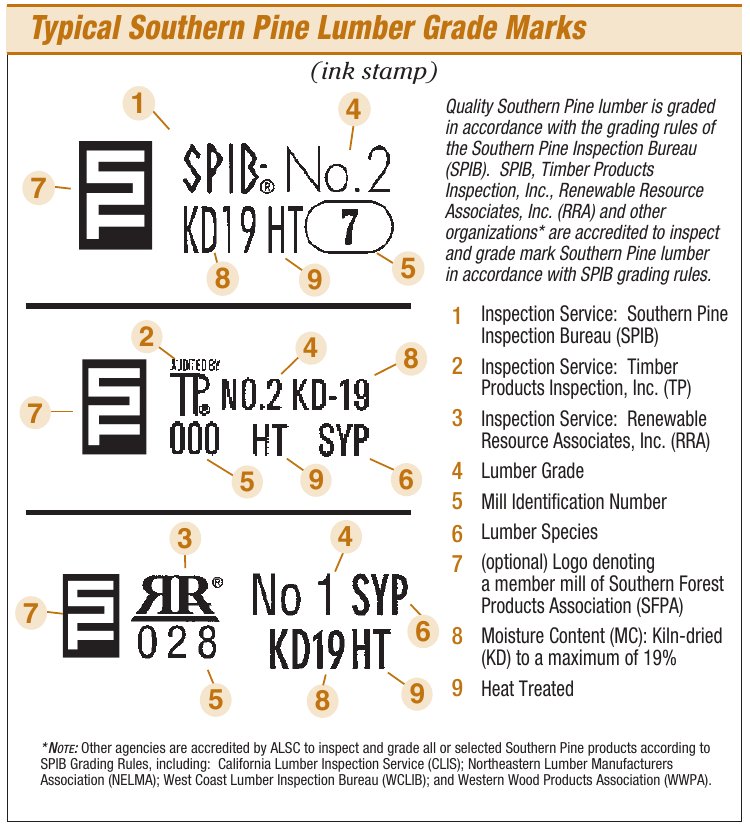
Five facts on every piece. Read them in order.
Every stick of framing lumber sold in this country carries a grade stamp, and the stamp is the spec. The grading agencies print what is on it: the agency mark (SPIB for Southern Pine, WWPA or one of its cousins for western wood, NLGA for Canadian SPF), the mill number that ties the piece to the sawmill that cut it, the grade, the species or species group, and the moisture content when it was surfaced. Southern Pine stamps add HT, heat treated, which is a bug rule for shipping and says nothing about drying.
The grade is the strength claim. No. 2 is the framing standard: the SFPA describes it as the grade for most general construction where moderately high strength is needed. No. 1 has fewer and smaller knots and higher design values. Select Structural is the top visual grade. Stud grade is for studs, and the rules limit it to vertical use. Southern Pine also stamps Dense and Non-Dense on the better grades, and the dense piece carries higher numbers in the SFPA design tables, which is why a dense No. 2 and a plain No. 2 are not the same board.
The moisture mark is the one most people skip, and it is the one that decides whether the wall stays straight. Lesson 2 reads the whole stamp slowly. For now: KD19 or S-DRY means the piece was dried to 19 percent or below before it was surfaced. S-GRN means it was not. That one line is the difference between lumber that did its shrinking at the mill and lumber that will do it in your house.
Pull three pieces off the bunk and find the stamp on each. The same agency, grade, and moisture mark on all three is a bunk that was graded. A bunk with no stamp on half the pieces is a question for whoever sold it. Ask which grade is on the quote line, not just the size.
Wood moves as it dries. Buy it already dry.
Wood shrinks as it loses water, and the grading rules are built on a simple number the SFPA prints in its use guide: about 1 percent change in size for every 4 points of moisture content. The same guide says framing settles in at about 12 percent moisture in most of the country, and interior wood in the humid Gulf South at about 11 percent. Lumber stamped KD19 left the mill at 19 percent or less, and on average, the guide says, about 15 percent. That piece has 3 or 4 points left to lose in your house. A green piece at 25 or 30 percent has 13 to 18 points to lose, which is 3 to 4 percent of its width, and it loses them the first summer the house is closed in with the air on.
Shrinkage by itself is not the problem. Uneven shrinkage is. A board with grain running at an angle shrinks more on one face than the other and turns into a twist. A board with the pith near one edge cups. Southern Pine, which the SFPA calls the most treatable species because water goes into it so easily, is also the one that moves the most when that water leaves. That is why the grading rules for 2-inch Southern Pine require drying to 19 percent before it can be stamped, and why the Wolmanized warranty on treated wood lists warping, twisting, splitting, and checking as weather effects it does not cover.
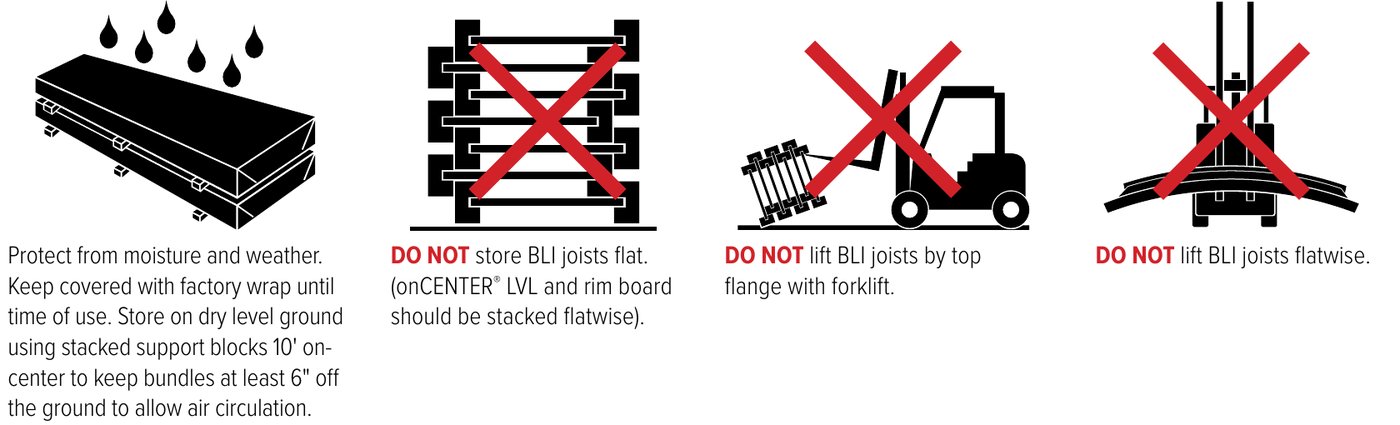
Dry lumber can get wet again. The SFPA storage rules are the ones every yard and every jobsite should follow: unload in a dry place, stack on stringers off the ground so air moves under it, cover it with something that sheds rain but does not trap moisture, and get framing lumber under a roof as soon as you can. onCENTER prints the same for engineered wood, with the numbers: keep the factory wrap on until you use it, and keep bundles at least 6 inches off the ground on blocks 10 feet apart. Lumber that sat in a mud puddle for two weeks is green lumber again, whatever the stamp says.
Look for KD19, KD, or S-DRY on the stamp. Look at how the bunk is stored: off the ground, covered, on a level base. Ask if we can meter a piece; a pin meter reads moisture in a few seconds. Then keep it that way once it is on your site.
Southern Yellow Pine or SPF. Both are right. Know which you got.
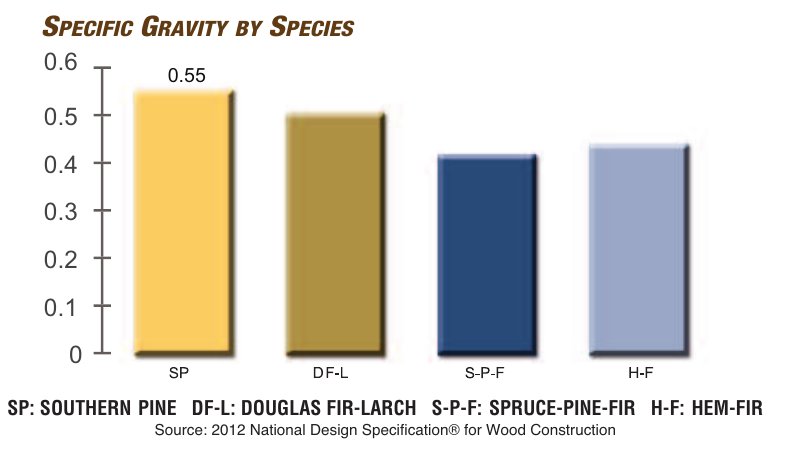
Midway stocks both, and the honest answer is that they are good at different things. Southern Yellow Pine is the densest common framing species. The SFPA chart puts it at a specific gravity of 0.55 against about 0.42 for Spruce-Pine-Fir, and the guide says that density is what gives it its fastener-holding power. A nail or a screw in pine bites harder than the same nail in spruce, which matters at a hanger, a ledger, or anywhere the fastener is doing the work. Pine also takes pressure treatment better than anything else, which is why the SFPA says 85 percent of the treated wood in the country is Southern Pine, and why the treated bunks on our yard are pine.
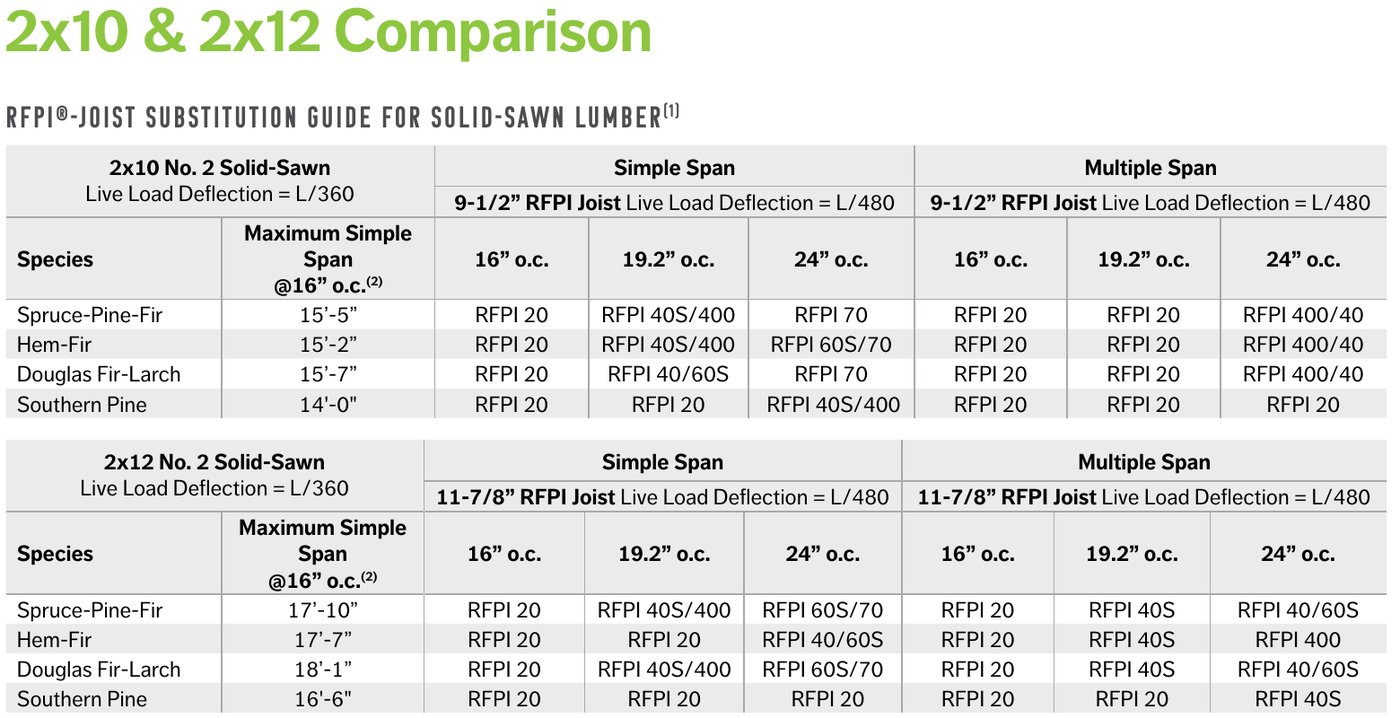
SPF is lighter, which a framer feels by noon. It is whiter and has less pitch, which a trim carpenter likes. And at No. 2 it spans a little farther: Roseburg prints the code span for a No. 2 2x10 at 16 inches on center as 15 feet 5 inches in SPF against 14 feet even in Southern Pine, and 17 feet 10 against 16 feet 6 for a 2x12. That is because the Southern Pine design values were revised in 2013 after more than 7,400 full-size pieces were tested, and the SFPA guide prints the new numbers. Pine is denser, not automatically stronger on a span table.
What you are paying for is not one species over the other. It is knowing which one is on the quote and on the stamp, and using each where it does its job: pine where it holds a fastener or has to be treated, either one for studs, and the span table for joists and rafters. The stamp settles the argument. SYP or SPF is printed on every piece.
Read the species on the stamp. Pick up a pine 2x10 and a spruce one; the weight tells you the density. Ask which species the span on your plans was figured for. If the plans say SPF and the bunk says SYP, that is a question before it is a problem.
Above Ground, Ground Contact, and the tag that says which.
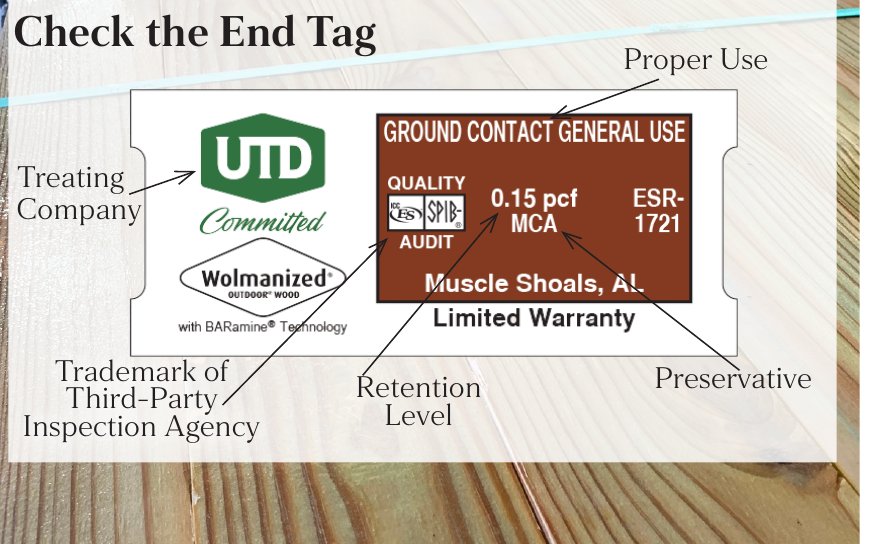
Treated lumber is Southern Pine with a copper preservative pushed into it under pressure. The bunks on our yard from United Treating & Distribution are Wolmanized Outdoor Wood, treated with micronized copper azole, MCA, which UTD's catalog describes as protection against termites and fungal decay for decks, fences, sill plates, and structural members. Every piece has an end tag, and UTD prints a drawing of the tag in its catalog because it wants you to read it.
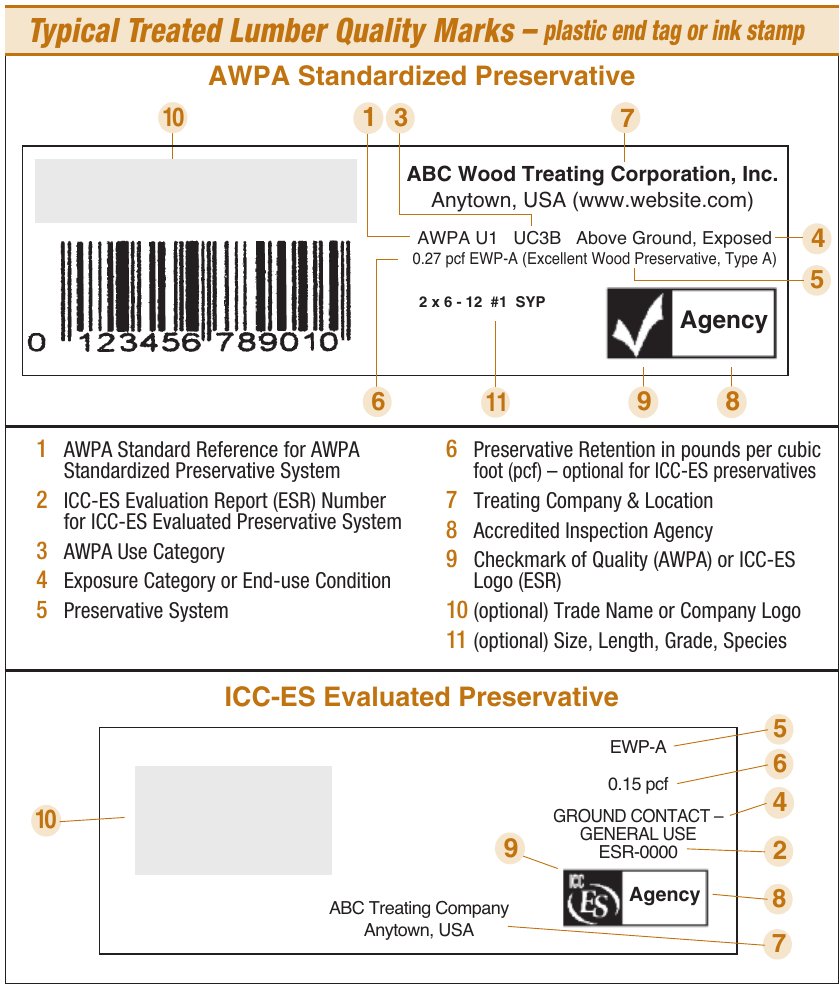
The tag carries the AWPA use category, and that is the rating. The SFPA's sample tag reads "AWPA U1 UC3B Above Ground, Exposed," with the preservative and its retention in pounds per cubic foot next to it. Above Ground is for wood that stays dry-ish and off the dirt: deck boards, rails, exposed framing with air under it. Ground Contact carries more preservative and is for wood that touches soil or concrete, sits close to the ground, stays wet, or would be a misery to replace. The Wolmanized warranty draws that line in plain words: Ground Contact is required wherever the wood stays in contact with soil, sits fewer than 6 inches above grade, cannot dry out, or is critical to the structure and hard to get at, and it names deck joists and beams. Posts holding up a house, garage, or barn have to be Ground Contact Heavy Duty. Buy Above Ground for a joist and the warranty is gone before the deck is finished.
Two more lines on the tag are worth a look. The inspection agency mark means a third party checked the retention; UTD says its plants are SPIB tested. And whether the piece is KDAT, kiln dried after treatment. Treating puts water into the wood, so a fresh treated board is a wet board. KDAT lumber has been dried again afterward, which UTD offers as a service and stocks for porch flooring. It costs a step at the plant and it saves the shrinkage in your frame.
Read the use category: UC3B for above ground, UC4A for ground contact, and the words next to it. Read the retention number. Find the inspection agency mark. Keep the tags; the Wolmanized warranty requires them for a claim, and it is not transferable, so the first owner is the one who needs them.
Straight, long, no crown, and a floor that stays quiet.
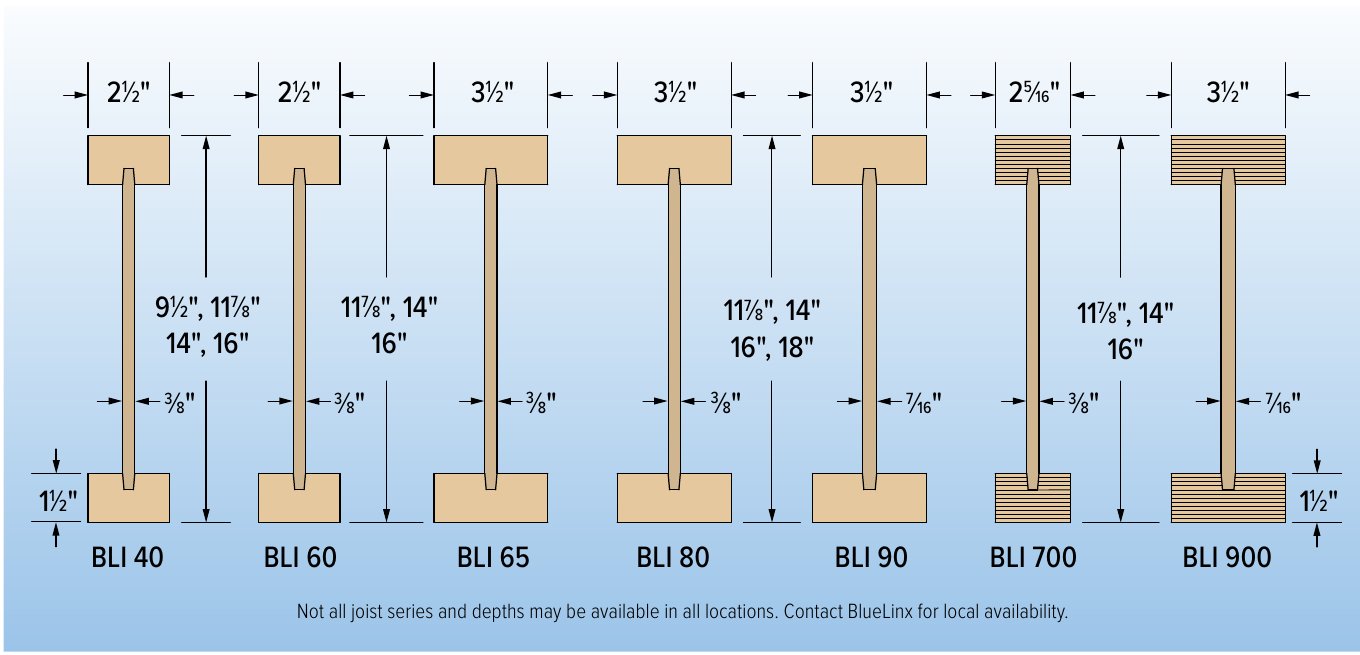
An I-joist is two flanges of LVL or machine-rated lumber glued to a web of OSB. onCENTER's BLI joists come with flanges 2-1/2 to 3-1/2 inches wide, in depths from 9-1/2 to 18 inches and lengths to 48 feet. The maker says what that buys you in its own words: the I shape gives longer spans and more load than dimension lumber, the low moisture content means dimensional stability and, quoting the guide, "quieter floors and fewer costly callbacks," and the wide flange gives more surface to nail the subfloor to. Roseburg says the same of its RFPI joists: they will not warp, twist, or shrink, they are more uniform than sawn joists, and they are made without camber, so there is no crown to read and either flange can go up. Blocking between them cannot be sawn lumber on edge, Roseburg says, because sawn lumber shrinks and I-joists do not.
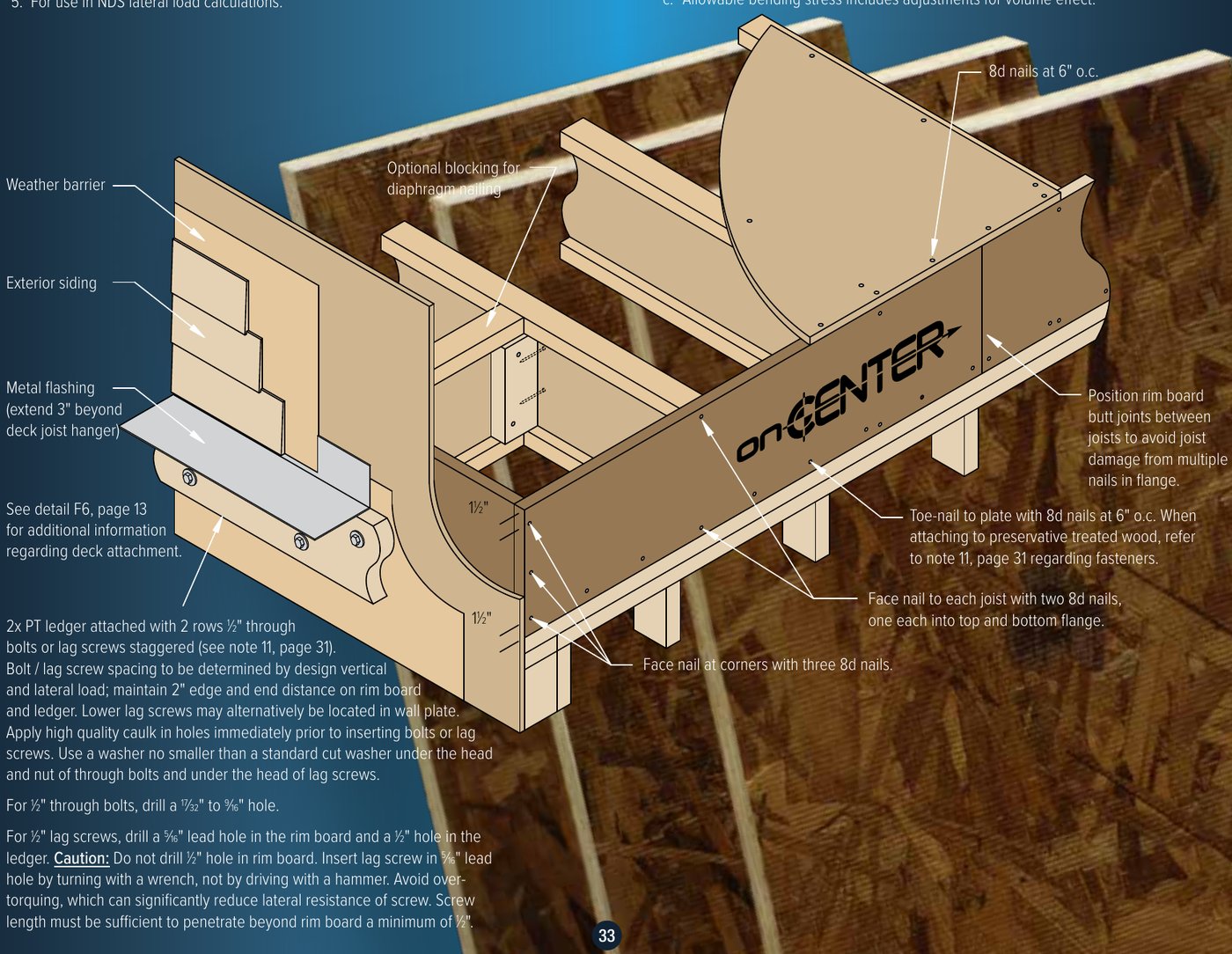
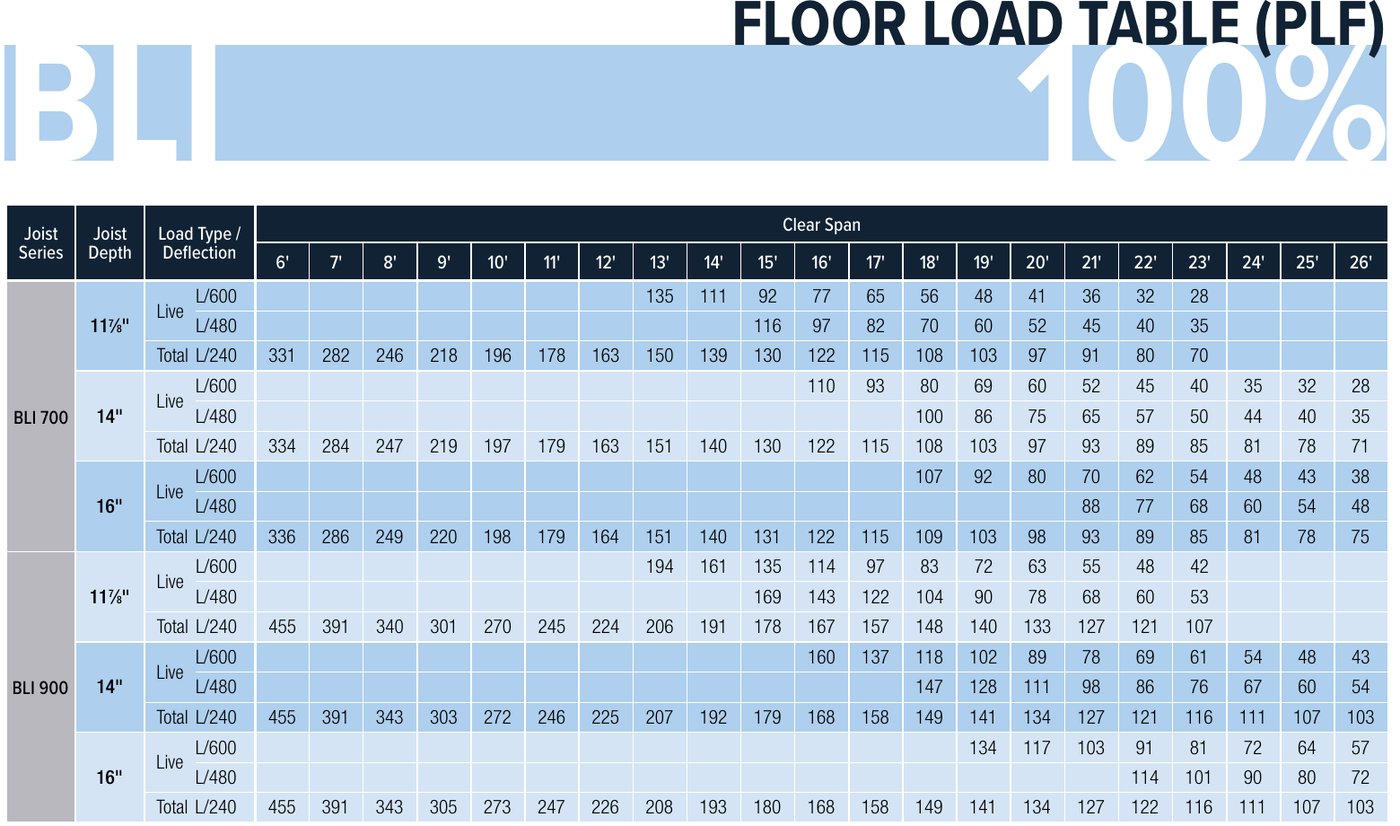
The span table is where you see the trade. Roseburg's substitution chart says a 9-1/2-inch I-joist at 16 inches on center replaces a No. 2 2x10, and an 11-7/8 replaces a 2x12. But look at the deflection line on the same chart: the sawn joist is figured at the code minimum, L/360, and the I-joist at L/480, which onCENTER calls one third stiffer. The I-joist floor is designed stiffer on purpose because the makers learned that a floor built to the code minimum, in Roseburg's words, may not meet what the occupant expects. Both makers' floor tables also assume a glued and nailed subfloor; onCENTER says take a foot off the span if you skip the glue. And onCENTER tells the installer to leave a 1/16-inch gap in the hanger and seat the joist firmly to stop the squeak from movement there.
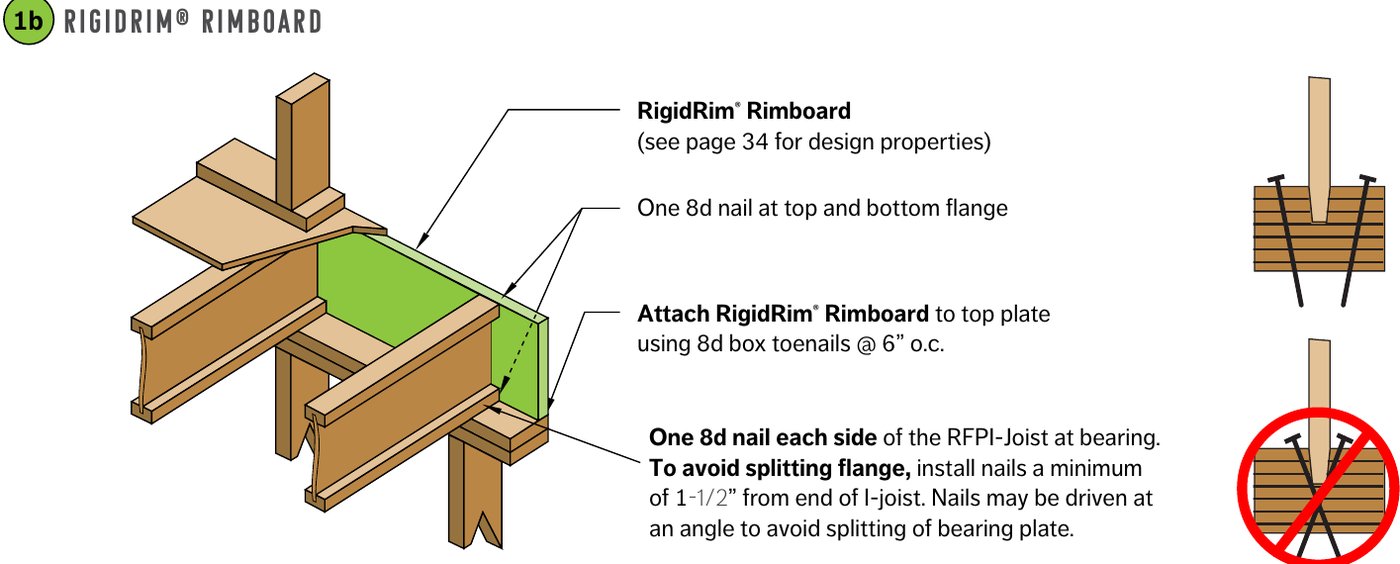
LVL, laminated veneer lumber, is thin veneers glued up in one direction into a beam that does not have a knot in it; onCENTER's is stamped 2.1E, which is its stiffness. Glulam is solid boards stacked and glued for long spans and beams that show. Rim board is the engineered board that closes the edge of the floor, matched to the joist depth so it does not shrink away from them, and it carries the wall above: onCENTER rates its 1-inch rim board at 3,300 pounds per foot vertical. Sheathing under it all carries an APA stamp with a span rating, and the APA's floor rules are the ones the makers lean on: 23/32 Sturd-I-Floor at 24 inches on center, glued with an AFG-01 adhesive and nailed 6 and 12, with a 1/8-inch gap at every edge so it can move without buckling.
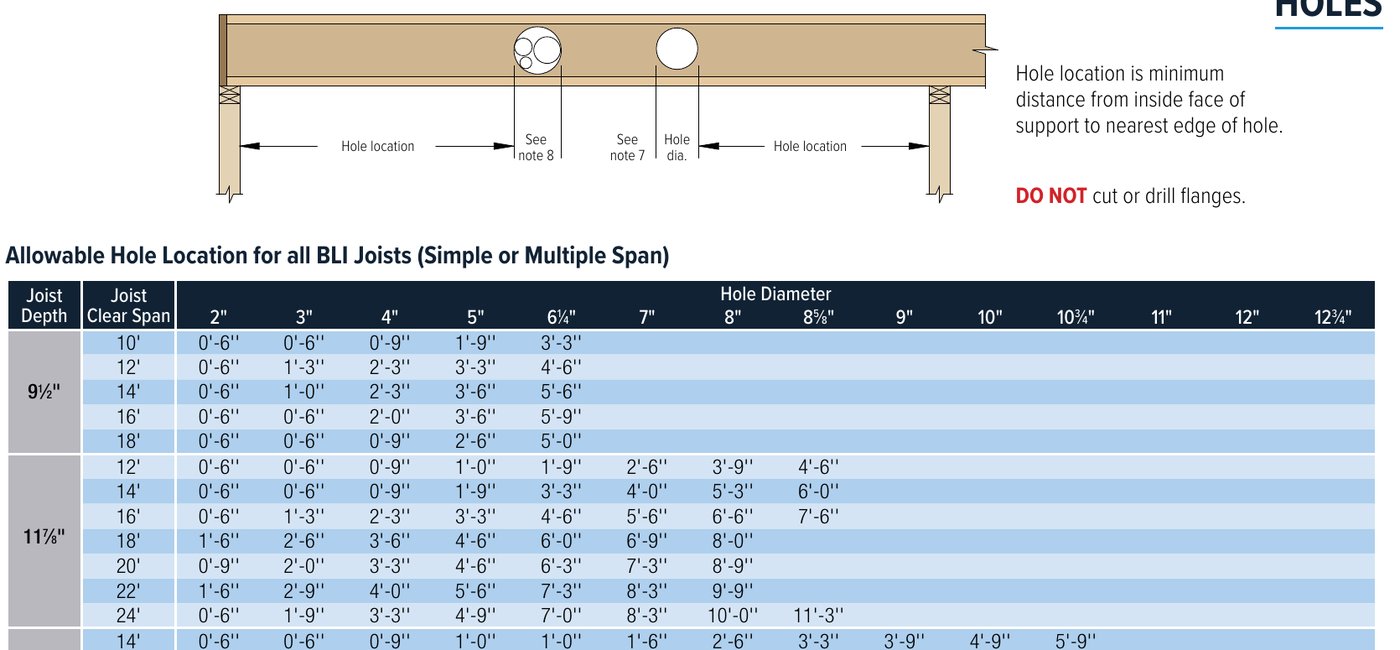
The honest part is the web. An I-joist web is 3/8 or 7/16 OSB, and both makers print a hole chart and say the same thing in bold: do not cut or drill the flanges. The plumber who saws through a flange has taken the strength out of the floor, and the fix is an engineer's letter. The hole chart comes with the order; make sure it gets to the trades.
Sight down an I-joist and then down a sawn 2x12. Read the series and depth stamped on the web, and the APA stamp on the subfloor bunk. Ask for the span table your floor was figured from and which deflection line it used. Ask whether the hole chart is in the package.
This is the checklist.
| Feature | What a straight frame has | What to ask |
|---|---|---|
| Grade stamp | Agency, mill, grade, species, and moisture mark on every piece; No. 2 or better where the plans call for it, stud grade only in studs | Which grade is on this line of the quote? Show me the stamp. |
| Moisture | KD19, KD, or S-DRY on the stamp; stored off the ground and covered, at the yard and on the site | Is it kiln dried? Can we meter a piece? |
| Species | SYP or SPF printed on the stamp and matched to the plans; pine where a fastener has to hold or the wood has to be treated | Which species was the span figured for? |
| Treated | End tag with the AWPA use category, retention, and inspection mark; Ground Contact for joists, beams, and anything near grade; KDAT where it gets built on right away | UC3B or UC4A? Is it KDAT? Are the tags staying on? |
| Floor | I-joists sized from the maker's table at L/480, glued and nailed subfloor with an APA span rating, engineered rim board at the joist depth, hole chart in the package | Which table and which deflection line? Is the glue on the order? |
| Beams | LVL or glulam sized from the maker's load table, bearing length checked, multi-ply nailing per the maker | What is the bearing at each end? |
It is all good lumber. Buy it on purpose.
A stud-grade SPF 2x4 in a closet wall is the right stud, and Midway sells thousands of them. A No. 2 dense Southern Pine 2x12 under a bathtub is the right joist if the span table says so. An I-joist floor under a kitchen with tile is the one we will steer you to, because the maker designed it a third stiffer than code and wrote "fewer callbacks" on the front of the guide. Ground Contact treated for the deck frame and KDAT for the sill is where the money is best spent, because that is the wood you cannot get back to.
None of it is wrong. What is wrong is buying a bunk without reading the stamp, or paying for engineered wood and then letting a plumber cut the flange. Bring the checklist. Every one of these lines is stocked on our yard, every piece has its mark on it, and we will pull the span table before we quote the floor.
Before You Price Lumber
Know what you are framing with.
Three short reads on framing lumber and engineered wood. Written for the builder who has to answer to the money, and for the money.
Frequently Asked
Lumber grades, moisture, and species, answered.
What does KD19 mean on a lumber stamp?
Why does green lumber twist after it is installed?
Is Southern Yellow Pine stronger than SPF?
What is the difference between Above Ground and Ground Contact treated lumber?
What is KDAT treated lumber?
Why does an engineered floor not squeak?
Come See It
Put your hands on it first.
Specs only tell you so much. Come walk the yard and the showroom.
119 Cumberland St, Ashland City. The coffee’s on.