
What you are paying for
in trim.
Trim is the last thing on the house and the first thing the eye lands on. Two rooms can be cased in the same profile and look the same the week the painter leaves. Five years on, one has open miters and a chipped corner and the other does not. The difference is the material and the primer, plus the profile and the joint. Every one of them you can check on a sample stick in our showroom.
Four materials. Same profile, different life.
Finger-joint pine is short pieces of clear pine with interlocking fingers cut in the ends, glued end to end into one long stick. That is Woodgrain's own definition, and the point of it is a 16-foot casing with no knots. The glue matters more than people think. Woodgrain's glossary sorts finger-joint adhesives into two classes: dry-use, rated for wood that stays under 16 percent moisture, and wet-use, rated for wood that sits at 16 percent or above. Interior trim is dry-use. Put a dry-use stick outside and the fingers are the first place it lets go. It takes paint well, comes primed or raw, and shows the fingers through a thin coat if the painter hurries. It dents like pine, which is to say it dents.
Solid pine and hardwood is one piece of wood with the grain running the whole length. Woodgrain sells solid pine, oak, and others; the WM catalog runs most profiles in solid pine and many in oak. It is the stain-grade choice, because there are no fingers and no primer to hide. It moves with the seasons more than the engineered sticks, and it is the material that gets the miter opened up in February if it went on the wall wet in August. Metrie's catalog tells you why: wood and wood-based products expand and contract with the moisture in the air, and it wants every stick stored in the room for at least 3 days before it is nailed.
MDF is wood fiber mixed with resin and wax and pressed into a board, then run through the moulder. Woodgrain says it has no grain, so it is less likely to split, crack, or warp than solid wood, and most of it comes primed with a white water-based primer. That smoothness is the whole appeal on paint-grade work. It is also the softest of the four at the corner and the one that swells if it gets wet; Woodgrain says in plain words that it can absorb water and start swelling, warping, or even disintegrating, and not to use it where it may get wet. Metrie, the biggest MDF moulding maker on the continent, runs most of its profiles in MDF and a lighter Ultralite version, and the same 3-day rule applies.
Coated MDF is the newer one. Woodgrain's Finished Elegance is MDF with a factory coating that it says resists scratching, marring, dents, and moisture and needs no painting. It is a finished stick, so the miter is cut and the job is done. The trade is that a scratch is a scratch, with no painter coming behind you.
PVC shows up on the interior list too; the WM catalog runs some casing and crown in it, marked V. Woodgrain puts it in exterior and wet locations, says it is rot and termite resistant, and says it may not have the look of wood. That is the honest place for it: a bathroom base, a garage door jamb, or the mudroom.
Look at the end of the stick. Fingers mean finger-joint; one grain means solid; a uniform tan with no grain means MDF. Press a thumbnail into the back of each one. Sight down the length. Ask whether the stick on the quote is primed or raw, and if it is primed, whose primer.
What rots first, and where.
Exterior trim fails at the bottom and at the cut ends, because that is where end grain meets standing water. The three exterior materials we sell handle that three different ways, and the makers say so in their own instructions.
Cellular PVC (AZEK, VERSATEX) is foamed vinyl with no wood in it. VERSATEX publishes the numbers: a density of 0.55 grams per cubic centimeter and water absorption under one half of one percent. AZEK says its density is comparable to pine. Neither one rots, and VERSATEX says it can be installed at or below grade, in ground contact and against masonry. What PVC does instead of rot is move with heat. AZEK's guide allows 1/8 inch per 18 feet when the board is fastened right, and warns that dark colors move more. VERSATEX says the movement only matters on runs of three or more 18-foot boards, and that short pieces around a window should be built with tight joints. Both makers want every PVC-to-PVC joint glued with PVC cement, and both rule out brads, staples, and wire nails.
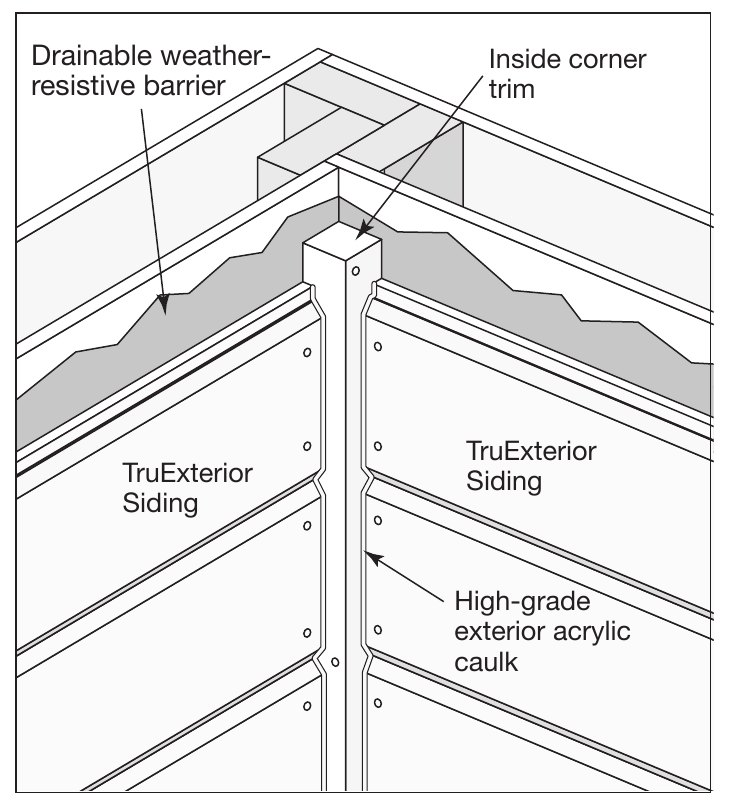
Poly-ash (TruExterior) is a polymer mixed with fly ash. It comes primed, and the maker says it must be painted within 150 days. What you get for that is a board TruExterior rates for ground and masonry contact, and one that it says needs no primer on the cut ends, because it takes on almost no water. It goes up with 15-gauge finish nails, two every 16 inches, and is not for anything load-bearing.
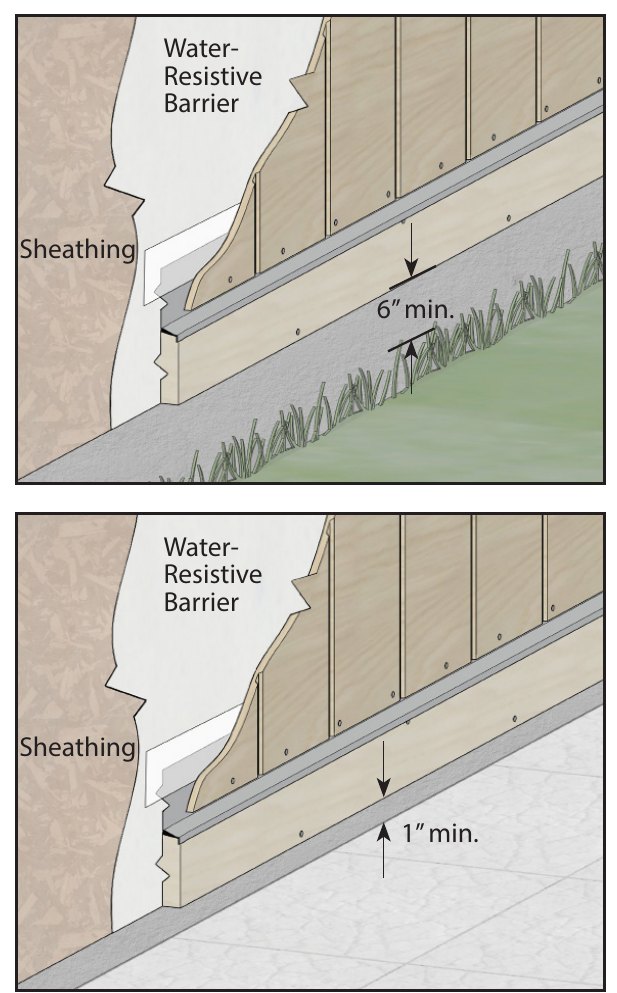
Engineered wood (LP SmartSide trim and fascia) is the same treated strand substrate as the siding, in three thicknesses LP calls the 190, 440, and 540 Series, with a factory edge coating LP says not to rip or rout off. It is wood, so LP's instructions are about keeping it dry: 6 inches to grade, 1 inch off roofs and porches and patios, never touching masonry, a 3/8-inch gap with flashing where it meets brick, and seal every cut. Finish coat within 180 days. Done that way it carries the same 50-year warranty as the siding.
Finger-joint primed pine is sold for exterior casing and brickmould too, and it is the one to be careful with. The glue class in the section above is the whole story: an exterior finger-joint stick needs a wet-use adhesive, back-priming, and sealed ends, and it needs the same clearances as the LP board. Ask which glue class, and if the answer is a shrug, put it under a porch roof.
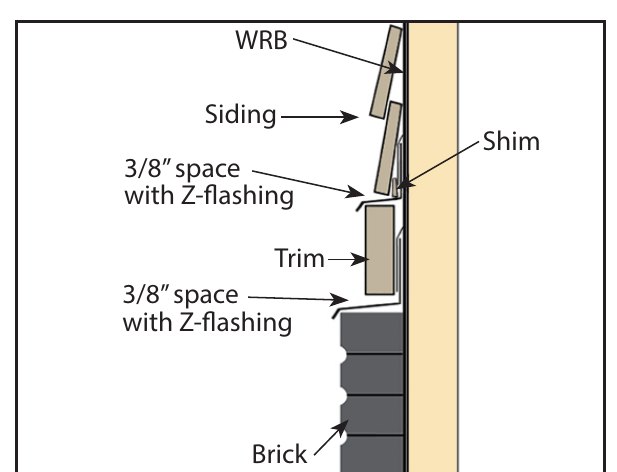
Cut end first, again. PVC is a white foam all the way through. Poly-ash is a gray-brown solid. Engineered wood shows strands under a coated edge. Finger-joint shows fingers. Then ask three questions about the bottom of every corner board on the quote: how far off the ground, what is under it, and who is sealing the cut.
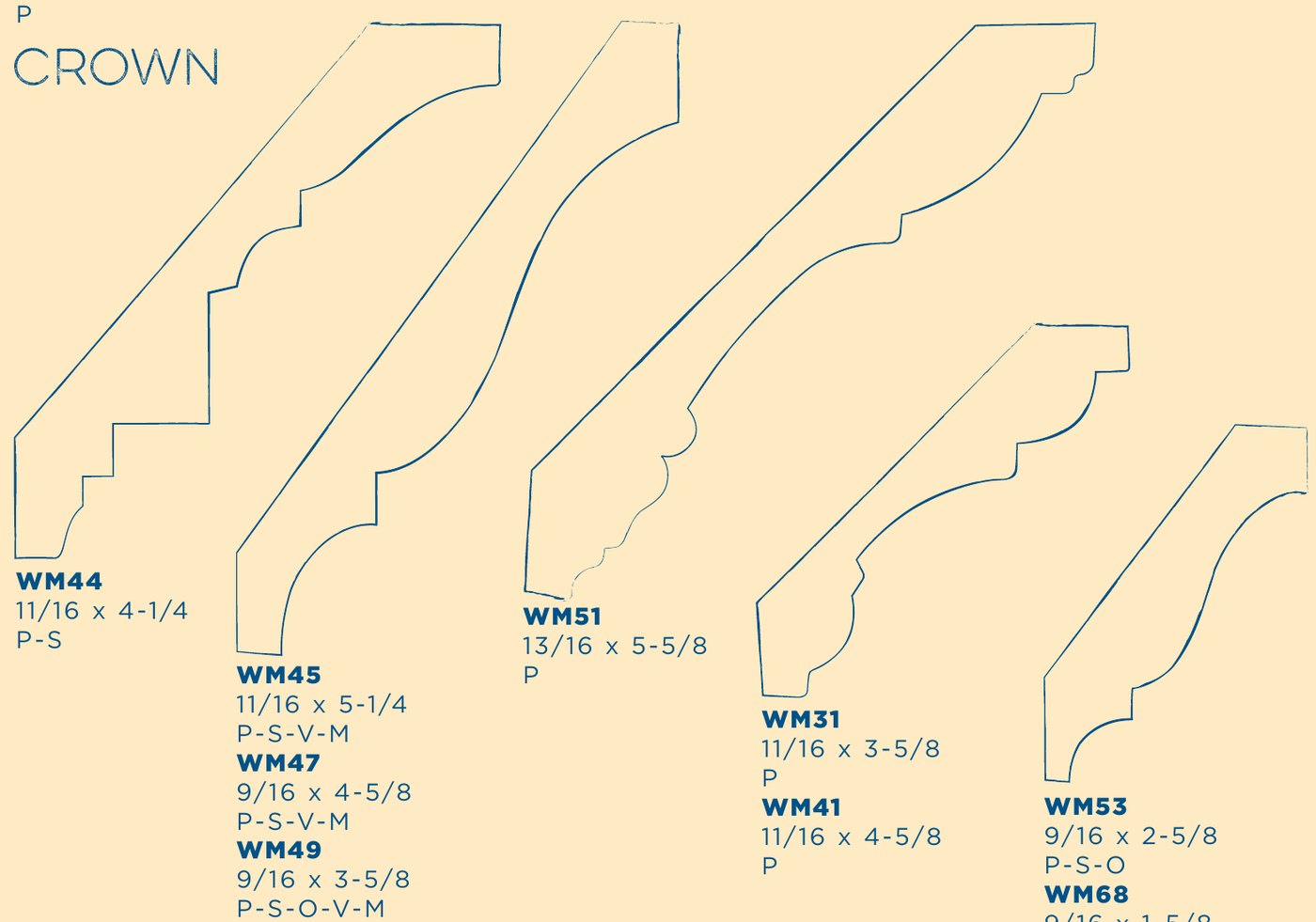
Depth is what you see. The WM number is how you order it.
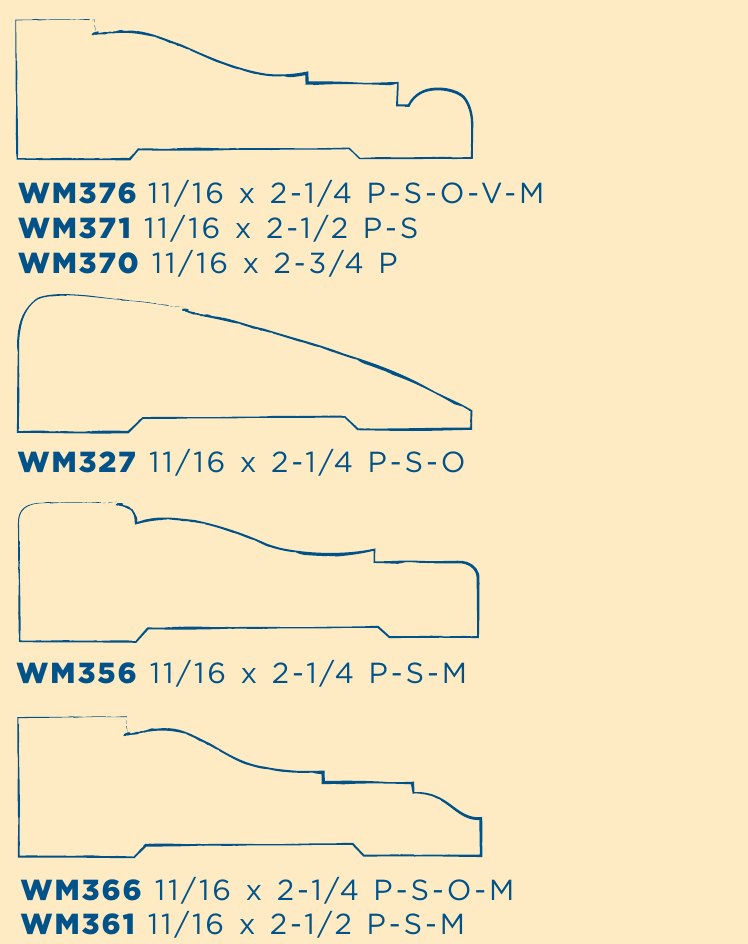
Two casings can both be 2-1/4 inches wide and look nothing alike, because one is 11/16 thick with a deep bead and the other is 9/16 thick with a shallow one. The thickness and the depth of the cuts are the shadow line, and the shadow line is what a room reads as "nice trim" from the doorway. On the sheet, thickness is the first number: WM356 is 11/16 by 2-1/4. WM472 is the same 2-1/4 width at 9/16 thick. Hold the two next to each other and the difference is obvious. On a quote, it is one fraction.
The number itself comes from the Moulding and Millwork Producers Association, which publishes the standard patterns the trade calls the WM series. A WM number is a shape, not a brand. Any mill running the pattern to the standard cuts the same profile, which is why you can add a room to a 1994 house and match the base. The catalog on our counter prints, for every profile, the number, the size, and the materials it comes in. WM376 casing, for instance, comes P-S-O-V-M: primed, solid, oak, PVC, and MDF. WM49 crown comes in all five too. WM623 base comes P-S-O-M. Same shape, your choice of the material from section one.
Not everything has a WM number. Metrie and Woodgrain each print their own numbers on their own profiles, and Wholesale Millwork's Legacy line, cut from high-density poplar and primed, buffed, and primed again, has its own L numbers. That is fine. What you want on the quote is a number of some kind, the thickness and width beside it, and the material letter. "Colonial casing" is not a spec. "WM356, 11/16 x 2-1/4, primed FJ pine" is.
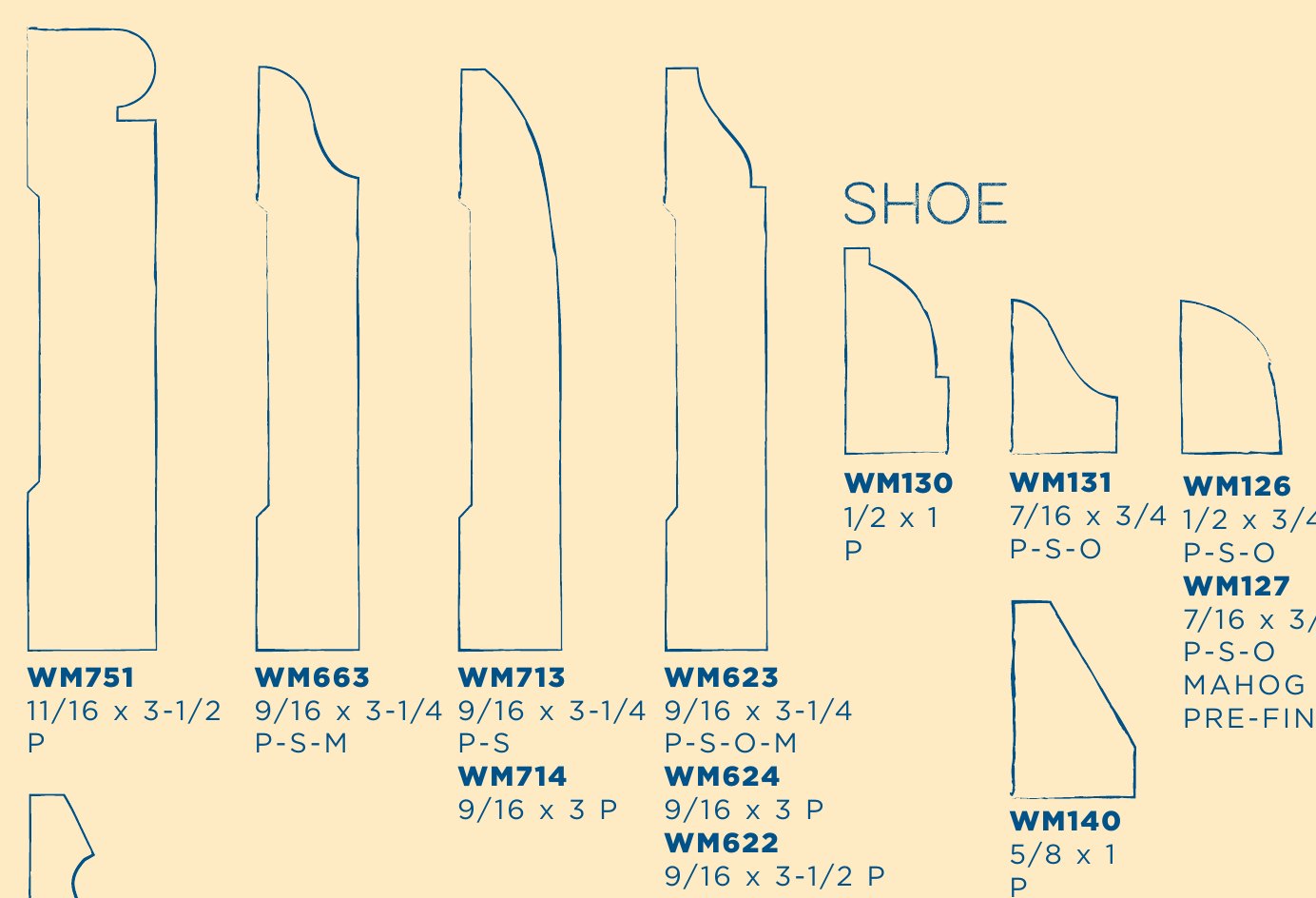
Every line should carry a profile number and thickness, then the width and the material. If the house already has trim, bring a 12-inch cutoff and we will put a number to it. If the quote says "base, 3-1/4" and nothing else, ask which base.
Pre-primed is a coat, not a finish. Read what it promises.
A primed stick has one coat on it, and the makers are careful about what that coat is for. Woodgrain says its primed finger-joint pine and most of its MDF carry a white water-based primer so you can finish with whatever color you want. That is the promise: a surface ready for paint, with the fingers and the fiber sealed under it. It is not a promise about the paint that goes on top. The primer gets the stick to the painter; the painter's coat is the painter's.
Outside, the primer comes with a clock. LP wants its finish coat on within 180 days, in 100 percent acrylic, and says no vinyl-based paint and no stain. TruExterior comes primed and says 150 days. AZEK PaintPro, the PVC made to be painted, says 180 days from the day it sees sun. Miss the window and the maker's warranty on the board steps aside, which is the part of the sheet Lesson 2 reads.
Unprimed PVC is the odd one. AZEK's premium trim and VERSATEX do not need paint at all, and both say paint lasts longer on them than on wood because there is no moisture cycling under it. AZEK adds that paint may take up to 30 days to fully cure on PVC for the same reason. The rule they both put on it is the color: light enough to reflect heat, which each states as a Light Reflective Value, 55 for AZEK and 50 for VERSATEX. Darker than that needs a vinyl-safe or heat-reflective paint from an approved line. And AZEK's lifetime warranty says in one sentence that it does not cover painted finishes or coatings applied by the purchaser or anyone else. The board is warranted. The paint on it is on you and your painter.
Scratch the primer on a primed sample with a fingernail; it should not flake. Ask whether the paint on the quote is 100 percent acrylic and, on PVC, what the LRV of the color is. Ask who is sealing the cut ends, and with what.
Nails hold trim to the wall. Glue holds trim to trim.
A miter that opens is not the trim's fault most of the time. Interior wood and MDF move with the room's humidity, and both Metrie and the 3-day acclimation rule exist because a stick nailed up the day it came off a cold truck will shrink in place. Glue in the miter is what holds it closed when the wood moves; the nails just hold the stick to the wall.
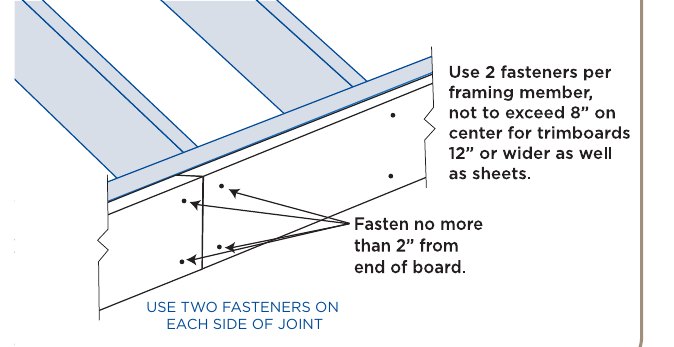
Outside, each maker writes the joint rule down. AZEK: glue all PVC-to-PVC joints with AZEK cellular PVC cement, which has a 10-minute working time and a 24-hour cure; use scarf joints on long runs, two fasteners on each side; fasteners within 2 inches of every end and two per framing member, sunk 1-1/2 inches into solid wood; a #8 trim screw is fine, stainless or hot-dip galvanized. VERSATEX: shiplap the joint, glue it with Weld-On 705, two sets of 8d annular nails on each side, and construction adhesive on the back for 2 feet either side; 8d nails with thin shanks and full round heads, 1-1/4 inches into the stud, two per width up to 6 inches wide and three at 8 to 10, every 16 inches; screws restrict movement more than nails; if you can bend the fastener in your fingers it is too thin. LP: no scarf joints at all; butt joints get a 3/16-inch gap sealed with a Class 25 sealant and four nails, two on each side; 8d hot-dip galvanized or stainless at 0.113 inch, 3/8 inch from ends and edges, two per width under 7 inches wide, three at 7 to 12; corners overlap with the same 3/16-inch sealed gap, and do not miter them. TruExterior: 15-gauge finish nails, two every 16 inches, within 2 inches of the edge, a bead of flexible exterior acrylic caulk where trim meets siding, and no adhesive caulk.
Those rules disagree with each other on purpose, because the materials move differently. That is the point of reading them: the joint detail for the trim on your quote is the one from its maker, not the one the crew used on the last house.
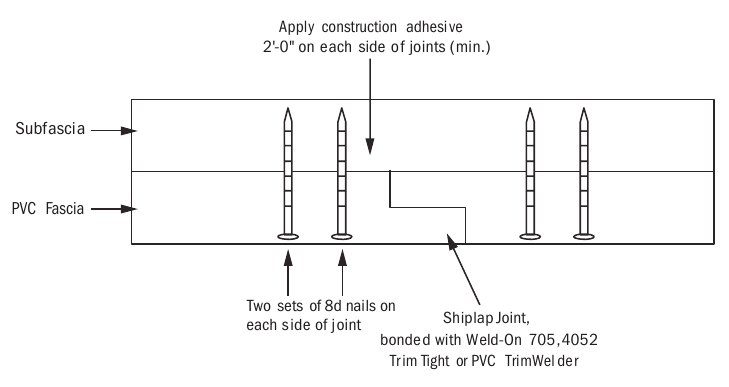
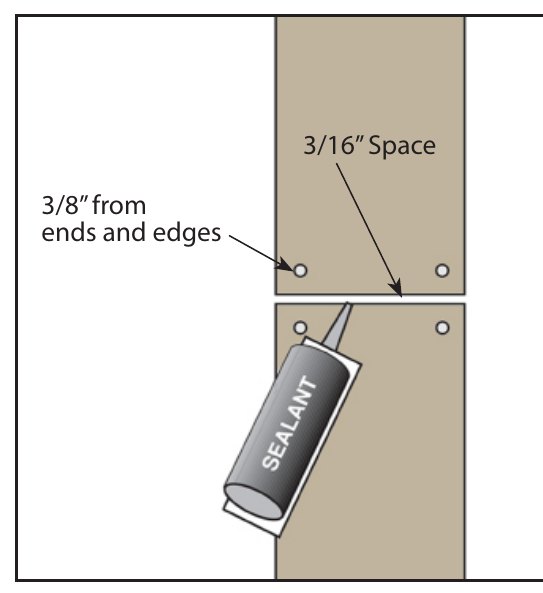
Is there glue on the order for the PVC joints, and is it PVC cement. Is the sealant Class 25 on the LP. Are the fasteners named, and are they stainless or hot-dip galvanized. Are the sticks going into the house 3 days before the trim carpenter.
This is the checklist.
| Feature | What lasting trim has | What to ask |
|---|---|---|
| Interior stick | Finger-joint or MDF for paint, solid wood for stain, coated MDF where nobody is painting; acclimated 3 days in the room | Primed or raw? Which material letter? When do the sticks go in the house? |
| Exterior board | Cellular PVC or poly-ash where it touches the ground or masonry; engineered wood or wet-use finger-joint with 6 inches to grade and every cut sealed | How far off the ground? Who seals the cuts? Which glue class? |
| Profile | A WM (or maker) number with its thickness, width, and material on every line | Which number? Show me 11/16 next to 9/16. |
| Primer | Factory primer with the finish coat on inside the maker's window; on PVC, a color inside the LRV rule | What paint, and by when? What is the LRV of the color? |
| Joint | Glue in every miter; PVC cement and two fasteners per side on PVC; 3/16-inch sealed gap on LP; named fasteners in stainless or hot-dip galvanized | What is in the joint besides a nail? Which fastener? |
| Warranty | Lifetime on PVC, 50-year prorated on LP trim, 20-year on poly-ash; none of them cover the paint | What does it pay after year five? Does it transfer? |
Every one of these is good trim. Pick on purpose.
MDF on a paint-grade house with a good painter is the smoothest wall of base you can buy, and we sell a lot of it. Finger-joint pine is the stick that takes a nail without a pilot hole and holds a corner. Solid poplar or oak under a clear finish is the room people photograph. Coated MDF is the one that goes up finished. Outside, cellular PVC is the board we recommend when someone asks for the trim they will not paint again, and poly-ash is the one for the porch skirt that touches the slab. LP trim is the honest match for an LP siding job, on the same warranty.
None of them is wrong. What is wrong is buying the cheaper one without knowing what you gave up, or the premium one without knowing what you bought. Bring the checklist. We keep a cutoff of every profile we stock on the counter, and the maker literature this page is written from is on the shelf behind it.
Before You Price Trim
Know what you are finishing with.
Three short reads on trim and moulding. Written for the builder who has to answer to the money, and for the eye that sees it every day.
Frequently Asked
Trim materials, answered.
What is a WM number on trim?
What is the difference between primed and raw trim?
Does PVC trim have to be painted?
Why does exterior wood trim rot at the bottom?
What is back-priming and end sealing?
What keeps a trim joint from opening up?
Come See It
Put your hands on it first.
Specs only tell you so much. Come walk the yard and the showroom.
119 Cumberland St, Ashland City. The coffee’s on.