
Read the tag.
Then read the warranty.
A barn package comes with more paper than any other thing we sell: a tag stapled to every post, a coil tag on the metal, drawings for the trusses, a tag on every roll of wire, and a warranty on the wood. None of it is hard. All of it is written to be skipped. Here is how to read it slowly, with a real post warranty as the example.
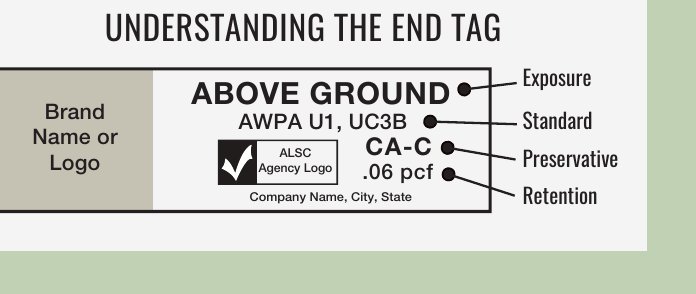
Five lines. The second one decides the barn.
The AWPA draws the tag with five callouts. Exposure: Above Ground, Ground Contact, or Ground Contact Heavy Duty. Standard: "AWPA U1" and the use category, UC3B for above-ground lumber that gets wet, UC4A for ground contact General Use, UC4B for Heavy Duty. Preservative: CA-C, MCA, CCA, or another. Retention: pounds of preservative per cubic foot, like .06 or 0.15 pcf. Agency: the logo of the third-party inspector that audits the treating plant, with the treater's name and town.
UTD's own sample tag in its catalog reads Ground Contact General Use, 0.15 pcf MCA, with the SPIB quality mark and the code report number ESR-1721. That is a fence post tag. A barn post tag says Heavy Duty, and the Wolmanized warranty will ask you to produce it. The retention number only compares across the same preservative; MCA, copper azole, and CCA each use a different scale, and the spec guide's CCA table (0.40 for UC4A, 0.60 for UC4B structural poles) does not translate to an MCA tag.
The tag is also the warranty claim. The Wolmanized warranty says the homeowner must provide end tags and the original invoice, enough tags to show the amount of wood bought equals or exceeds the amount being claimed. Pull the tags off the posts before they go in the hole and put them in the folder with the truss drawings.
Which line is the exposure. Which use category. What is the retention and which preservative is it for. Who is the agency. Does the barn post say Heavy Duty.
Five documents, and where each one comes from.
The coil tag on the metal names the gauge, the substrate, and the paint system, and the coating warranty is split into film integrity and chalk and fade, each with a term in years. The GingCo panels Midway quotes are 29 or 26 gauge with a Sherwin-Williams WeatherXL coating. The roofing lesson reads that tag line by line, and it reads the same on a barn.
The truss drawing is the sheet the inspector will ask for, and the residential code, R802.10.1, says what has to be on it: the design wind speed and exposure category; slope or depth, span, and spacing; the location of every joint; required bearing widths; the design loads, top and bottom chord, live and dead, plus any concentrated loads and the controlling wind and earthquake loads; each reaction force and its direction; the connector plate type, size, and dimensioned location at every joint; the lumber size, species, and grade for each member; the connection requirements for girders, plies, and field splices; the calculated deflection ratio; the axial forces the permanent bracing has to carry; and where that bracing goes. The code says the drawing goes to the building official and is approved before installation, and rides with the trusses to the job. If the truck shows up without it, the trusses wait.
The wire tag carries the gauge, the knot, and the class. The classes come from the ASTM standard for zinc-coated steel wire, and Red Brand publishes its own reading of them: Class 1 is at least .28 ounces of zinc per square foot, most of its woven styles come in Class 1 or Class 3, Class 3 service life is 2.5 times longer, and Class 3 is the one for ground prone to rust. Red Brand's Square Deal field fence is 12-1/2 gauge filler with 10 gauge top and bottom; its Non-Climb horse fence is a 2 by 4 mesh, 12-1/2 gauge lines and 10 gauge top and bottom; its barbed wire is 12-1/2 gauge.
The gate has no load rating in print. What the makers publish is the tube and the use. Behlen sorts by confinement level and puts its 2-inch 16-gauge AgStar at Level 3, Maximum Confinement, for cattle handling, breeding pens, and loading. Its Frontier and Pasture Pro gates are 1-5/8 tube; Tarter's 6-bar gate is 1-3/4 tube and Tarter calls it light confinement. Both makers print the size allowance, 3 inches under the listed width on Tarter and 4 on Behlen, and the hinge that ships in the box.
The code report on treated wood is ICC-ES ESR-1721 for Wolmanized copper azole, and the Wolmanized product sheet points to it for allowable values and conditions of use. It is also what makes a treated post acceptable to the inspector.
What gauge and coating are on the coil tag. Is the truss drawing approved and on the truck. Class 1 or Class 3 on every roll. What confinement level is the gate rated for, by the maker. What is the report number on the treated wood.
| Document | Where it comes from | What it tells you | Look for |
|---|---|---|---|
| End tag | AWPA U1; the treater and its inspection agency | What the wood is rated for and how much preservative is in it | Ground Contact Heavy Duty (UC4B) on barn posts; Ground Contact (UC4A) on fence posts; the pcf number |
| Coil tag | The panel maker and its coil coater | Gauge, substrate, paint system, coating warranty | 29 or 26 gauge; film integrity and chalk-and-fade terms in years |
| Truss drawing | The truss engineer, per IRC R802.10.1 | Loads, spans, bearing, plates, lumber grade, bracing | Approved before installation; on the truck with the trusses |
| Wire tag | The fence maker, per the ASTM zinc-coated wire classes | Gauge, knot, and class of galvanizing | Class 3 on wet or corrosive ground; 10 gauge top and bottom on field fence |
| Gate literature | Behlen, Tarter | Tube diameter and gauge, confinement level, size allowance, hinge | The confinement level matched to the animal; the hinge matched to the post |
| Code report | ICC-ES ESR-1721 (Wolmanized copper azole) | The inspector can accept the treated wood and its values | The number on the tag and on the submittal |
A rating with a standard and a tag behind it is a spec. "Treated," "galvanized," and "heavy duty" on a brochure are words. Ask for the tag.
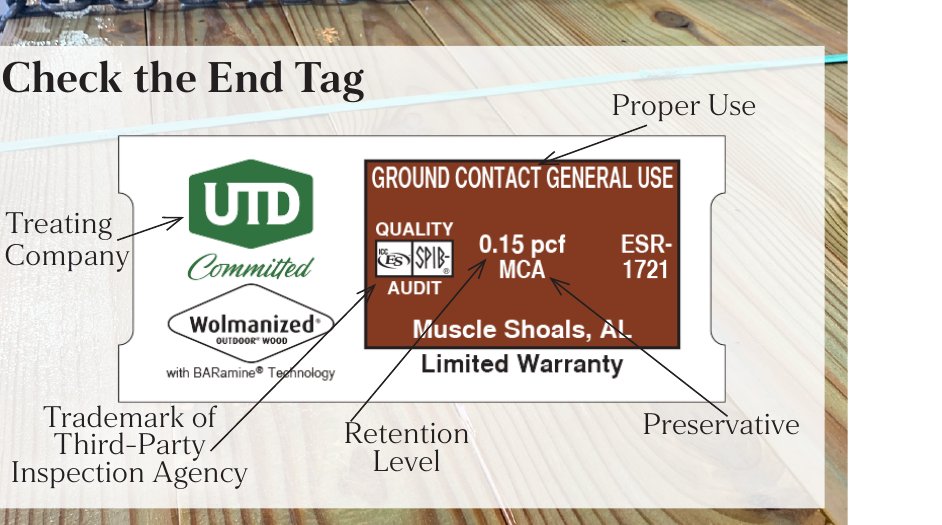
"Lifetime" has conditions. Here is what Wolmanized covers in the ground.
The Wolmanized Residential Wood Limited Warranty is a one-page document from Arch Treatment Technologies, effective September 1, 2023, and it is the warranty on the treated lumber and posts Midway sells. It is a fair example of how every treated wood warranty is built. What it covers: termites and fungal decay that make the wood structurally unfit for its permitted use. How long: for as long as the original homeowner owns the structure. It ends when the property is sold and it does not transfer. Where: privately owned residential or agricultural property in the United States. A barn on a farm qualifies. A commercial building does not.
The conditions are the part to read twice. The wood has to be used for the permitted use printed on its tag, and the warranty spells out four cases where Ground Contact is required even if the wood is technically above the ground: wood that stays in contact with soil or debris, wood without enough air to dry, anything less than 6 inches above grade, and wood that is critical and hard to replace, which it says includes deck joists and beams. Then the sentence this whole lesson is built on: Wolmanized wood posts supporting houses, garages, sunrooms, barns, or other permanent structures must be treated to Ground Contact Heavy Duty. Surfaces that have been cut or trimmed may not be used in the ground. Cuts and holes above ground get an end-cut preservative with at least 0.675 percent copper as oxine copper or 1 percent copper as copper naphthenate. The structure must be built to code.
What it does not cover is where an honest salesman earns his keep. Weathering of any kind: discoloration, graying, splitting, cracking, checking, warping, shrinkage, twisting. Surface mold and stain. Acts of God. Vineyard stakes. And, in a line that matters for a barn, wood used in foundation systems or in framing such as permanent wood foundations, piling, and post-frame construction using round poles or heavy timbers. Read that as: a square sawn 6x6 or a laminated column, properly rated, is inside the warranty; a round pole barn or a heavy-timber frame is outside it. Ask before you buy the poles.
The remedy is replacement wood or the reasonable cost of it. Arch does not pay labor, removal, disposal, delivery, or installation. If a barn post decays at grade, the warranty buys a post. The jacking, the dig-out, and the crew are yours, which is what Lesson 3 is about. The claim takes the end tags and the invoice, photographs, and samples of damaged and sound wood, and Arch can come inspect. Register the purchase at the address on the warranty and they keep the tags on file for you.
None of that is a criticism. It is a long warranty on a real risk, and it says in writing which post to buy for a barn. UTD's laminated columns carry their own limited warranty against termites and fungal decay, and UTD's catalog prints a QR code to the full text. The wrapper says lifetime. The conditions say Heavy Duty, uncut in the ground, on a farm or a house, for the first owner, wood only. Both are the same page.
| Read for | Where it hides | What a strong answer looks like |
|---|---|---|
| What is covered | Section I, first sentence | Termites and decay that make the wood structurally unfit; nothing about looks |
| The rating | Requirements for Coverage, item 4 | Heavy Duty on every barn post, and the tags say so |
| Cut ends | Requirements, item 5 | Factory end in the ground; end-cut preservative on every cut above it |
| Post-frame exclusion | What this Warranty Does Not Cover, item 2 | Sawn or laminated posts, not round poles or heavy timbers |
| Labor | Remedy | You planned for it; the warranty buys wood |
| Transfer | Who is Covered | None. Original owner only |
| The claim | How to Make a Claim | The tags and the invoice are in a folder, registered |
Are the barn posts Heavy Duty, and does the tag say so. Are the posts ordered to length so no cut end goes in the hole. Is the end-cut preservative on the order. Is this a sawn or laminated post barn, or a round pole barn. Who keeps the tags.
Before You Price a Barn
Know what you are putting up.
Three short reads on pole barns, fencing, and outdoor structures. Written for the owner who has to answer to the budget, and for the weather.
Frequently Asked
Tags, drawings, and warranties, answered.
What do the numbers on a treated post tag mean?
Does the Wolmanized warranty cover posts in the ground?
What has to be on a truss drawing?
What does Class 3 mean on a roll of fence wire?
Is there a rating on a farm gate?
What is on the coil tag of a metal barn panel?
Come See It
Put your hands on it first.
Specs only tell you so much. Come walk the yard and the showroom.
119 Cumberland St, Ashland City. The coffee’s on.