
The failed inspection
is the expensive one.
Fasteners are a rounding error on the takeoff. They are also the only line that can get a framed deck torn back to the joists on inspection day. This page is about what the wrong box costs once the labor to undo it is counted, and it is written for the person paying for the job as much as the person nailing it.
Four ways a cheap line becomes a dear one.
The wrong nail in the hanger. The crew has a box of 1-1/2 inch hanger nails and the LUS26 calls for 0.148 by 3. The catalog says that swap leaves 0.77 of the download. In a hanger built for 0.162 by 3-1/2, the short nail leaves 0.64 and uplift is not allowed on some rows. The inspector reads the stamp on the hanger and the nail heads and asks for the row. Every joist in the run gets its nails pulled, or gets a new hanger. The nails were the same price either way.
Bright fasteners in treated lumber. A box of bright common nails or electroplated screws goes into a treated deck frame. Simpson puts bright and electroplated in its low corrosion tier, for dry service. Treated wood in the weather is medium at best, and the codes call for hot-dip galvanized or stainless in it. Koppers, which treats most of the lumber on our yard, prints the same minimum. Nobody publishes the year those fasteners give up; Simpson says plainly it cannot estimate service life. What is published is that they are in the wrong tier, and the fix is a deck frame with a thousand fasteners in it that should have been a different thousand.
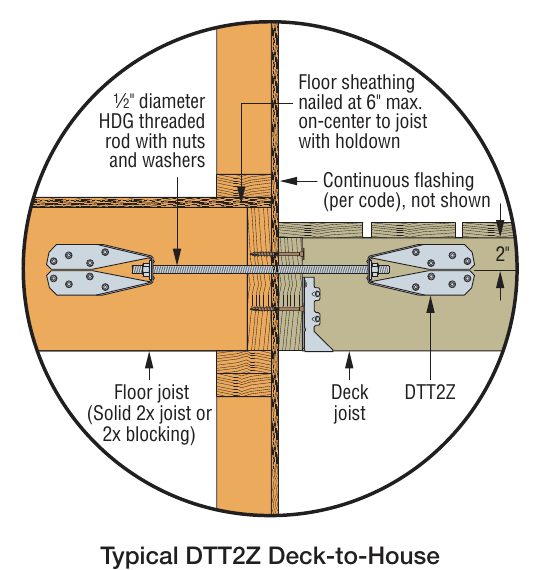
The deck ledger. The ledger is bolted, the joists are hung, and there is no lateral connection to the house. Simpson's catalog describes the IRC provision: 1,500 pounds at two places, or 750 pounds at four, and it sells the DTT2Z and the DTT1Z to meet each one. Missing, it is the item a deck fails on. Added after the fact, it means opening the floor from inside the house for the DTT2Z detail, which is exactly why Simpson designed the DTT1Z to reach the plates and studs from the deck side.
The re-do. Every one of these is fixed the same way: the crew comes back, the connectors or fasteners come out, and the right ones go in, on a day that was scheduled for something else, while the inspector waits for a second visit. The fasteners for the re-do cost about what they cost the first time. The labor is the whole bill.
The question is not whether the right box costs more than the wrong one. It is whether the difference is bigger than the chance of a re-do times what the re-do costs. That is arithmetic, and the calculator does it with your numbers.
Bring two boxes. We do not put prices on the site.
Count the connectors on the job, or the fasteners in a run of the same kind: every hanger in a floor, every tie on a roof, or all the screws in a ledger. Read the fastener column for that connector to get the count per connector; the catalog row or our counter will give it to you. Then take two box prices from wherever you buy, one for the fastener the row names and one for the fastener the crew would reach for otherwise, and the count in each box.
Then two numbers only you can supply. How likely is it that the wrong fastener gets caught, by the inspector or the engineer, by the deck in ten years, or by nobody. And what would it cost to come back and put it right: the crew day, the connectors, and the return trip for the inspection. The calculator multiplies the two and calls it the expected cost of the wrong box, and sets it against the difference on the bid.
It does not know which fasteners you are comparing. It only knows arithmetic.
Numbers to start from, not to stop at.
Counts per connector, from the Simpson tables: LUS26, eight 0.148 by 3 nails. LU26, six 0.162 by 3-1/2 and four 0.148 by 1-1/2. H2.5A, ten 0.131 by 2-1/2. ABA44Z, six 0.148 by 3. ABU44Z, twelve 0.162 by 3-1/2. DTT2Z, six SD screws and one 1/2-inch bolt.
Substitution factors, from the same catalog: 0.77 for a 1-1/2 inch nail where 3 inches is called for at 0.148; 0.84 for a 0.148 by 3 where 0.162 by 3-1/2 is called for; 0.64 for a 0.148 by 1-1/2 in that hanger. Overdriven nails: no reduction only if the four conditions on page 26 are all met.
Corrosion tiers: bright and electroplated are low; A153 hot-dip and the coatings with a code report are medium; 304 and 305 stainless high; 316 stainless severe. Treated wood in the weather starts at medium.
Service life: none published. Simpson says it cannot estimate one. Use your own judgment in the chance box below.
Cost Over Time
The right box, the wrong box, and the re-do.
Nothing you type here is sent anywhere. It runs in your browser.
Before You Price Fasteners
Know what is holding it together.
Three short reads on fasteners and connectors. Written for the builder who has to answer to the money, and for the inspector.
Frequently Asked
Fastener cost over time, answered.
What happens if the wrong nails are used in a joist hanger?
Are overdriven nails in a hanger a problem?
What is the deck lateral load connection the inspector asks about?
How long will bright nails last in treated lumber?
Stop By the Desk
Let’s talk it through in person.
Bring your plans or just your questions. We’ll get you squared away.
119 Cumberland St, Ashland City. The coffee’s on.