
What you are paying for
in fasteners.
Fasteners are the cheapest line on the takeoff and the one that decides whether the deck is still a deck in fifteen years. Two boxes of nails can look the same in the bin and be a world apart once they are in treated lumber. The difference is the coating, the shank and thread, and whether the nail in the hanger is the nail the catalog says. Every one of them you can read off the box or off the connector itself.
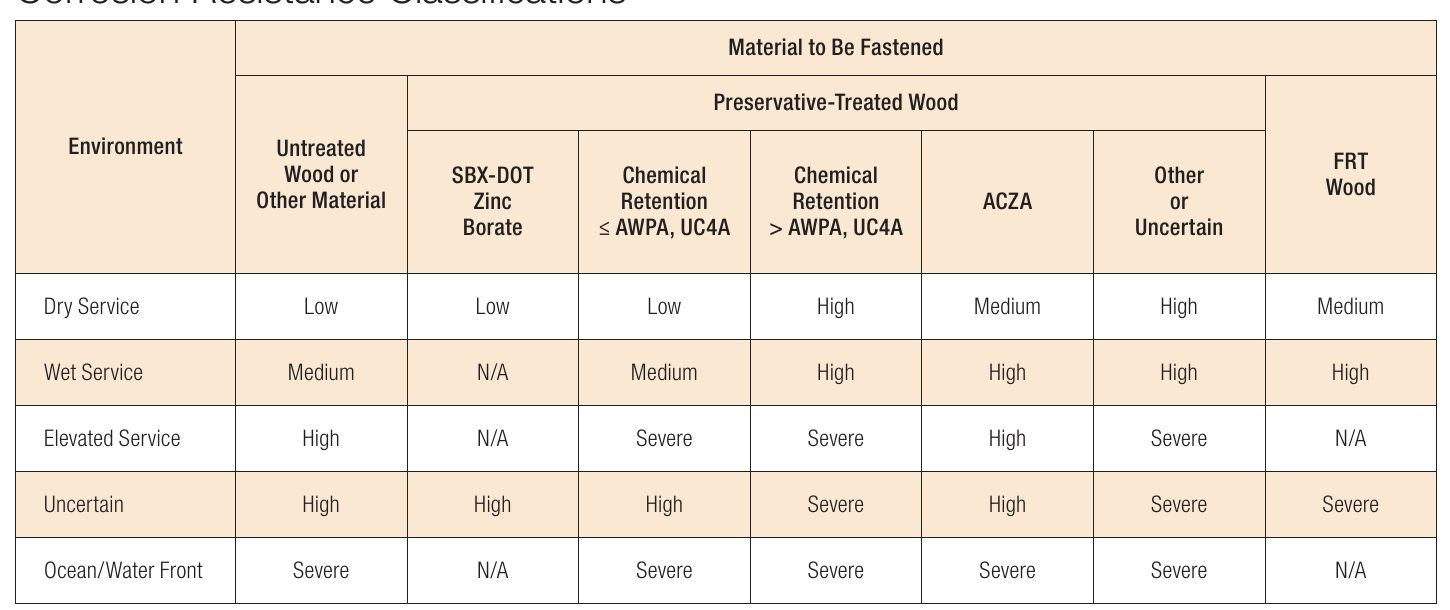
Zinc by the ounce. Read which ounce.
A fastener is steel, and steel rusts. What you are paying for on the coating line is how much zinc is between the steel and the weather, and whether that zinc is thick enough for the wood it is going into. Simpson's catalog sorts every coating it sells into four tiers, and the tiers are worth learning because every maker's box uses the same words.
Low. Bright means no coating at all. Electroplated zinc comes next: the catalog rates clear zinc at 24 hours in the salt spray test before red rust shows, blue-bright zinc at 36 hours, and yellow zinc at 72. Gray or black phosphate is for dry interior work. Standard connectors are G90 galvanized, 0.90 ounce of zinc per square foot. Simpson says these are for dry service, and its own fine print says the paint on a painted connector is there to protect it in the warehouse and on the truck.
Medium. Hot-dip galvanized fasteners to ASTM A153 Class D carry at least 1.0 ounce of zinc per square foot, applied by dipping the finished nail or screw in molten zinc. Connectors come two ways at this tier: ZMAX, which is G185 or 1.85 ounces, and post-hot-dip galvanized, which is bent first and dipped after, at 2.0 ounces or more. Mechanically galvanized screws to ASTM B695 Class 55 are here too. So are the proprietary coatings on structural screws: Simpson's Double Barrier, GRK's Climatek, Grip-Rite's zinc with a black top layer, FastenMaster's coating with a clear top coat. Each of those has a code report that says where it is equal to hot-dip, and Lesson 2 shows how to read that report. A zinc plating with a baked ceramic top coat, the ceramic-coated deck screw in the bin, is what Simpson describes as added protection for moderately corrosive work.
High and severe. Type 304 and 305 stainless is the high tier. Type 316, with 2 to 3 percent molybdenum, is the severe tier and the one Simpson names for chlorides: salt air, de-icing salt, pool decks. Hot-dip galvanized to A153 Class C, 1.25 ounces, is also on the severe list for fasteners. Stainless connectors take stainless fasteners; the catalog says the compatible fastener for a Type 316 connector is Type 316. Two more lines from the same pages. Hardened fasteners can crack from hydrogen in wet service, so Simpson recommends them for dry conditions only. And some stainless is prone to stress cracking around an indoor pool, where Simpson would rather see a heavy galvanized coating than stainless at all.
Treated lumber is why the tiers exist. Simpson's testing found ACQ-D wood more corrosive than copper azole, micronized copper azole, or the old CCA-C. The catalog draws the line at the AWPA UC4A retention level: above it, stainless; at or below it in wet service, hot-dip galvanized as the medium tier. Koppers, which makes the MicroPro treatment in most of the treated wood on our yard, says its wood corrodes metal about like untreated wood and still sets the outdoor floor at A153 hot-dip for fasteners and G90 for hardware, with stainless required below grade and wherever the wood stays wet. Koppers allows plain carbon steel in one place: interior, above-ground, weather-protected framing like sill plates. Fire-retardant lumber needs hot-dip or stainless unless the treater says otherwise. Aluminum flashing can touch MicroPro wood above ground where it drains; Simpson's galvanic series puts zinc at the anode end and stainless near the cathode end, which is the reason you do not mix them on a wet joint.
Look for hot-dip galvanized and A153, or stainless and the type number. If the box says a coating name instead, look for the ICC-ES report number beside it. Then look at the end tag on the treated lumber it is going into and read the use category and the chemical. Ask us which tier the job is in. We keep the Simpson corrosion pages at the counter.
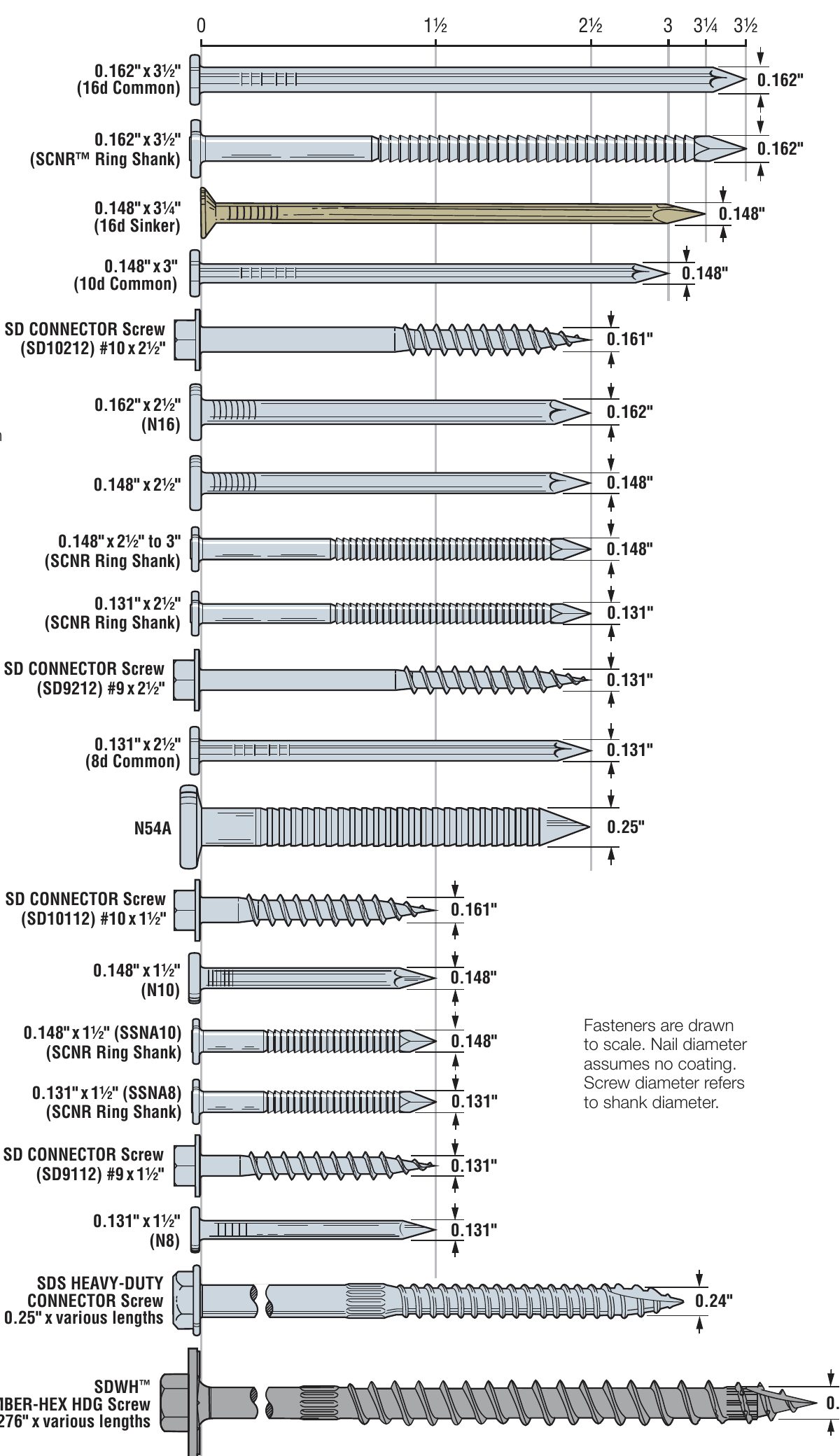
Diameter, length, and what is cut into the steel.
Nails are sold by penny size and specified by diameter and length, and the two do not always agree. Simpson prints both: a 16d common is 0.162 by 3-1/2 inches, a 16d sinker is thinner at 0.148 by 3-1/4, a 10d common is 0.148 by 3, an 8d common is 0.131 by 2-1/2. The short connector nails are the N16, N10, and N8, the same diameters at 2-1/2 and 1-1/2 inches. The catalog's general notes say a connector nail has to be a concentric, full round head nail that meets ASTM F1667, which rules out clipped-head framing nails in a hanger. The shank is the other half. A smooth shank drives easy and carries shear. A ring shank, with rings rolled into it, locks the wood fibers and resists pulling out; Simpson's stainless connector nail is a ring shank for that reason. A spiral shank twists in as it drives; Grip-Rite's wood and hardboard siding nail is a thin spiral shank with a hot galvanized coating and an oval head made for blind nailing, and its common nail is bright steel that Grip-Rite itself says is for work where corrosion resistance is not a priority.
Structural screws are where the thread design earns the money. Simpson's SDS is a 1/4-inch screw: 0.256 inch across the thread, 0.188 at the root, a 0.239 shank, 10 threads to the inch, a plain hex washer head, a Type 17 drill point, and a knurl between the threads and the shank that reams the hole so the shank does not bind. The threads run about two thirds of the length. It is heat-treated 1022 or 10B21 steel, or 316L stainless. GRK's RSS is case-hardened steel with a star drive, a flat washer head with teeth under it, W-Cut threads toward the point, a Type 17 point, 7 threads to the inch, and on lengths of 3-1/8 inches and up a CEE thread that does the same reaming job. Grip-Rite's structural screws are partially threaded, self-drilling, with hex washer or flat star-drive heads, a Type 17 point, and the same knurl on the 1/4, 5/16, and 3/8 sizes. FastenMaster's TimberLOK and LedgerLOK have a 5/16 hex head, rolled threads, and a gimlet point, heat-treated. All four are made to go in without a pilot hole; every one of those code reports says so.
Deck and exterior screws are the bin most people buy from. Grip-Rite's PrimeGuard Plus exterior screw has a T-20 or T-25 star drive, a bugle head with nibs that cut a countersink, coarse threads, and a Type 17 point, and Grip-Rite backs the coating with a 10-year warranty when the screw is installed correctly. The head is the tell on any deck screw: a bugle head sinks flush in wood, a flat washer head sits on top and clamps, and a hex head takes a socket and a lot of torque. Read the box for which one you have.
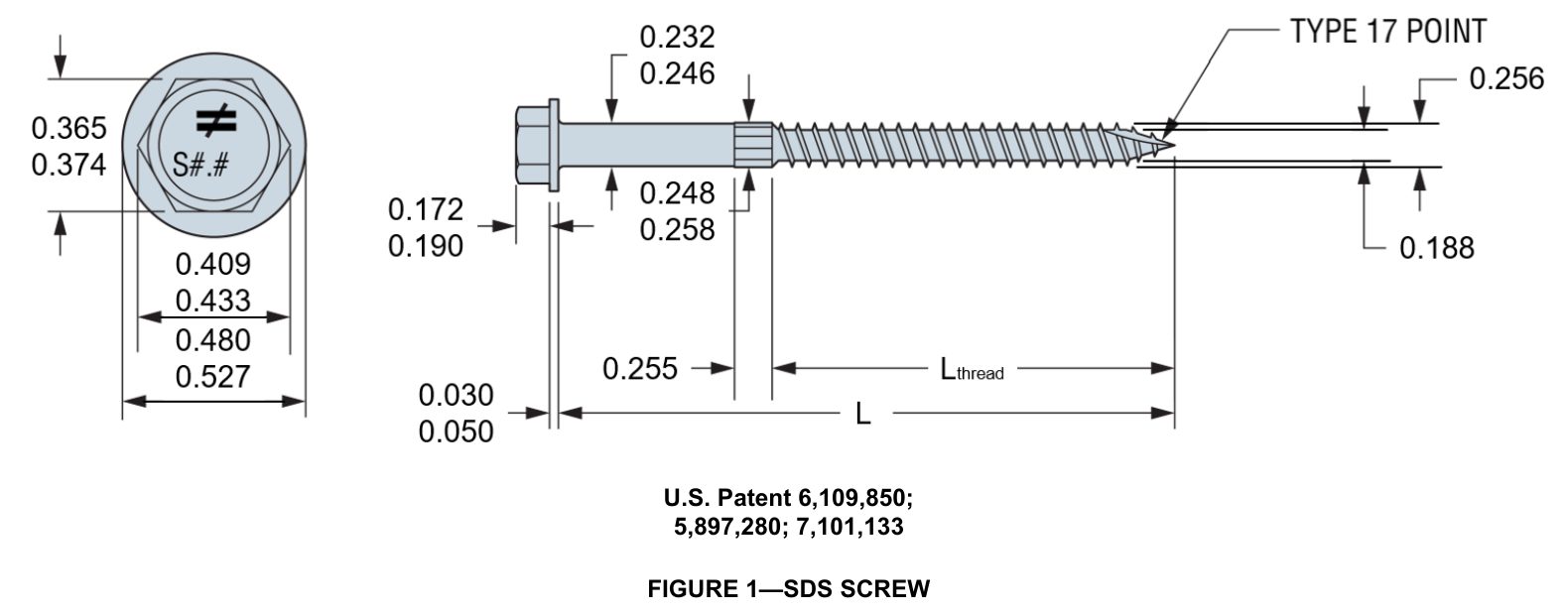
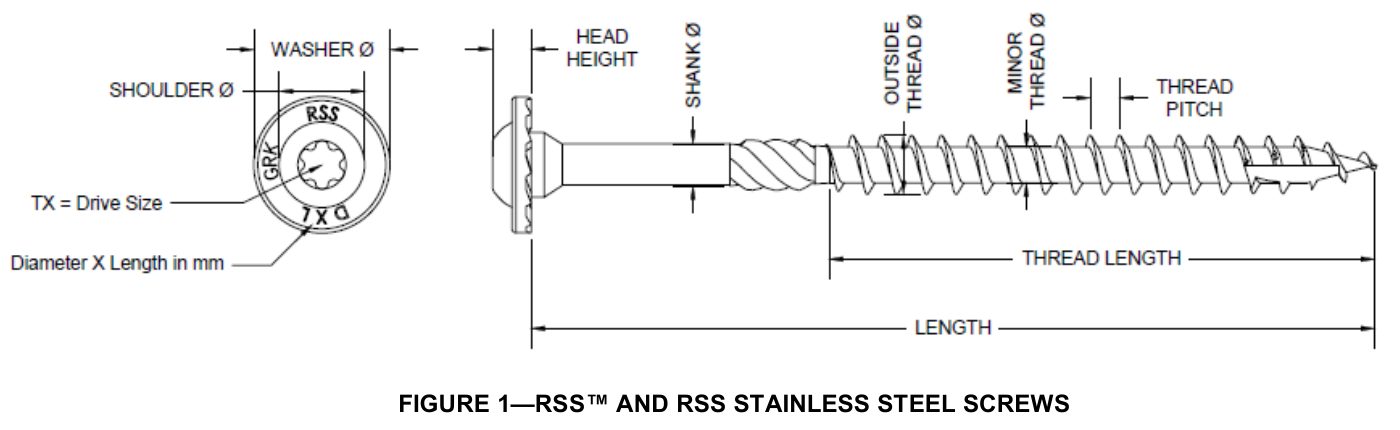
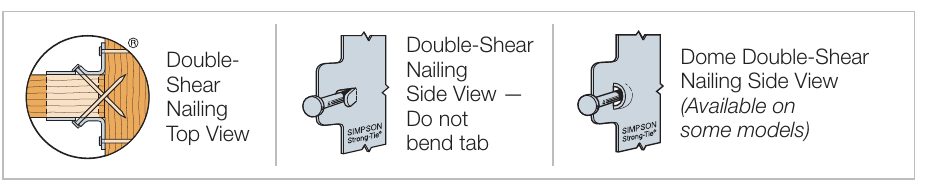
Read the diameter and length on the box, not the penny size. Look at the head: full round, clipped, bugle, washer, or hex. Look at the shank for rings or a spiral. On a structural screw, find the knurl above the threads and the report number on the box. Then hold it against the hanger it is going into.
Each one earns its keep somewhere.
The nail is the framing fastener and the connector fastener. It is fast, it is cheap, and it is what nearly every hanger, tie, and strap in the Simpson catalog was tested with. Pneumatic nailers are allowed in connectors as long as the nail is the right diameter and length and lands in the hole. The rule that gets missed is depth. An overdriven nail, one whose head dents the steel, gets no reduction only when the connector is 14, 16, or 18 gauge, the head is not driven past flush, the nail went through an existing hole without enlarging it, and the steel is not torn. Miss any one and the load table no longer applies.
The structural screw replaces the lag bolt in most of the places a builder used to reach for one: ledgers, beams to posts, stair stringers, rail posts. GRK calls the RSS an easy-to-install lag alternative. Every one of the code reports named above covers the screw as a dowel-type fastener installed with no lead hole, with published withdrawal and lateral values a designer can use under the building code. Simpson's DTT2Z deck tension tie ships with SDS screws for that reason, and its DTT1Z kit ships with SDWH Timber-Hex screws to reach the house framing. What a structural screw is not is a connector nail. Simpson's general notes are blunt: its SD Connector screw is the only screw approved in its connectors, and screws from other makers are not supported in them.
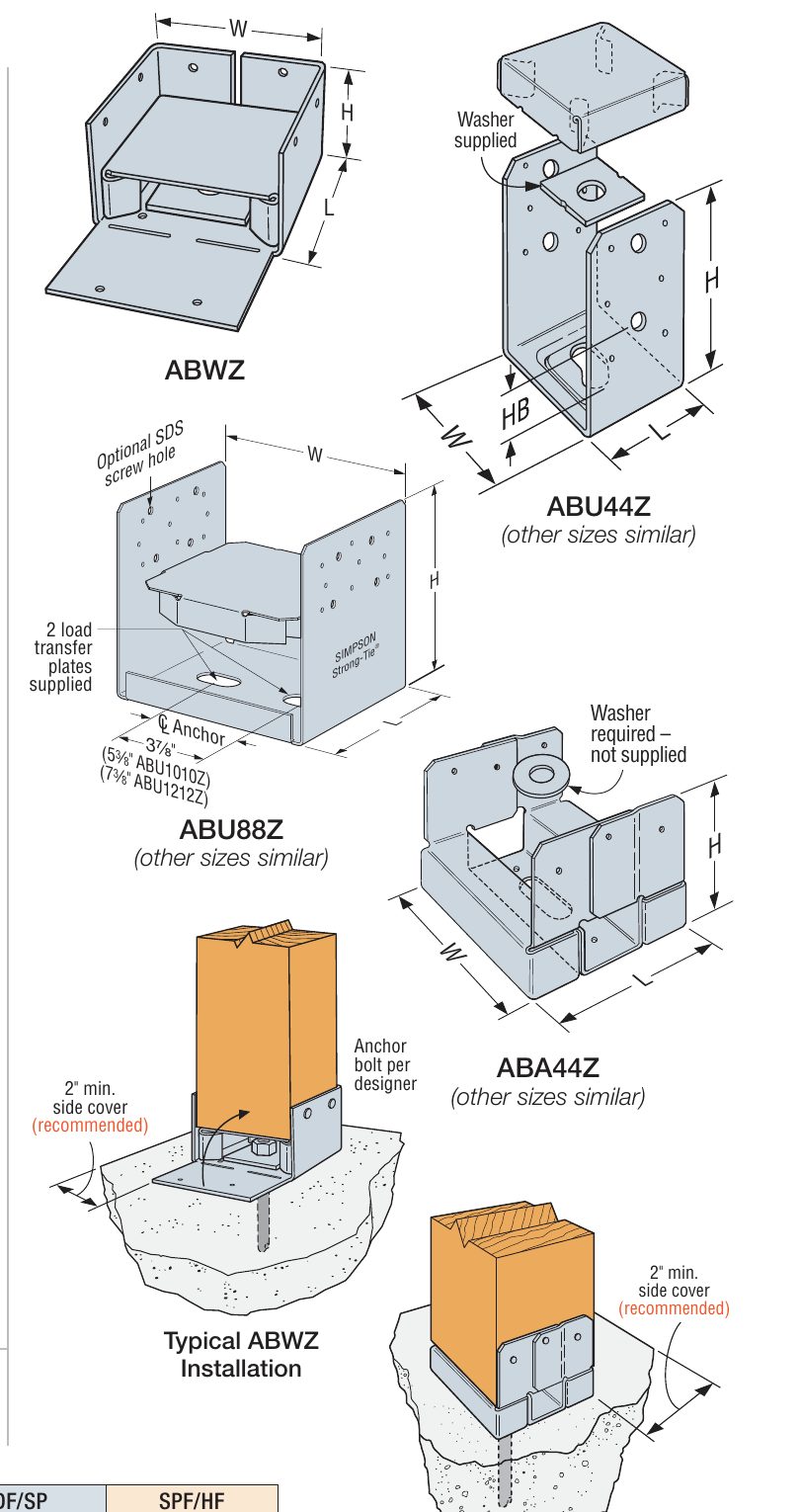
The bolt is still the fastener when the catalog says bolt. Simpson's post bases list bolt loads and nail loads separately; an ABU44Z takes twelve 0.162 by 3-1/2 nails for 1,900 pounds of uplift, or two 1/2-inch bolts for 2,300. The catalog says every reference to a bolt means a structural through-bolt at least as good as ASTM A307 Grade A, not a lag and not a carriage bolt, in a hole drilled between 1/32 and 1/16 inch larger than the bolt. Bolts and nails may not be combined to reach a higher number, and neither may nails and screws.
Where the drawing or the catalog says nail, it means a specific nail. Where it says bolt, it means a through-bolt, and a lag is not one. Where a structural screw is replacing a lag, ask for the report number and the length that gives the thread penetration the report calls for.
The hanger is a table row. The nail is in the row.
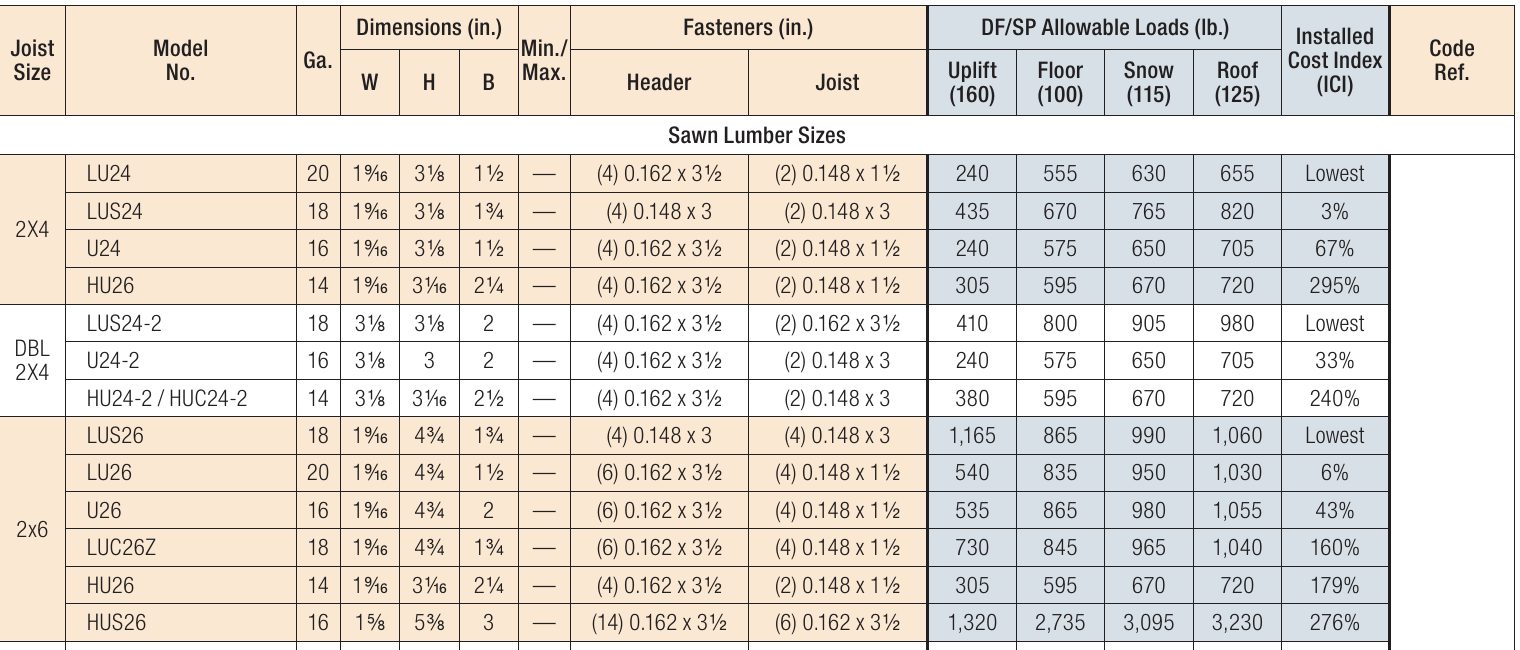
A connector is a bent piece of galvanized steel and a row in a catalog table, and the row is the part you are paying for. It names the fastener count and size into each member, and the load the connector carries only when those holes are filled with those fasteners. Take the three connectors on nearly every deck and floor we sell.
The joist hanger. An LUS26 takes four 0.148 by 3 inch nails into the header and four more into the joist, driven at an angle through the tab so each joist nail bears in two places. That is what Simpson calls double-shear nailing, and it is why the LUS26 posts 1,165 pounds of uplift and 865 pounds of floor load against 540 and 835 for the LU26 next to it, which takes six 0.162 by 3-1/2 nails in the header and four short 0.148 by 1-1/2 nails in the joist. Different nails, different numbers, same joist. The catalog also publishes what happens when the crew reaches for the wrong box: a 0.148 by 1-1/2 nail in a hanger that calls for 0.148 by 3 cuts the download to 0.77 of the table. In a hanger that calls for 0.162 by 3-1/2, a 0.148 by 3 gives 0.84 and a 0.148 by 1-1/2 gives 0.64, with uplift not allowed at all on some rows.
The hurricane tie. An H2.5A takes five 0.131 by 2-1/2 nails into the rafter and five into the plate for 700 pounds of uplift in Douglas fir or southern pine. Use 0.131 by 1-1/2 nails instead and the catalog footnote gives 635 in southern pine. The catalog also says not to nail through a truss plate from the back side, because it can push the plate off the truss.
The post base. An ABA44Z takes six 0.148 by 3 nails for 690 pounds of uplift. An ABU44Z takes twelve 0.162 by 3-1/2 nails for 1,900, or two 1/2-inch bolts for 2,300. Both carry the post on a 1-inch standoff so the end grain is off the concrete, which the catalog notes is a code requirement for structural posts exposed to weather or splash.
The deck tension tie. A DTT2Z takes six #9 by 1-1/2 SD screws or eight 0.148 by 1-1/2 nails plus a 1/2-inch bolt, and Simpson says it satisfies the IRC's 1,500 pound lateral connection between deck and house at two places per deck. The DTT1Z does the same job at 750 pounds at four places and reaches the house framing with a Timber-Hex screw instead of a bolt.
The rule under all of it is on page 22 of the catalog: incorrect fastener quantity, size, placement, type, material, or finish may cause the connection to fail. The fastener is not an accessory to the connector. It is half of it.
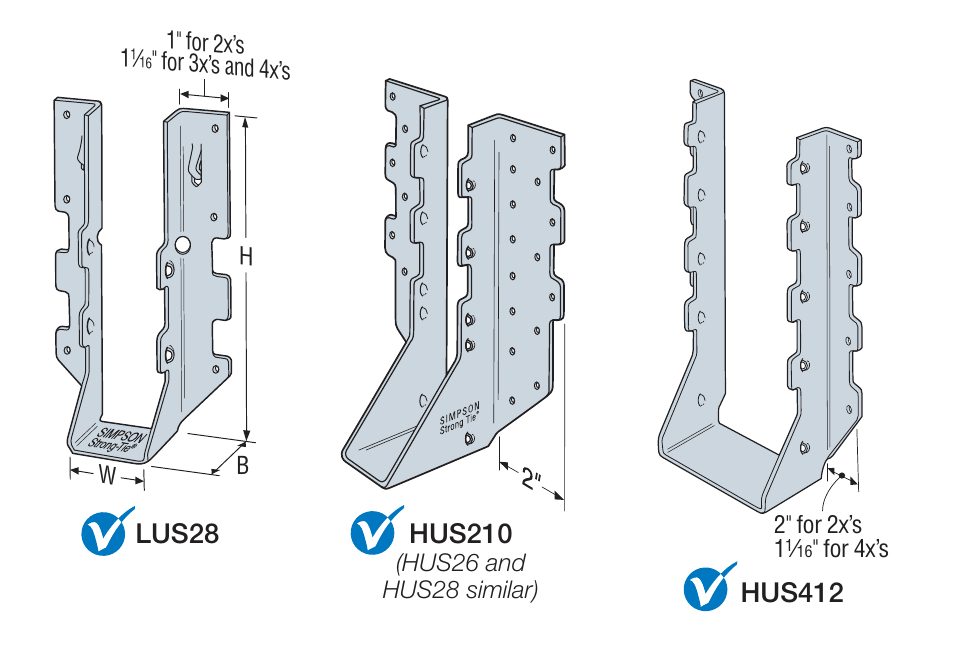
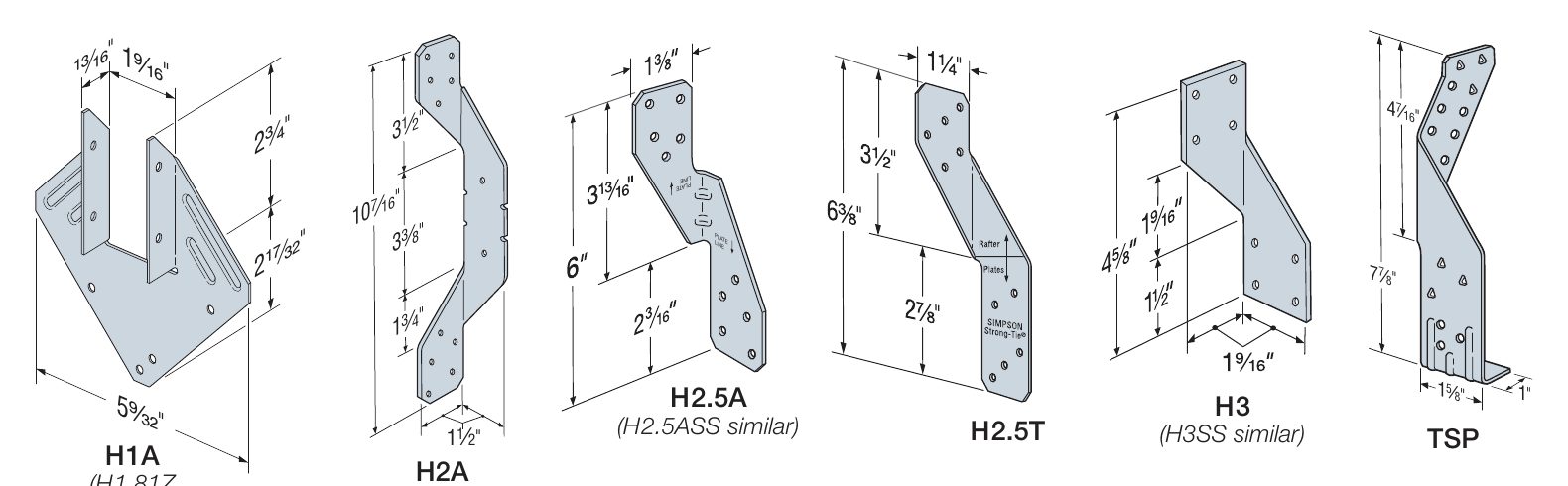
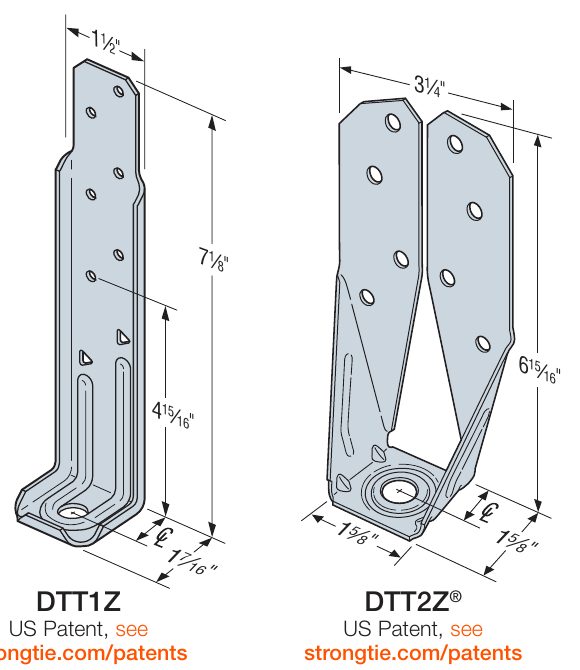
The model number is stamped in the steel. Find its row in the catalog, or ask us to, and read the fastener column before you read the load column. Count the holes. Then look at the box of nails on the truck and read the diameter and length off it.
A lock has a grade. It is on the box.
Locksets and deadbolts are graded under an ANSI/BHMA standard the same way a hanger has a load table, and the grade is the thing to buy. Allegion, which makes Schlage, publishes what the grades mean in cycles: a Grade 1 bored lock has to operate 1,000,000 times, a Grade 2 lock 400,000, a Grade 3 lock 200,000, with strength, impact, and bolt tests on top of the cycling. Schlage's own words for the tiers: Grade 1 is commercial quality for heavy use in commercial and public buildings, Grade 2 is the best residential quality, and Grade 3 is the minimum acceptable for a residential door.
Residential hardware carries a second mark, a BHMA letter grade in three categories. Schlage explains them plainly. Security is the sledgehammer, the pull, and the weight of a child hanging on the lever. Durability is whether it still works smoothly when the door swells and shrinks with the seasons and after a lifetime of use. Finish is salt, humidity, sun, and scratches. A is best, C is good, and AAA is the top grade in all three. Schlage says all of its mechanical deadbolts, knobs, levers, and handlesets, plus its Connect, Sense, and Touch locks, are certified AAA. Kwikset says its 980 deadbolt is Grade 1 BHMA certified in Security, Durability, and Finish, built for the highest level of security and frequent use, and it carries Kwikset's SmartKey, which lets you re-key the lock yourself. Kwikset backs its hardware with a lifetime mechanical and finish warranty.
What that means at the counter: a builder-line lever and a top-line lever can look alike on the display. The grade on the box is the difference, and it is printed there so you do not have to guess.
Look for the ANSI/BHMA grade number and the three-letter residential grade. A deadbolt for an exterior door should show Grade 1 or AAA. Ask which grade the lever on the quote carries, not which brand.
This is the checklist.
| Feature | What a fastener that holds has | What to ask |
|---|---|---|
| Coating | Hot-dip galvanized to A153 or a coating with a code report that says it is equal; stainless where the wood stays wet or the air is salt; matched to the connector's tier | Which tier is this job in? Does the box say A153, stainless, or a report number? |
| Treated lumber | Fastener chosen for the chemical and retention on the end tag; bright and electroplated kept indoors and dry | What does the end tag say? Is anything bright going into it? |
| Nail | Diameter and length that match the table; full round head; shank matched to the load | What is the diameter and length on the box, not the penny size? |
| Structural screw | Heat-treated, self-drilling, with a report number, a knurl, and a head that fits the job | Which report? What thread length does it need in the holding member? |
| Connector | Every hole filled with the fastener in its row; no mixed nails and screws; no overdriven heads past flush | Show me the row. Which nail, how many, and is that what is on the truck? |
| Bolt | A through-bolt where the table says bolt; hole 1/32 to 1/16 over | Is that a bolt or a lag on the plan? |
| Lock | ANSI/BHMA grade on the box; AAA or Grade 1 on the exterior door | What grade is on this box? |
None of this is expensive. A box of the right nail costs about what a box of the wrong one does, and the connector is the same connector either way. What you are paying for is the row in the table, and it is worth the minute it takes to read. Lesson 2 reads the box the same way.
Before You Price Fasteners
Know what is holding it together.
Three short reads on fasteners and connectors. Written for the builder who has to answer to the money, and for the inspector.
Frequently Asked
Fastener construction, answered.
What does hot-dip galvanized mean on a box of nails?
Can I use bright nails in treated lumber?
What nails go in a joist hanger?
What is a ring shank nail and when does it matter?
What is a Grade 1 lock?
What is ZMAX?
Come See It
Put your hands on it first.
Specs only tell you so much. Come walk the yard and the showroom.
119 Cumberland St, Ashland City. The coffee’s on.