
Read the box.
Then read the table.
A box of fasteners carries a coating name, a diameter and length, sometimes a report number, and a line about treated lumber. A connector carries a model number that points to a row in a catalog. A lock carries a grade. None of it is hard. All of it is printed small. Here is how to read each one, with the Simpson catalog and the code reports as the examples.
Three steps, one table, and a line on the box.
Simpson lays out fastener corrosion as a three-step choice, and it is the clearest version in print. Step one is the environment. Dry service is interior work in a building designed to keep out condensation, and Simpson warns that a long wet spell during construction can push a job out of it. Wet service is ordinary exterior work, what the AWPA calls UC3 above ground and UC4A in general ground contact. Elevated service is fumes, fertilizer, soil, the heavier ground-contact treatments, and salt air. Uncertain is when you do not know. Ocean or waterfront is salt and de-icing salt.
Step two is the table. Environment down the side, the material being fastened across the top: untreated wood, borate-treated wood, preservative-treated wood at or below the UC4A retention and above it, ACZA, unknown treatment, and fire-retardant wood. Each cell reads low, medium, high, or severe. Untreated wood in dry service is low. Treated wood at UC4A retention in wet service is medium. The same wood above UC4A is high. Anything on the waterfront is severe. A deck frame in Middle Tennessee in the treated lumber on our yard lands in the medium column, which is the hot-dip column.
Step three is matching the tier to a coating, and the catalog defines each one by a standard and a number, so the box can be checked against it. Low: bright, electroplated zinc to ASTM F1941, phosphate, G90 connectors. Medium: hot-dip galvanized fasteners to ASTM A153 Class D at 1.0 ounce of zinc per square foot, mechanically galvanized to ASTM B695 Class 55, ZMAX G185 and post-hot-dip connectors, and the proprietary coatings whose reports say they are equal to A153 Class D in non-marine exposures. High: Type 304 and 305 stainless. Severe: Type 316 stainless and A153 Class C hot-dip. The catalog adds one line most people miss: mechanical galvanizing under the C3 and N2000 names should not go anywhere more corrosive than UC3A, exterior above ground with rapid runoff.
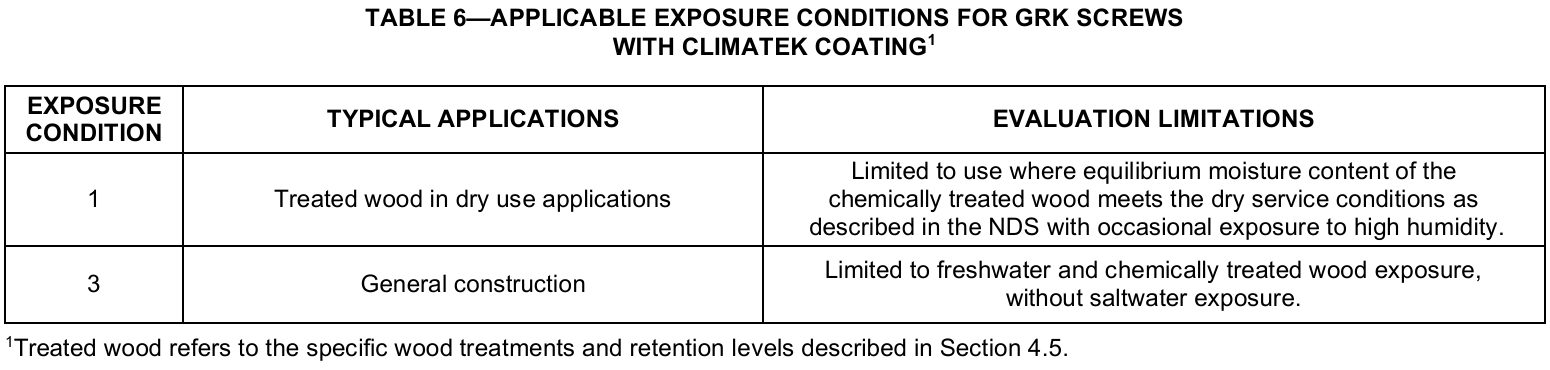
The treated-lumber line on the box comes from the code report, not the marketing. ESR-2236 says Simpson's Double Barrier coating was evaluated in ACQ-D treated wood and is an alternate to A153 Class D hot-dip. ESR-2442 says GRK's Climatek, a multi-layer coating of zinc and polymer in gold, silver, or black, was evaluated in copper azole CA-C wood up to 0.15 pounds per cubic foot. ESR-3933 says Grip-Rite's zinc plus black top coat was evaluated in ACQ-D. ESR-1078 says FastenMaster's LOK coatings were evaluated in ACQ-D up to 0.40 pounds per cubic foot, and in the same breath says the mechanically galvanized ThruLOK is outside the report for treated wood at all. Each report caps the coating at Exposure Conditions 1 and 3: dry use, and general construction with no saltwater. That is the sentence the box is summarizing when it says approved for treated lumber.
Which column is this job in. Which coating standard is on the box: A153, B695, a stainless type, or a report number. Which chemical and retention was that report evaluated in, and does it match the end tag on the lumber. If the answer is a pool deck or a salt road, the answer is stainless.
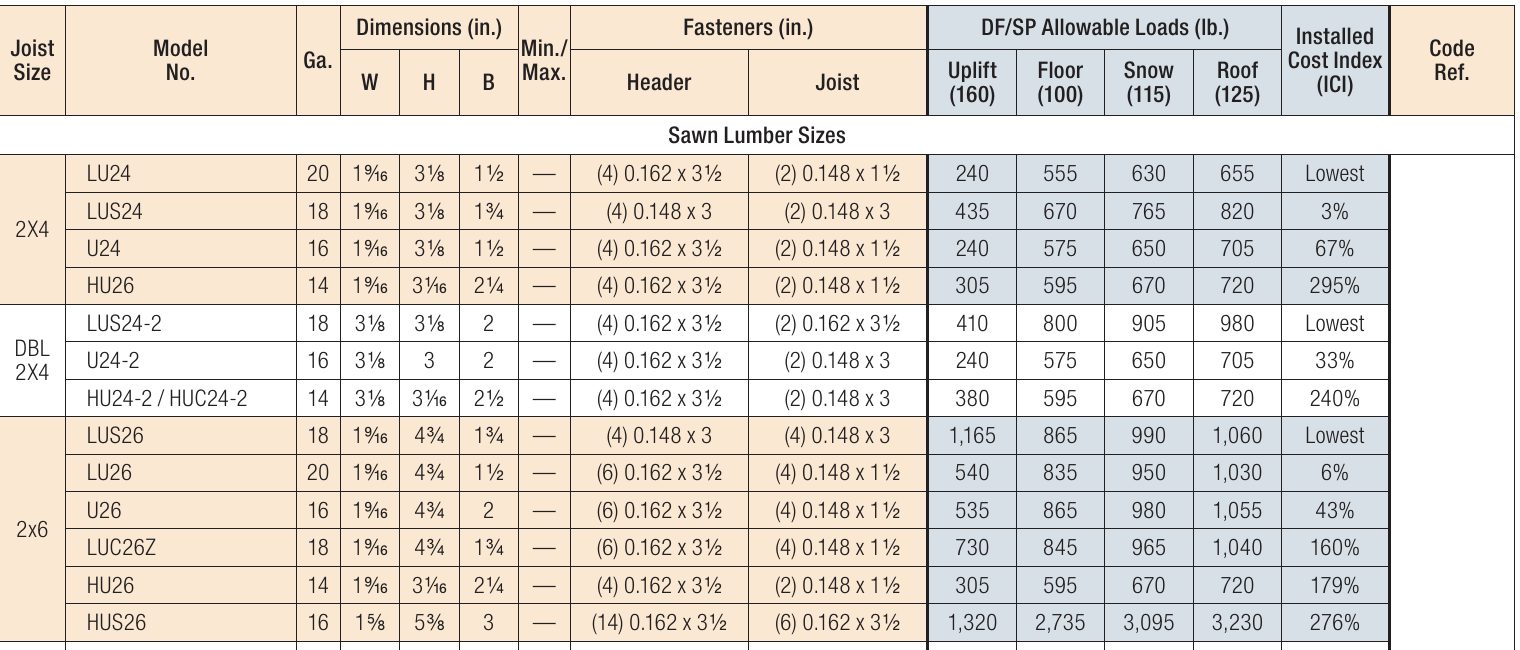
Nine columns. The inspector reads three of them.
Every connector in the Simpson catalog is a row, and the rows all read the same way. Model is the number stamped in the steel; a Z at the end means ZMAX, SS means stainless. Gauge is the steel thickness, and the catalog's conversion chart says 18 gauge is about 0.048 inch, 16 is 0.060, 14 is 0.075, 12 is 0.105. Dimensions are width, height, and the seat. Then the three columns that matter on the job.
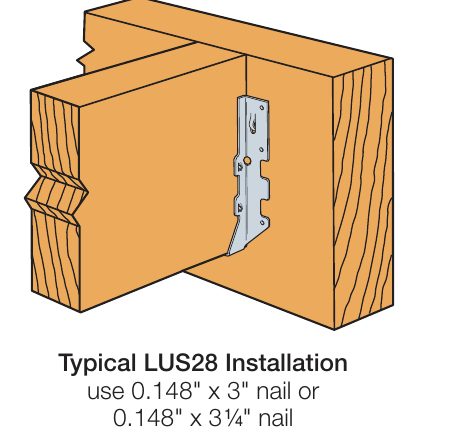
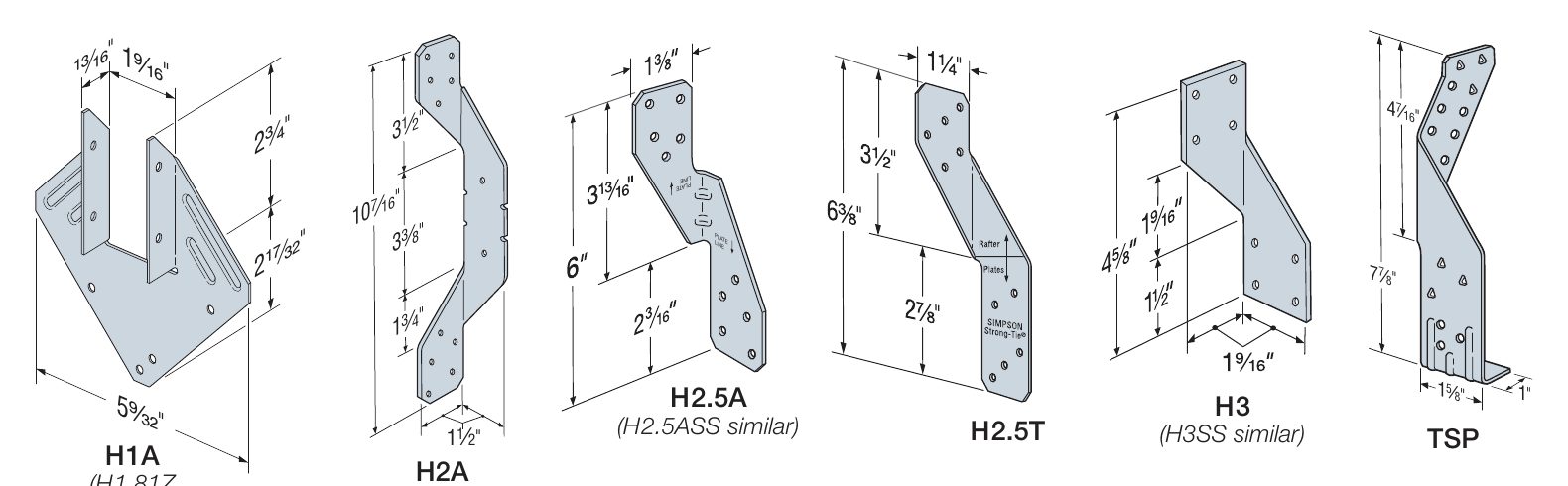
Fasteners. Header first, then joist, each as a count in parentheses and a diameter by length. LUS26: four 0.148 by 3 and four 0.148 by 3. LU26: six 0.162 by 3-1/2 and four 0.148 by 1-1/2. H2.5A: five 0.131 by 2-1/2 into the rafter, five into the plate. ABU44Z: twelve 0.162 by 3-1/2 or two 1/2-inch bolts, on a 5/8-inch anchor. When a row says SD screws it means Simpson's SD Connector screw and no other. The catalog notes that some hangers accept a shorter or thinner fastener with a published reduction factor, and it prints that table on page 26 so nobody has to guess.
Allowable loads. Four columns with a number in parentheses under each heading: uplift at 160, floor at 100, snow at 115, roof at 125. The parenthetical is the load duration factor the building code allows, which is why one hanger has four different capacities. Uplift is wind and earthquake. Floor is the long-term load. The loads are for Douglas fir-larch and southern pine; the general notes give the specific gravity for each species and say other species must be adjusted per code, and some tables print a second block for spruce-pine-fir and hem-fir, which is where the H2.5A goes from 700 to 615 pounds. Loads are for a joist that bears fully on the seat with no more than a 1/8-inch gap to the header.
Code reference. The catalog's key says IBC means the connector has an ICC-ES or IAPMO UES report under the International Building Code and Residential Code, FL means Florida statewide product approval, LA means a City of Los Angeles supplement, and a dash means no report at all. That column is what the plans examiner is looking at when the framing inspection is signed.
Two more columns are for the buyer. Installed cost index compares each hanger on the page to the lowest-cost choice for that joist size; the LUS26 is marked lowest in its group and the HUS26 is listed at 276 percent of it, for 2,735 pounds of floor load instead of 865. The right answer is the row that meets the load, not the biggest number. And the footnotes under every table carry the conditions, which is where the catalog says things like uplift loads already include the wind increase and may not be increased again.
| Read for | Where it is | What a strong answer looks like |
|---|---|---|
| Coating standard | The box, usually the front | A153 hot-dip, B695 Class 55, a stainless type, or a report number with the coating named in it |
| Treated-wood evaluation | The report, corrosion section and Table 6 | The chemical and retention on your end tag, in Exposure Condition 1 or 3 |
| Report number | The box and the head or label | ESR-2236, ESR-2442, ESR-3933, ESR-1078, or the number for the screw on the quote |
| Fastener size | The box: diameter by length | Matches the connector row, including which member gets which nail |
| Connector loads | The catalog row, with duration factor | Meets the load on the plan at the right duration and species |
| Substitution | Catalog page 26 or the product page | A published factor, applied on purpose, or the right nail on the truck |
| Code reference | Last column of the row | IBC, and FL or LA if the jurisdiction wants them |
| Lock grade | The lock box | ANSI/BHMA grade number and the three-letter residential grade |
Which row is this connector. Which nail goes in the header and which in the joist. Is the load on the plan floor, roof, or uplift, and does the row meet it for the species on the truck. Is the code reference there. If the crew has a different nail, what is the factor.
What the label has to say, by the makers' own reports.
The code reports are specific about labels, which makes them easy to check. ESR-2236 says a box of SDS screws is labeled with product name, Simpson's name and address, fastener size and point type, coating type, and the report number. ESR-2442 says GRK stamps RSS or JTS on the head of every screw with the diameter and length in millimeters, and that the package label carries the finish, stainless or Climatek. ESR-3933 says Grip-Rite's structural screw packaging shows length and head style, a lot number, and the report number. ESR-1078 says FastenMaster packaging carries the size and the report number and that the head markings identify the screw. Grip-Rite's PrimeGuard Plus exterior screws are a different kind of box: no structural report is claimed, the coating is described as meeting ASTM B117, and the maker states a 10-year warranty when the screw is installed correctly.
Warranties on fasteners and connectors read shorter than on siding, and it is worth knowing why. Simpson's catalog says it provides no warranty for products that are modified, improperly installed, or used outside its published information, and the same page says the catalog's loads and instructions are the specification. There is no proration table because the promise is the row in the table, and the row holds only when the fastener, the count, and the placement match. The fastener box is the warranty document.
A lock box carries two marks. The ANSI/BHMA grade number is the commercial-style test, and Allegion publishes the cycles for a bored lock: 1,000,000 for Grade 1, 400,000 for Grade 2, 200,000 for Grade 3. The BHMA residential grade is three letters, one each for security, durability, and finish, A through C, and AAA is the top. Schlage says its mechanical deadbolts, knobs, levers, and handlesets are all AAA. Kwikset says its 980 deadbolt is Grade 1 in all three categories and backs it with a lifetime mechanical and finish warranty. Look for the mark on the box, and if it is not there, ask.
A coating with a standard number behind it is a spec. A report number is a spec. A grade is a spec. "Exterior grade," "heavy duty," and "contractor grade" on a label are words. Ask for the number.
Before You Price Fasteners
Know what is holding it together.
Three short reads on fasteners and connectors. Written for the builder who has to answer to the money, and for the inspector.
Frequently Asked
Fastener labels and tables, answered.
What is the ESR number on a box of structural screws?
What do Exposure Condition 1 and 3 mean on a fastener report?
What does the fastener column in a joist hanger table mean?
What do uplift, floor, snow, and roof mean on a connector table?
What should I ask the treated lumber supplier about fasteners?
What does AAA mean on a door lock?
Come See It
Put your hands on it first.
Specs only tell you so much. Come walk the yard and the showroom.
119 Cumberland St, Ashland City. The coffee’s on.