
The second kitchen
is the expensive one.
Cabinets are priced by the box and paid for by the year. The quote shows what the first kitchen costs. This page is about what a kitchen costs per year it keeps working and keeps looking like a kitchen someone would buy, and it is written for the person funding the build as much as the person building it.
Four costs that never make the spreadsheet.
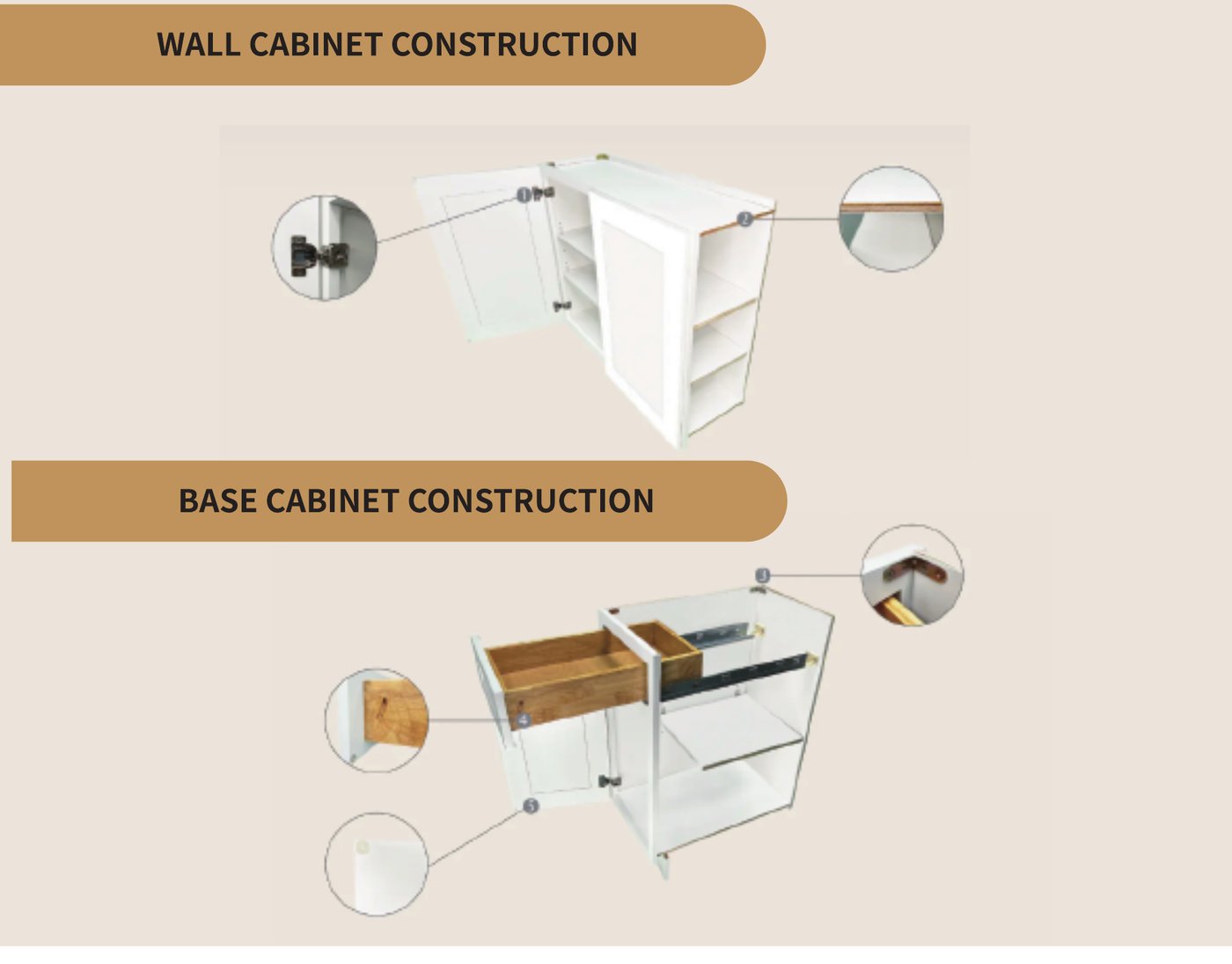
The shelf and the drawer. A kitchen does not fail all at once. It fails one shelf at a time, bowing under the plates, and one drawer at a time, when a stapled bottom lets go or a slide starts to grind. The KCMA standard loads shelves for a week and runs drawers 25,000 cycles for exactly this reason, and the lines that skip the seal skip the test. Each one of those is a Saturday, a trip for a part, or a call to a handyman. None of it is on the quote.
The door. A wrapped door is a film over a pressed core, and the edge is where the film ends. Steam from the dishwasher and the wet rag over the sink work at that edge for years. The makers know it; that is why a wrapped door carries a five-year term where the wood door next to it carries lifetime. A painted wood door shows a hairline at the joints when the house dries out in winter, and every warranty on this spine says that line is the nature of the material. A door that has to be replaced does not match the doors around it, and the makers say that too. So the door repair is either a mismatch you live with or a run of doors, not one.
The hardware. A hinge with no soft-close gets slammed a few thousand times a year. A hinge with no adjustment goes crooked when the house settles and stays crooked. A side-mount slide with a bent track is a drawer nobody uses. Blum tests its hinges through 200,000 cycles and counts more than 80 openings a day in a kitchen; on that arithmetic a hinge on the cabinet by the sink sees 25,000 cycles, the KCMA test number, in about a year. Hardware is a small line on the quote and the biggest line in the callbacks.
The second kitchen. When enough of the above has happened, or when the house goes on the market and a buyer stands in the room, the kitchen gets torn out. That job starts by paying to remove the first one, it happens while the house is occupied or under contract, and it is priced in a later year's dollars. For a builder it is the callback with your name on it. For an owner it is the credit on the closing statement. It is the one cost that turns a cheaper quote into the more expensive kitchen, and it is the one the calculator below is built around.
The question is not which cabinet line is cheaper. It is what each kitchen costs per year it does its job.
Bring two quotes. We do not put prices on the site.
Get a quote for the kitchen you are being told to buy and one for the kitchen you would rather live with, both for the same room and the same box count. Enter the number of cabinets (or the linear feet, whichever the quotes are written in), both quotes, and how long you expect to own the house. Then enter, for each, the service life you believe, how many door or hardware failures you expect over the hold, what one of those costs to fix with a part and a trip, and what a tear-out costs when the day comes. The questions below give the terms the makers publish; the lives and the failure counts are yours.
The calculator charges the repairs across the hold, counts a full replacement and a tear-out whenever a kitchen's life runs out inside your hold, and credits the unused life of whichever kitchen is still good when you sell. The result is what each choice costs over the hold, per cabinet, and per year of service.
It does not know which lines you are comparing. It only knows arithmetic.
Terms to start from, not to stop at.
Warranty terms. Marsh: limited lifetime for the first owner while they own the home, five years on Captiv8, no labor. U.S. Cabinet Depot: limited lifetime for the first owner, hinges and glides included. Fabuwood: limited lifetime on Allure, Illume, Value Premium, and Quest, five years on the rest of Value, Blum hardware warranted by Blum. L&C: a "Limited 3 Years" heading and an as-long-as-you-own-it body; Midway will confirm which applies. None transfer.
Test numbers. KCMA A161.1: shelves at 15 pounds a square foot for seven days, drawers and doors 25,000 cycles, 65 pounds on an open door. Blum: hinges 200,000 cycles, Tandem runners 100 pounds a drawer. U.S. Cabinet Depot: framed drawers 70 pounds, altamax metal drawers 88 and 132 pounds, roll-out trays 35.
Service life. No maker Midway sells publishes one in years. Use the number you would defend to a buyer walking through the room.
Cost Over Time
Two kitchens, one house, your numbers.
Nothing you type here is sent anywhere. It runs in your browser.
Before You Price Cabinets
Know what you are buying.
Three short reads on cabinets. Written for the builder who has to answer to the money, and for the homeowner who has to live with the kitchen.
Frequently Asked
Cabinet cost over time, answered.
How long do kitchen cabinets last?
What fails first on a cheap cabinet?
Does a cabinet warranty pay to fix any of this?
Do cabinets matter at resale?
Visit the Showroom
See it set up, in person.
Browse the displays and talk it through with our team, face to face.
119 Cumberland St, Ashland City. Y’all come by.