
Read the spec sheet.
Then read the warranty.
A cabinet line comes with a certificate, a construction sheet, and a warranty. All three are short. All three are written to be skimmed. Here is how to read them slowly, with the lines Midway sells as the examples.
The KCMA seal is a list of tests. Here they are.
The Kitchen Cabinet Manufacturers Association has certified cabinets since 1965. The standard is ANSI/KCMA A161.1, the current edition is 2022, and the certificate a maker gets names the door styles that passed and says in plain words that flat-pack cabinets are not covered. The tests run in an independent lab on samples pulled during an unannounced visit to the plant. There are more than a dozen, in five groups, and they are worth knowing because they are the failures you are trying to buy your way out of.
Structure. Every shelf and bottom is loaded at 15 pounds a square foot and left for seven days; no sag past the limit, no joint opening. A mounted wall cabinet is loaded to 600 pounds. The front joints of a base take 250 pounds pushed against the stiles from inside. A 3-pound steel ball is dropped 6 inches onto the shelves, bottoms, and drawer bottoms, the way a can gets dropped.
Drawers. Loaded at 15 pounds a square foot and run through 25,000 cycles; afterward the drawer has to work and the bottom cannot have sagged into the slide. Then a 3-pound weight is dropped 8 inches against the drawer front ten times, which is a drawer being slammed.
Doors. Swung 90 degrees, 25,000 times, with the hinges then checked for looseness. Then 65 pounds is hung on the open door, it is worked ten times, and it hangs there ten minutes. That is a child on the door.
Finish. A door goes in a box at 120 degrees and 70 percent humidity for 24 hours. Another goes through the hot box for an hour and then a cold box at 5 below zero. Then the exposed surfaces sit for 24 hours under vinegar, lemon, orange and grape juice, ketchup, coffee, olive oil, and 100-proof alcohol. Mustard gets an hour. A door edge soaks in detergent for up to a day. Nothing may discolor that will not polish off.
Of the lines Midway sells, Marsh, Kith, and Premium Choice are in the KCMA directory of certified companies. Marsh publishes its certificate: number 25099R, issued August 2025, listing 22 door styles by name. Fabuwood, U.S. Cabinet Depot, and L&C are not in the directory at this writing; their construction is on their own sheets, which the next section reads, and Midway keeps every one of them open on the floor. There is also a KCMA Severe Use standard, written first for HUD housing that turns over often; if you are building rentals, ask about it.
Is this line certified, and is the door style I picked on the certificate. If it is not certified, which of these tests does the maker publish. Is the cabinet shipping assembled, since the seal does not cover flat pack.
| KCMA A161.1 test | What the lab does | The kitchen failure it stands for |
|---|---|---|
| Shelf load | 15 pounds per square foot on every shelf and bottom, seven days | The sagging shelf |
| Wall cabinet load | Mounted cabinet loaded to 600 pounds | The upper that pulls off the wall |
| Front joint | 250 pounds against the stiles from inside (200 without a drawer rail) | The face frame that opens at the corner |
| Drop | 3-pound steel ball from 6 inches onto shelves and drawer bottoms | The dropped can |
| Drawer cycles | 25,000 cycles at 15 pounds per square foot | The drawer that binds or drops its bottom |
| Drawer front | 3-pound weight dropped 8 inches, ten times | The slammed drawer |
| Door cycles | 25,000 swings through 90 degrees | The door that goes loose at the hinge |
| Door load | 65 pounds on the open door, ten cycles, ten minutes | The child on the door |
| Heat and cold | 24 hours at 120 degrees and 70 percent humidity; hot box then 5 below zero | The door over the range, the unheated house |
| Spill and stain | Vinegar, juices, ketchup, coffee, olive oil, 100-proof alcohol for a day; mustard for an hour; detergent on the edge | The finish that clouds or lifts |
A seal with a certificate number and a door-style list behind it is a spec. "Built to last" on a brochure is a claim. Ask for the certificate.
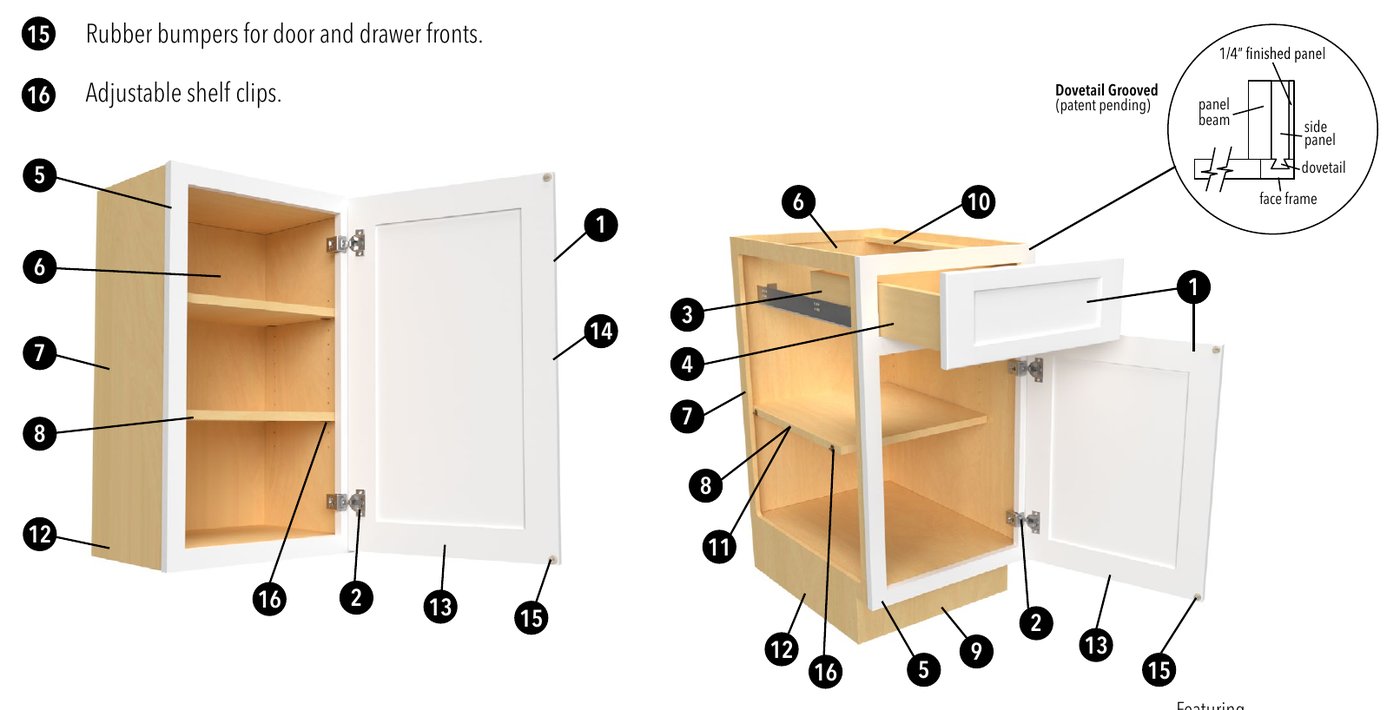
Every line Midway sells, line by line.
A construction sheet is one page, and the same eight lines appear on every one. Below is what each maker prints for the lines Midway carries, in the maker's own words where it matters. Where a maker does not publish a line, the cell says so; Midway will not fill it in for them, and neither should a salesman.
Read the sheet top to bottom in this order: box panels, back, face frame or edge banding, shelf, door frame and panel by finish, drawer box and bottom, hinge and slide with the brand and rating, and the interior finish. Then read the exposed-end line, because a frameless box in a melamine skin needs a panel on any side you can see, and the sheet will say so. Lesson 1 explains why each line matters; this one is the reference.
| Line | Fabuwood Allure | U.S. Cabinet Depot Capital | L&C framed | Frameless lines |
|---|---|---|---|---|
| Box | 1/2-inch veneered plywood sides, top, and bottom; sides dovetailed into the face frame; 2-1/2 by 1/2 inch plywood panel beams dovetailed into the sides | 1/2-inch plywood box, UV-coated to match the exterior; solid birch and furniture-grade plywood | 1/2-inch plywood panels with a wood veneer (wall cabinets); all-metal brackets | U.S. Cabinet Depot altaeuro: 18-millimeter plywood composite, melamine in and out, dowel and screw. L&C E-Series: 3/4-inch plywood, white melamine. Premium Choice Eurolux: 3/4-inch plywood, taupe finish |
| Back | 1/2-inch veneered plywood, stapled and screwed | 1/2-inch plywood, full height | Not published | altaeuro: top and back support rails. Others not published |
| Face frame | 3/4 by 1-1/2 inch solid wood, glue and dowel | 3/4 by 1-3/4 inch hardwood; a 30-inch base has a 26-1/2 inch opening | Not published | None; 1-millimeter edge banding (altaeuro), front edge banding (L&C) |
| Shelf | 18-millimeter veneered plywood, wood veneer edge, metal clips | 3/4-inch plywood, front edge banded | Not published on framed; metal shelf pins on frameless | altaeuro: full-depth 18-millimeter, fully edge banded. L&C: 3/4-inch plywood |
| Door | Solid wood stiles and rails, mortise and tenon, MDF center panel; painted styles HDF frame with moisture-resistant MDF panel; 3/4 by 2-1/2 inch stiles on Galaxy | Stained: 3/4-inch solid birch, solid or veneered MDF panel by style. Painted: all HDF, five-piece | Five-piece shaker; M-Series door is HDF | altaeuro Torino: melamine over engineered wood; Verona: five-piece painted HDF. Eurolux: 3/4-inch MDF or particleboard core, laminate |
| Drawer | 5/8-inch solid wood dovetail, 3/8-inch plywood bottom, 3 inches inside | 5/8-inch solid hardwood dovetail, captured 3/8-inch plywood floor, 70 pounds | 1/2-inch hardwood dovetail | altaeuro altamax: 1/2-inch metal sides, 5/8-inch melamine floor, 88 or 132 pounds. L&C: 3/4-inch plywood box |
| Hinge and slide | Blum Compact Clip with Blumotion, six-way, 110 degrees (31C3355B.20); Blum Tandem plus Blumotion full extension (563H); no soft-close on Lazy Susan, Easy Reach, Pie Cut | Six-way European hinge with soft-close; undermount full-extension soft-close glides; roll-out trays side-mount, no soft-close, 35 pounds | Six-way 110-degree soft-close hinge; undermount full-extension self-close glide | altaeuro: Hettich Sensys 110-degree soft-close, altamax full-extension soft-close. L&C: DTC soft-close hinges and undermount glides |
| Interior and ends | Natural finished plywood; 1/4-inch finished MDF applied to the ends you flag | UV-coated natural plywood; finished exterior, no end panel needed | Not published | altaeuro: grey linen melamine, end panel required on exposed sides |
Marsh and Kith do not publish a box construction sheet on their public sites; Marsh's KCMA certificate and warranty and Kith's door species (maple, oak, HDF) are what is in print. Both are made to order and both are on the floor. Open the display and ask the designer for the dealer spec book for your door style.
"Limited lifetime" has four lines that matter.
A cabinet warranty is one or two pages, and it is built the same way at every maker. The headline is the term. Under it are four lines that decide whether it pays: who is covered, what is paid, what is excluded, and whether it moves with the house. Here are the lines Midway sells, from their own documents.
Who. The first owner, for as long as they own the house. Marsh: "the original consumer purchaser ... for as long as they own the home in which Marsh products are originally installed." U.S. Cabinet Depot: "the original consumer purchaser ... for the lifetime of the product," proof of purchase required. Fabuwood: the "First Residential Purchaser," and for a builder, the first owner of the house. L&C: the original purchaser, as long as you own the dwelling. Not one of the four transfers to the next owner. Marsh says it "may not be transferred or assigned," U.S. Cabinet Depot and Fabuwood say "not transferable." A lifetime warranty is the life of your ownership, not the cabinet's.
What is paid. The part. Marsh: repair or replace at its election, and "does not cover any labor involved in the repair or installation of replacement parts," nor removal, nor transit damage. Fabuwood: "will not provide or pay for the cost of removal of defective product, transportation of defective, repaired or replaced product," and may refund the original price of the part instead. U.S. Cabinet Depot: repair or replace, and replacement parts "may differ from original." All three warn that a replacement door will not match the finish next to it, because the wood next to it has aged. None of them pay the installer.
What is excluded. The environment and the cleaning. Fabuwood does not cover cabinets "installed in locations that do not maintain year-round environmental controls," or hinges, slides, or cabinetwork that were modified, and it does not cover the Blum hardware at all; Blum warrants that itself, to the original homeowner, and its name has to be on the part. Marsh excludes abrasives and harsh cleaners, extreme temperature and moisture, prolonged tobacco smoke on the finish, improper installation, and cabinets bought before April 2018. L&C excludes outdoor use, improper storage before installation, and improper installation. Every one excludes the natural change of wood color in sunlight, and Fabuwood adds that finish stress lines at the joints of a painted door are the nature of the material, not a defect.
The term that is not lifetime. This is the line to find. Fabuwood's limited lifetime covers Allure, Illume, Value Premium, and Quest; its other Value series carries a limited five-year warranty. Marsh warrants wood-door cabinets for the owner's lifetime and its Captiv8 wrapped-MDF doors for five years. L&C's 2026 catalog heads the page "Limited 3 Years Warranty" and then, in the body, says the period runs as long as you own the dwelling; Midway will ask L&C which applies to your order and put the answer on the quote. When a maker sells two tiers and warrants one for five years, it is telling you where it expects the wear. That is useful information, and Lesson 3 uses it.
| Read for | Marsh | Fabuwood | U.S. Cabinet Depot | L&C |
|---|---|---|---|---|
| Term | Limited lifetime; Captiv8 five years | Limited lifetime on Allure, Illume, Value Premium, Quest; five years on other Value | Limited lifetime, including hinges and glides | "Limited 3 Years" heading; body says as long as you own the dwelling |
| Who | Original purchaser, household use, while they own the home | First residential purchaser; builder passes to first owner | Original consumer purchaser, residential | Original purchaser |
| Labor | Not covered; no removal or reinstall | No removal or transport | Repair or replace the part | Not stated |
| Transfer | May not be transferred | Not transferable | Not transferable | Original purchaser only |
| Hardware | Covered as Marsh product | Blum hardware excluded; Blum warrants it to the original homeowner | Hinges and glides covered | Not stated |
| Environment | Extreme temperature or moisture excluded | Year-round environmental control required | Lack of maintenance excluded | Outdoor use and improper storage excluded |
| Wood and finish change | Natural aging and sunlight excluded; abrasives excluded | Painted joint lines and glaze variation are not defects | Color change is not a defect; replacement may not match | Normal wear excluded |
| Notice | Claim during the term; show you owned the home at purchase | Via the original dealer, with the invoice | Through the supplier, with the invoice | Contact L&C |
Which term is my door style on. Who pays the labor if a door comes back. Does the hardware have its own warranty, and whose. Is the house conditioned year round, since one of these warranties requires it. Keep the invoice; every one of them asks for it.
What "semi-custom" means is mostly a date.
The word describes how the cabinet gets made, and what it really tells you is when it arrives. A stock line is built ahead, in fixed sizes and a set finish list, and pulled from a warehouse. U.S. Cabinet Depot ships from regional stock and sells both assembled and flat-pack kits; L&C stocks in La Vergne, Tennessee, about 30 minutes from Midway; Fabuwood is built for quick-ship and is often about a week out. Premium Choice is a ready-to-assemble line stocked in nine finishes. A semi-custom line is built after you order it, in the door, species, and finish you picked, with some sizes and modifications available. Marsh builds in High Point, North Carolina, and Kith in Haleyville, Alabama; Midway figures four to eight weeks depending on the door style, the finish, and the season, and confirms the current number at quote. Custom is anything, and the longest wait.
Two things on the sheet change with that word. The certificate: the KCMA-certified lines Midway sells are the made-to-order ones and Premium Choice, and the seal does not cover flat pack. And the finish list: a semi-custom line offers dozens of stains, paints, and glazes because it sprays your door after you pick; a stock line offers what is on the shelf. Fabuwood's lifetime warranty on its quick-ship Allure line shows the two are not always a trade. Ask for the ship date and the certificate together, and pick the line the house is asking for.
Is this line stock or built to order, and what is the ship date on today's quote. Is it shipping assembled. Which door styles and finishes are on the line as printed, and which are a modification. What happens to the date if I change the door.
Now put a number on it.
The certificate tells you which failures the line was tested against. The warranty tells you which ones the maker will pay for, and for whom. Lesson 3 is about the ones you pay for: the sagging shelf, a door peeling at its edge, slides that quit, and the kitchen a buyer asks you to replace before closing. It has a calculator that takes your own two quotes.
Before You Price Cabinets
Know what you are buying.
Three short reads on cabinets. Written for the builder who has to answer to the money, and for the homeowner who has to live with the kitchen.
Frequently Asked
Cabinet certification and warranties, answered.
What does KCMA certified mean on a cabinet?
What does a limited lifetime cabinet warranty actually cover?
Why do some cabinet lines carry a five-year warranty instead of lifetime?
What voids a cabinet warranty?
What does semi-custom mean on a cabinet order?
What is CARB2 on a cabinet spec sheet?
Visit the Showroom
See it set up, in person.
Browse the displays and talk it through with our team, face to face.
119 Cumberland St, Ashland City. Y’all come by.