
What you are paying for
in cabinets.
Two kitchens can look the same the day the doors go on and be fifteen years apart in when one gets torn out. The difference is inside the box, at the corner of the drawer, under the paint, and in the hinge. Then there is the design work that puts the right thirty boxes on the wall. Every one of these you can check on a display in our studio.
The part you never see is the part that holds the countertop.
A cabinet is a box with a face on it. The face is what you pick. The box is what you live with. It carries the countertop, the drawers, and thirty years of cans, and it sits in the wettest room in the house. Three things on the spec sheet tell you how it will hold up.
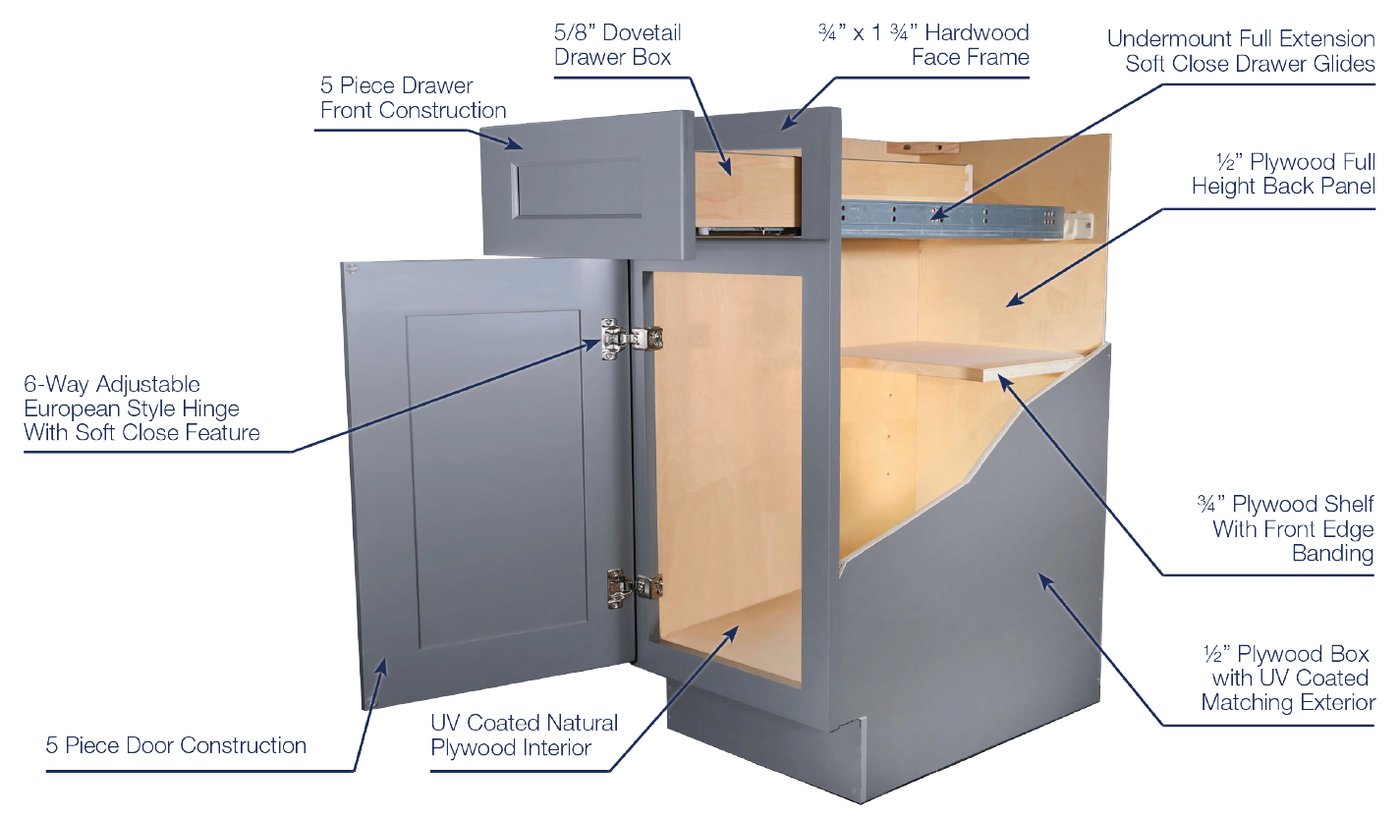
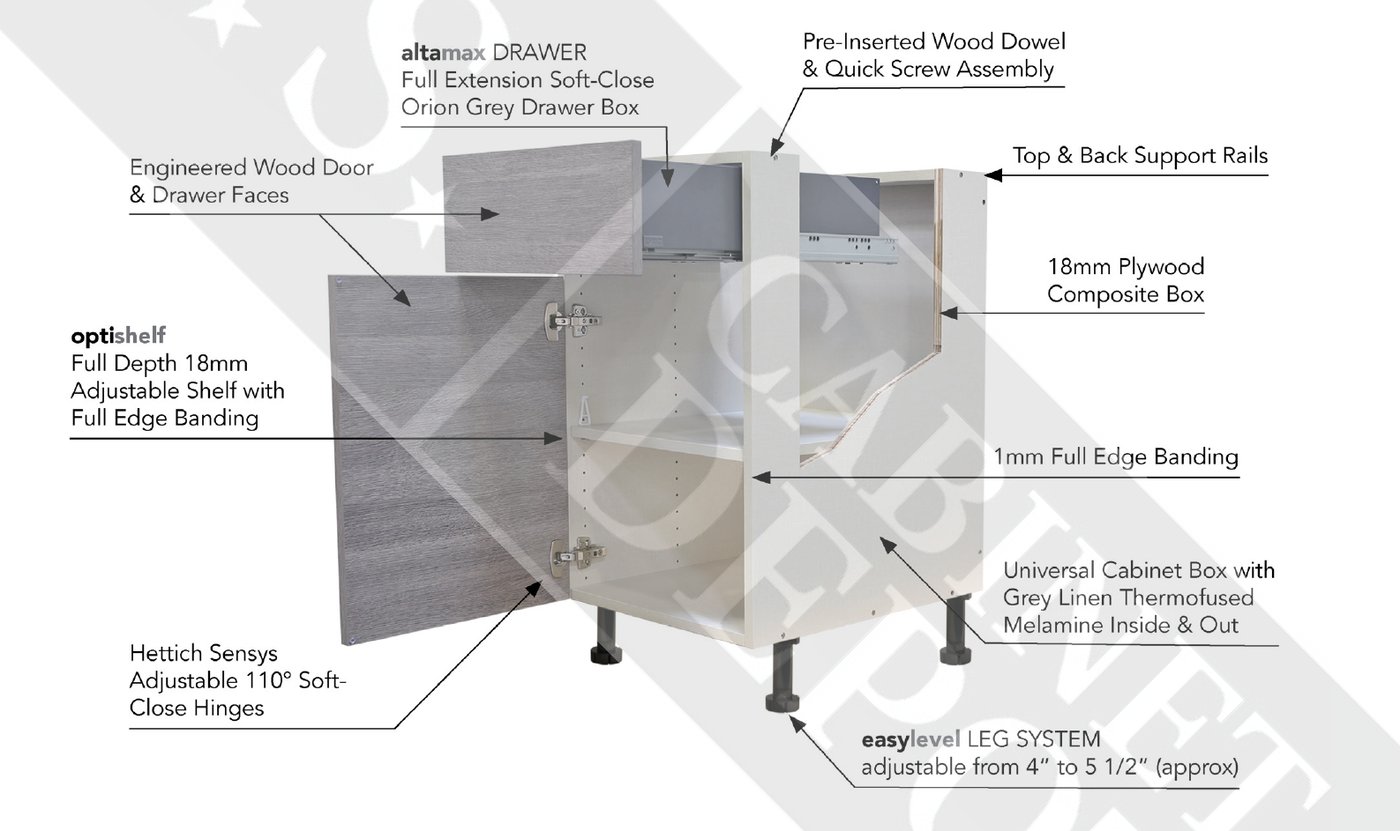
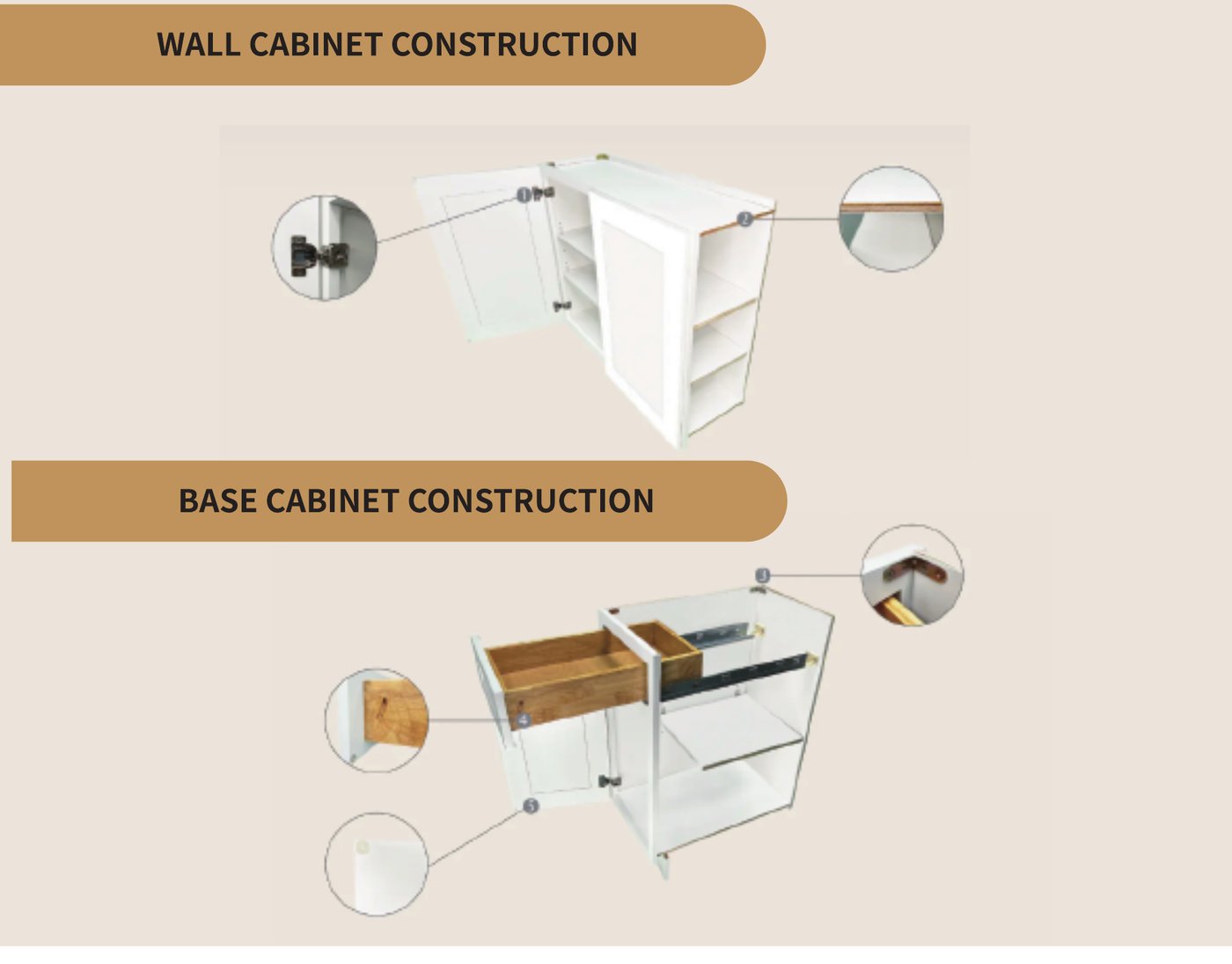
What the panels are made of. Plywood is thin layers of wood glued with the grain crossed. It holds a screw and it tolerates a wet spot. Particleboard and MDF are pressed boards; they are flat and cheap to machine, and they swell when they get wet. The makers print which one they use. Fabuwood Allure: 1/2-inch veneered plywood sides, back, top, and bottom. U.S. Cabinet Depot Capital: 1/2-inch plywood box with a 1/2-inch full-height plywood back. L&C framed lines: 1/2-inch plywood panels with a wood veneer. The frameless lines run thicker because there is no face frame to stiffen them: L&C's E-Series and Premium Choice's Eurolux both list a 3/4-inch plywood box, and U.S. Cabinet Depot's altaeuro uses an 18-millimeter plywood composite with melamine bonded inside and out. Where a maker uses MDF it says so, and it is usually in the door, not the box; Lesson 2 has the line-by-line.
How the parts are joined. A side panel can sit in a groove, or it can be cut with a dovetail and locked into a matching groove in the face frame so it cannot pull away. Fabuwood makes the difference plain in its own two catalogs: the Allure box has side panels "dovetailed into face frame" and 2-1/2 by 1/2 inch plywood panel beams dovetailed into the sides at the top of every base cabinet, "for strength and stability" and to carry the countertop; the Value Premium box has the same panel beams but the sides are "grooved into face frame." Both are plywood. One is a stronger joint. Backs matter too: Fabuwood staples and screws its backs in, U.S. Cabinet Depot runs a full-height 1/2-inch back, and L&C adds all-metal corner brackets to every framed cabinet. A back that is a thin skin stapled to the edges is the reason a wall cabinet racks when it is hung.
The face frame, or none. A framed cabinet has a solid wood frame on the front: 3/4 by 1-1/2 inch on Fabuwood, glued and doweled; 3/4 by 1-3/4 inch hardwood on U.S. Cabinet Depot. It squares the box and gives the hinge something solid to bite. A frameless cabinet skips it and relies on a thicker box and the edge banding, which is why the frameless sheets read 3/4 inch where the framed ones read 1/2. Both are good construction. They are different construction, and the sheet for each says which you are getting.
Two more lines to read on the box. The shelf: 3/4-inch plywood with the front edge banded on U.S. Cabinet Depot, 18-millimeter veneered plywood with a wood veneer edge on Fabuwood Allure, 15-millimeter on Fabuwood Value Premium, 3/4-inch plywood on L&C frameless. A thin shelf on a wide cabinet is the one that bows under the dishes. And the interior: U.S. Cabinet Depot and Fabuwood both finish the inside of the box (UV-coated natural plywood on one, natural finished plywood on the other), so the inside wipes clean and does not drink up a spill.
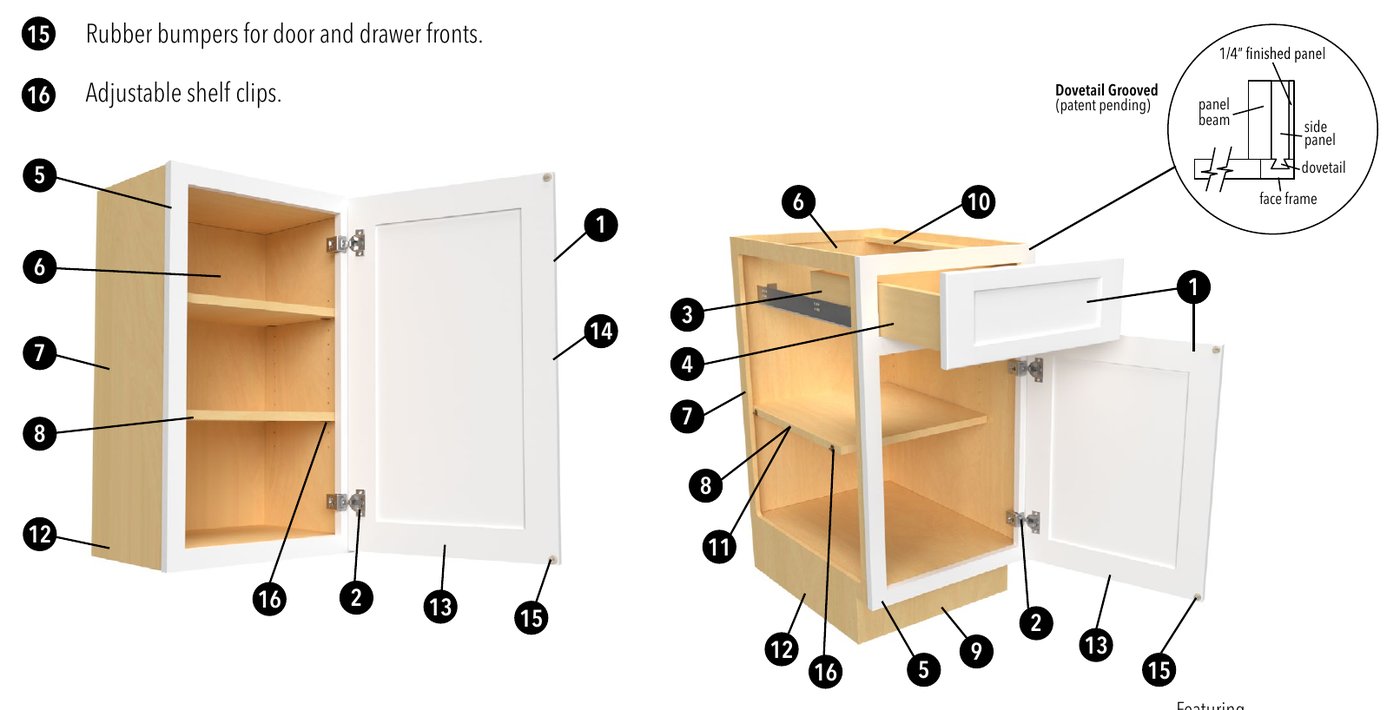
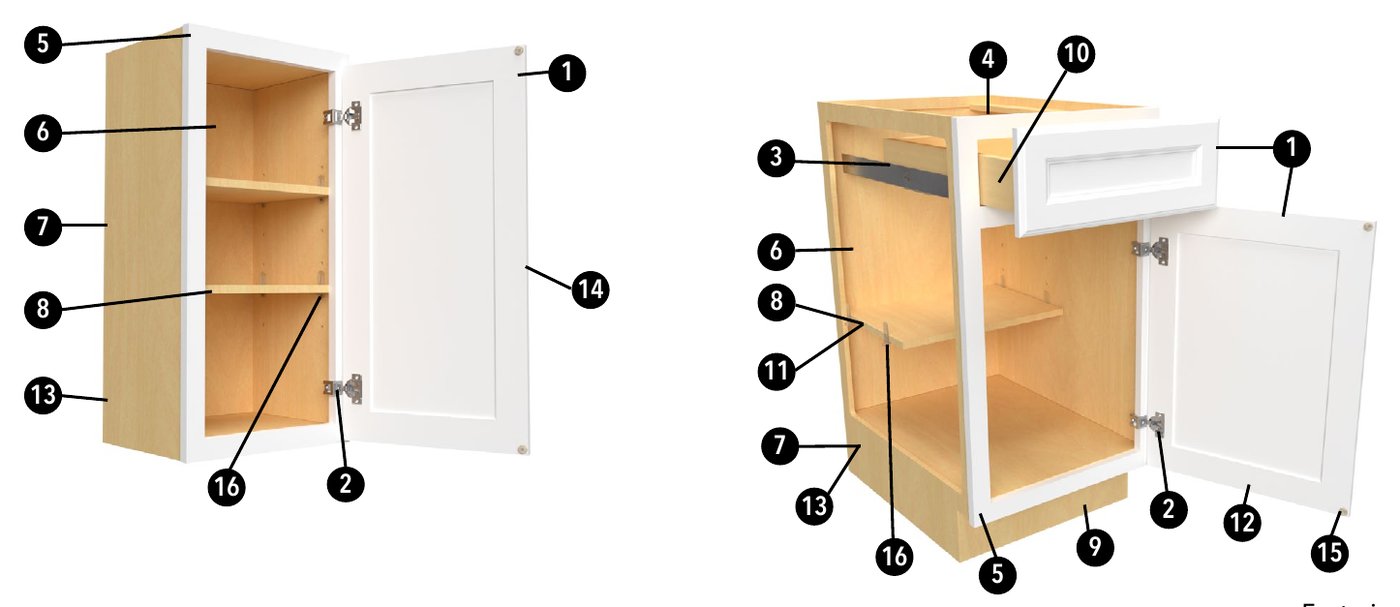
Open a base cabinet and look at the back corner where the side meets the face frame. Look at the cut edge of a shelf: layers, or crumbs. Push on the back panel. Put your hand on the top rail of a base cabinet and rock it. Then ask for the same line's spec sheet and find the panel thickness on it.
The door is what you chose. The drawer is what you use.
The door. Most doors Midway sells are five-piece: two stiles, two rails, and a center panel floating in a groove. What the five pieces are made of depends on the finish, and the makers are honest about it. On a stained door the frame is solid wood: U.S. Cabinet Depot builds stained Capital doors from 3/4-inch solid birch, and Fabuwood uses solid wood stiles and rails joined with mortise and tenon. The center panel on a stained door is often a veneered MDF panel (U.S. Cabinet Depot names the styles that get a solid birch panel and the ones that get veneered MDF) because a wide solid panel moves with the seasons. On a painted door the frame itself is usually HDF: U.S. Cabinet Depot's painted Capital styles are "an all HDF door," L&C's M-Series door is HDF, Fabuwood's Value Premium is full HDF, and Fabuwood's painted Allure doors use HDF stiles and rails with a moisture-resistant MDF center panel "to reduce the possibility of shrinkage." Fabuwood calls MDF "the preferred material for painted finishes." That is not a maker cutting a corner; a painted solid wood door shows a hairline at every joint by the second winter, and every warranty on this page says that line is not a defect.
Then there are the wrapped doors. Premium Choice's Eurolux slabs are a 3/4-inch MDF or particleboard core under a laminate. U.S. Cabinet Depot's altaeuro Torino is textured melamine over engineered wood, edge-banded all around; its Verona is a five-piece painted HDF door. Marsh's Captiv8 is "a highly engineered color coating that fully wraps MDF door components," and Marsh warrants it for five years against the lifetime on its wood doors. A wrapped door gives you a clean modern slab at a price a painted wood door cannot match. It also has an edge, and Lesson 3 is about what happens at that edge.
The drawer. This is the part of a kitchen that fails first and the easiest part to check. A dovetail box has corners cut into interlocking wedges and glued; it gets tighter when you pull on it. A stapled box does not. Fabuwood Allure and Value Premium: 5/8-inch solid wood dovetail box, 3/8-inch plywood bottom, 3-inch interior height on Allure. U.S. Cabinet Depot Capital: 5/8-inch solid hardwood, dovetail joints, "a fully captured 3/8-inch thick plywood floor," rated at 70 pounds. L&C framed: 1/2-inch hardwood dovetail box; L&C frameless: 3/4-inch plywood box. The frameless lines also offer a metal drawer, and it is not a downgrade: U.S. Cabinet Depot's altamax has 1/2-inch metal sides and a 5/8-inch melamine floor and is rated 88 pounds in the short height and 132 in the tall one. The word to look for on the bottom is captured, meaning the floor sits in a groove on all four sides. A bottom that is stapled up from underneath is the one that drops the silverware.
Pull a drawer all the way out and look at the corner: wedges, or staples. Turn it over: is the bottom in a groove, and how thick is it. Look at the back of a painted door at the joint between stile and rail. Ask which styles on the line are solid wood and which are HDF; the answer is on the sheet.
The finish is the only part you can see. It gets its own tests.
Nobody sells you a cabinet by describing the finish chemistry, and the spec sheets for the lines Midway carries do not print it either. What they print is what the finish has to survive, and that is the honest way to read it. The KCMA A161.1 standard puts a finished door in a box at 120 degrees and 70 percent humidity for 24 hours, then cycles it to five below zero, then leaves vinegar, lemon, orange and grape juice, ketchup, coffee, olive oil, and 100-proof alcohol sitting on the face for a day and mustard for an hour. A door with the seal came out of that with nothing that would not polish off. Marsh, Kith, and Premium Choice are certified. Lesson 2 has the full list.
The warranties tell you the rest. Fabuwood covers the finish for the life of the cabinet on Allure but says plainly that finish stress lines may show at the joints of a painted door as the wood moves, that glazed finishes are uneven by nature, and that its warranty does not apply in a house without year-round heat and air. Marsh excludes finish changes from sunlight and from tobacco smoke, and the use of abrasives. U.S. Cabinet Depot says the same about color: wood darkens and lightens, and a replacement may not match. Read those as the maker telling you what a finish is: a coating on a material that moves. Keep the house conditioned, keep the harsh cleaners off it, and expect a painted door to show a line at the joint someday.
Where finish is a real spec on the sheet is the inside of the box and the ends. U.S. Cabinet Depot coats the interior with a UV-cured finish and ships every framed cabinet with a finished exterior, so no end panel is needed; its altaeuro line is melamine inside and out and does need a panel on an exposed end. Fabuwood applies a 1/4-inch finished MDF panel to whichever side you flag as exposed. Ask which ends in your kitchen are exposed and whether they are on the order.
Run a thumbnail along the joint of a painted door. Look at the inside of the box: is it finished or raw. Ask to see an exposed end on the display and find the end-panel line on the quote. Ask whether the line carries the KCMA seal, and if not, which of the finish tests the maker publishes.
The hinge and the slide are the moving parts. They wear.
Every other part of a cabinet just sits there. The hinge and the drawer slide move, and Blum, whose hardware is on the Fabuwood lines and much of the rest of what Midway sells, figures a kitchen's doors and drawers are opened and closed more than 80 times a day. Its hinges are tested through 200,000 opening and closing cycles. The KCMA standard runs 25,000 cycles on doors and drawers and calls that a pass. Either way, the number on the sheet is the number to ask for.
Hinges. A concealed hinge is a cup in the door and an arm on the box or face frame. The two things that matter are the damper and the adjustment. Fabuwood ships Blum Compact Clip hinges with Blumotion soft-close built in, six-way adjustable, opening to 110 degrees, and it prints the model number (31C3355B.20) on the door-style page. U.S. Cabinet Depot lists a six-way adjustable European hinge with soft-close on Capital and Hettich Sensys 110-degree soft-close hinges on altaeuro. L&C lists six-way adjustable 110-degree soft-close hinges on its framed lines and DTC soft-close hinges on frameless. Blum says all its hinges adjust side, depth, and height, and that the Compact Clip has a cam height adjustment so the installer always has the full range. Adjustment is what keeps the gaps even after the house settles and the doors get used. One honest note from Fabuwood's sheet: Lazy Susan, Easy Reach, and Pie Cut corner cabinets do not get the soft-close mechanism.
Slides. An undermount slide hides under the drawer box and carries it on the bottom, so the sides of the drawer are wood, not metal track, and the whole drawer comes out. Full extension means the back of the drawer clears the face frame. Fabuwood uses Blum Tandem plus Blumotion full-extension concealed runners (model 563H). Blum rates Tandem at up to 100 pounds a drawer on zinc-plated runners with nylon rollers, and its Legrabox metal drawer at 125 and 170 pounds. U.S. Cabinet Depot prints undermount full-extension soft-close glides on Capital and rates its framed drawers at 70 pounds. L&C prints undermount full-extension self-close on framed and DTC undermount soft-close on frameless. The one place the sheets step down is the roll-out tray: U.S. Cabinet Depot notes its roll-out shelf glides are side-mounted ball bearing with no soft-close, rated 35 pounds. Ask about the roll-outs separately.
Open a door and let it go from a foot out; it should catch and close itself. Pull a drawer all the way out and see whether the back clears the frame. Look under it: a slide you cannot see from the side is an undermount. Ask for the hinge and slide brand and model on the exact line quoted, and the pounds it is rated for.
Thirty boxes on a measured wall. That is a takeoff, not a shopping list.
A kitchen is not a product. It is thirty or forty boxes, in the right widths, that have to land on a wall that was measured right, with the fillers, end panels, toe kick, crown, and countertop overhang counted. The makers' spec books are mostly pages of cabinet dimensions for that reason: U.S. Cabinet Depot's manual tells you that a B30 base cabinet has a 26-1/2 inch opening because the frame takes 3-1/2 inches, and Fabuwood's runs a height alignment guide so the wall cabinets line up with the tall ones. Somebody has to do that arithmetic for every box, and that somebody is the difference between a kitchen and a pile of cabinets.
At Midway that is a full-time designer working in ProKitchen. The room gets measured. Plan and elevations get drawn, and you get a rendering you can walk through on the screen before anything is ordered. The designer is the one who knows the frameless line needs an end panel on that exposed side, that the corner cabinet will not have soft-close, and that the drawer stack next to the dishwasher needs a filler so the pulls clear. The designer also knows which door styles on the line are HDF and which are solid wood. The order that leaves here is the takeoff from that drawing, and our crew installs to the same drawing.
That is what you are paying for in the design work: the second order that never has to happen, and the countertop that fits the first time.
Ask for the plan view, the elevations, and the cabinet list from the same drawing. Count the end panels and fillers. Find the corner cabinet and ask what hardware it gets. Ask who measured the room and when.
This is the checklist.
| Feature | What a lasting kitchen has | What to ask |
|---|---|---|
| Box | Plywood sides and a plywood back, 1/2 inch on a framed box and 3/4 inch (or 18 millimeters) on a frameless one; sides dovetailed or grooved into a solid wood face frame; panel beams or brackets at the top of every base | What is the panel thickness on this exact line? Show me the cut edge and the back corner. |
| Shelf | 3/4-inch (18-millimeter) plywood with the front edge banded, on metal clips | How thick is the shelf, and what holds it up? |
| Door | Five-piece, mortise and tenon; solid wood frame on stained doors, HDF frame and MDF panel on painted doors, and the sheet says which | Which door styles on this line are solid wood and which are HDF? |
| Drawer | 5/8-inch solid wood dovetail box with a captured 3/8-inch plywood bottom, or a rated metal box on frameless | Dovetail or stapled? Is the bottom captured? What is it rated for? |
| Finish | KCMA seal or the maker's published tests; finished interior; exposed ends on the order | Is this line certified? Which ends are exposed, and are the panels on the quote? |
| Hinges | Concealed, soft-close in the cup, six-way adjustable, 110 degrees, with a brand and model on the sheet | Whose hinge, what model, and which cabinets do not get soft-close? |
| Slides | Undermount, full extension, soft-close, with a weight rating | Undermount or side-mount? What is the rating? What about the roll-outs? |
| Design | A measured room, a plan, elevations, a rendering, and a cabinet list from the same drawing | Who measured, and can I see the elevations before I sign? |
Every line here is good cabinetry. Pick on purpose.
A quick-ship line with a plywood box and dovetail drawers, on a house that has to close next month, is the right kitchen and Midway sells a lot of them. A made-to-order line from North Carolina or Alabama, with the KCMA seal and a warranty that runs as long as you own the house, is the right kitchen for the house you plan to grow old in. A wrapped slab door is the right kitchen for a clean modern room on a rental or a flip. None of them is wrong.
What is wrong is buying the cheaper one without knowing what you gave up, or the better one without knowing what you bought. Bring the checklist. Every line is on the floor in the studio with a door open and a drawer out, and the designer specs the whole room, so the kitchen on the quote is the kitchen that shows up with the end panels and the fillers to go with it.
Now read the sheet.
Lesson 2 takes the KCMA certificate, the construction spec sheet, and the warranty for the lines Midway sells and reads them line by line, including what "limited lifetime" covers, what five years covers, and what "semi-custom" means on an order.
Before You Price Cabinets
Know what you are buying.
Three short reads on cabinets. Written for the builder who has to answer to the money, and for the homeowner who has to live with the kitchen.
Frequently Asked
Cabinet construction, answered.
Is a plywood cabinet box better than particleboard?
What is a dovetail drawer box?
What is a five-piece door, and is MDF a bad sign?
What does soft-close hardware actually do?
What is the KCMA seal on a cabinet?
Why does Midway design every kitchen in 3D before ordering?
Visit the Showroom
See it set up, in person.
Browse the displays and talk it through with our team, face to face.
119 Cumberland St, Ashland City. Y’all come by.