
Every mark on the label,
and what it certifies.
The building code names performance, not products. The marks on a label are how a product proves it: a tested number, fire class, grade, or report. Here are 65 of them, across everything we sell: who issues each one, what it actually certifies, where you find it on the product, and which lesson uses it. Bring the label to the counter if one is missing.
Find the mark. Read what it promises. Check the lesson.
Three kinds of marks show up on building materials. A tested number (the NFRC label, an R-value, a design pressure) is a measurement made the same way for every maker, so two products can be compared on it. A class or grade (a Class A roof, a No. 2 stud, a UC4A post) puts the product in a band the code can name. A report (an ICC-ES ESR, a UL assembly number) says a specific product, installed a specific way, meets the code sections it lists, and it is what an inspector can accept without an engineer's letter.
Every row below links to the body that issues the mark, so you can read the source, and to the Before You Buy lesson that puts it to use. Where a maker publishes its own number (an ESR, a warranty table), the lesson names it. Where we could not verify a number, the row says so and stays general.
By Material
The marks, by what they are on.
Windows & Doors
| Mark | What it certifies | Where you see it | Read more |
|---|---|---|---|
| AAMA 2603 / 2604 / 2605 (aluminum finish)FGIA (formerly AAMA) | Three grades of factory paint on aluminum, tested for how long the color and gloss hold up outdoors. 2603 is the basic coat, 2604 is a mid grade, and 2605 is the premium 70 percent PVDF finish that keeps its color the longest. | On the window or door spec sheet under finish, and sometimes on the frame sticker. Not on the glass label. |
Windows: Read the label Doors: Read the spec sheet fgiaonline.org ↗ |
| AAMA/WDMA/CSA 101/I.S.2/A440 (NAFS) performance grade and DPFGIA, WDMA, and CSA, jointly | The North American Fenestration Standard. A window or door is tested for air leakage, water penetration, and structural load, then given a performance class (R, LC, CW, AW) and a performance grade or design pressure (DP) number, such as PG 30 or DP 50. The higher the number, the more wind and rain it was proven to take. | On the permanent frame label, usually a small sticker or etching in the jamb or track. The inspector may ask for it in high-wind or coastal work. |
Windows: Read the label Doors: Read the spec sheet fgiaonline.org ↗ |
| ASTM E2190 (insulating glass unit durability)ASTM International | The seal standard for double and triple pane glass. The sealed unit is run through weather cycling, high humidity, and fog testing to show the edge seal will hold and the space between the panes will stay clear. | Stamped or printed on the spacer bar between the panes, along with the maker and date. Look at the edge of the glass, inside the frame. |
Windows: Read the label Windows: The second window is the expensive one astm.org ↗ |
| ASTM E330 (structural load test)ASTM International | The test method behind the structural part of a DP rating. The window or door is sealed in a chamber and pushed and pulled with uniform air pressure to see what wind load it holds without breaking or deflecting too far. | Named on the test report behind the NAFS or DP rating. You will not see E330 on a sticker, but it is what the DP number came from. |
Windows: Read the label astm.org ↗ |
| ENERGY STAR for windows, doors, and skylights (Version 7.0)U.S. EPA | A pass or fail mark that the unit meets EPA's U-factor and solar heat gain limits for its climate zone, using the NFRC-certified numbers. Version 7.0 took effect in October 2023 and tightened the targets. Middle Tennessee falls in the North-Central zone on the ENERGY STAR map. | The blue ENERGY STAR sticker next to the NFRC label on the glass. It shows a map of which zones the unit qualifies in. |
Windows: Read the label Windows: What you are paying for energystar.gov ↗ |
| NFRC label (NFRC 100 / 200)National Fenestration Rating Council | A tested, whole-unit rating for U-factor, solar heat gain, visible transmittance, and air leakage. The one number set every window maker reports the same way, so two windows from two makers can be compared honestly. | The temporary sticker on the glass of every certified window and glass door. Peel it off after the inspector has seen it. |
Windows: Read the label Windows: What you are paying for nfrc.org ↗ |
| Safety glazing (16 CFR 1201 / ANSI Z97.1)U.S. Consumer Product Safety Commission (federal rule) and ANSI (industry standard) | Tempered or laminated glass that breaks safely, tested by dropping a weighted bag into it. The code requires it in doors, sidelights, tub and shower enclosures, and any large pane near the floor or a walking surface. Category I and II are the two impact levels. | A small permanent etch or ceramic mark in the corner of the glass, showing the maker and the standard. If the corner has no mark, the inspector will assume it is not safety glass. |
Windows: Read the label Doors: Read the spec sheet cpsc.gov ↗ |
| UL 10C (20-minute fire door)UL Solutions | A fire test for door assemblies with positive pressure in the furnace, the way a real house fire pushes on a door. The 20-minute rating is what the residential code requires between an attached garage and the house. The rating covers the door, the frame, and the hardware together. | A metal or foil label on the hinge edge of the door slab and often on the frame. Do not paint over it. |
Doors: Read the spec sheet Doors: What you are paying for ul.com ↗ |
Roofing
| Mark | What it certifies | Where you see it | Read more |
|---|---|---|---|
| ASTM A653 (galvanized steel sheet)ASTM International | The spec for hot-dip galvanized steel coil. The coating weight is the G number: G60 is a light coat and G90 is the common roofing and trim grade. Heavier zinc means longer before the sheet shows rust at cut edges and scratches. | On the coil tag and the panel maker's spec sheet, written as G60, G90, and so on. Ask for the number if the sheet only says galvanized. |
Roofing: Read the spec sheet Farm: Read the tag astm.org ↗ |
| ASTM A792 (Galvalume, AZ50 / AZ55)ASTM International | The spec for steel coated with a mix of aluminum and zinc, sold under the Galvalume name. AZ50 is the usual painted-panel grade and AZ55 the usual bare or heavier grade. It outlasts plain galvanized in most roof exposures, but it should not touch wet concrete, mortar, or treated lumber. | On the panel spec sheet and the coil tag as AZ50 or AZ55. Most residential metal roofing sold here is AZ50 with a painted finish. |
Roofing: Read the spec sheet Roofing: The second roof is the expensive one astm.org ↗ |
| ASTM D3161 Class F (shingle wind resistance, fan test)ASTM International | The older shingle wind test. Installed shingles are blown on with a fan, and Class F means they held at 110 mph. Most shingles carry both this and the D7158 rating. | On the end of the shingle bundle wrapper, usually next to the D7158 class and the UL 790 fire class. |
Roofing: Read the spec sheet astm.org ↗ |
| ASTM D3462 (asphalt shingle spec)ASTM International | The base specification for fiberglass-mat asphalt shingles. It sets minimums for the mat, the asphalt, granule adhesion, tear strength, and nail pull-through. A shingle that does not meet it is not a code-approved shingle. | On the bundle wrapper and the product data sheet. Many makers also list UL certification to D3462, which means UL checked the claim. |
Roofing: Read the spec sheet Roofing: What you are paying for astm.org ↗ |
| ASTM D7158 Class D / G / H (shingle wind resistance, uplift)ASTM International | The newer shingle wind test, based on measured uplift force rather than a fan. Class D is rated to 90 mph, Class G to 120 mph, and Class H to 150 mph. The code in most of Tennessee calls for D or better; the makers we stock generally carry H. | On the bundle wrapper as a class letter. The class only holds if the shingle is nailed the way the wrapper says, with the right number of nails in the nail line. |
Roofing: Read the spec sheet Roofing: What you are paying for astm.org ↗ |
| ICC-ES ESR for metal roofing panelsICC Evaluation Service | An evaluation report that says a specific panel profile, gauge, and fastener pattern meets the building code for wind uplift, fire, and attachment. Each panel maker holds its own report number. Without one, the inspector has only the maker's word. | The ESR number is on the panel maker's spec sheet and installation guide. Ask us for the report that matches the profile you are buying. |
Roofing: Read the spec sheet Codes & permits icc-es.org ↗ |
| PVDF (Kynar 500) vs SMP (silicone-modified polyester) coatingsGeneric coating chemistries; Kynar 500 is a resin trade name | The two paint systems on metal roofing. PVDF is the premium resin that holds color and gloss the longest and resists chalking. SMP is a good mid grade that costs less and fades a little sooner in full sun. Neither is a rating by itself, so ask for the maker's weathering warranty and test data. Coating makers cite the AAMA 2605 test program for aluminum; the matching steel spec, AAMA 621, has been withdrawn, so on steel you will see the individual ASTM tests instead. | On the panel spec sheet and the color chart under finish. The bare panel does not tell you which one you have. |
Roofing: Read the spec sheet Roofing: The second roof is the expensive one fgiaonline.org ↗ |
| UL 2218 Class 1 to 4 (impact resistance)UL Solutions | A steel ball is dropped on the roofing from a set height to imitate hail. Class 1 is a small ball and Class 4 is a 2-inch ball dropped from 20 feet. Class 4 is what insurers ask about for a hail discount. | On the shingle wrapper or metal panel spec sheet as a class number. Keep the wrapper or the sheet; the insurer will want to see it. |
Roofing: Read the spec sheet Roofing: The second roof is the expensive one ul.com ↗ |
| UL 790 / ASTM E108 Class A, B, C (fire rating)UL Solutions (UL 790) and ASTM International (E108), same test | How well the roof covering resists fire from outside: burning brands, flame spread, and intermittent flame. Class A is the highest and is what nearly all fiberglass shingles and metal roofing carry. Class C is the lowest allowed on a house. Some products only earn Class A as part of an assembly with a certain underlayment. | On the bundle wrapper or panel spec sheet as Class A, B, or C. If it says Class A as an assembly, the underlayment named must go under it. |
Roofing: Read the spec sheet ul.com ↗ |
Siding & Sheathing
| Mark | What it certifies | Where you see it | Read more |
|---|---|---|---|
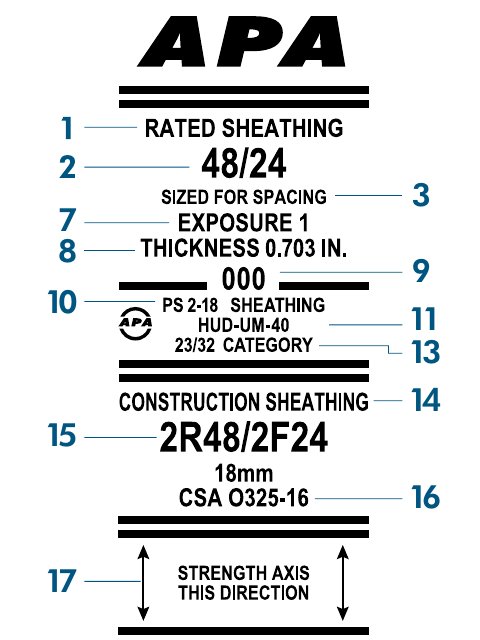
| APA PS 1 / PS 2 sheathing stampAPA, The Engineered Wood Association, under U.S. voluntary product standards | PS 1 is the standard for construction plywood and PS 2 is the performance standard for OSB and other structural panels. The APA trademark stamp shows the panel was made under a third-party inspection program and tells you the grade, the exposure rating, and the thickness. | Stamped on the back face of every sheet. Exposure 1 means it can take normal construction wetting; Exterior means it is glued for permanent weather. |
Lumber: Read the stamp Siding: Read the spec sheet apawood.org ↗ |
| APA span ratingAPA, The Engineered Wood Association | Two numbers on the sheathing stamp, such as 24/16 or 32/16. The first is the maximum rafter spacing in inches when the panel is used on a roof; the second is the maximum joist spacing when it is used on a floor. A single number, such as 24 oc, is for siding and single-floor panels. | On the APA stamp on the back of the sheet, right under the grade. It is what the inspector reads to check your framing spacing. |
Lumber: Read the stamp Lumber: What you are paying for apawood.org ↗ |
| ASTM C1186 (fiber cement siding)ASTM International | The spec for flat fiber cement sheet, covering strength, water absorption, freeze-thaw, and dimensional stability. Grade II is the standard siding grade. James Hardie siding is listed to C1186 in its code report, ICC-ES ESR-2290, which is the report an inspector asks for. | On the product data sheet and the ESR. The board itself carries a printed maker name and lot code on the back. |
Siding: Read the spec sheet Siding: What you are paying for icc-es.org ↗ |
| ASTM D3679 (vinyl siding)ASTM International | The spec for rigid vinyl siding: thickness, impact strength, weathering, and how much it can shrink and expand. The Vinyl Siding Institute runs a certification program against it and adds a wind-load rating. A thicker panel (0.044 inch and up) resists denting and oil-canning better than the minimum. | On the carton label as ASTM D3679 and, if certified, the VSI mark. The thickness is on the spec sheet. |
Siding: Read the spec sheet Siding: The second siding job is the expensive one astm.org ↗ |
| ASTM E2178 (air barrier material)ASTM International | The test for how much air leaks through a sheet material. A house wrap or sheathing that passes it can count as the air barrier the energy code requires, which saves a separate layer. The number to look for is 0.02 L/(s m2) at 75 Pa or less. | On the house wrap or sheathing data sheet. If the sheet does not list E2178, the product is a water barrier only, not an air barrier. |
Siding: Read the spec sheet Insulation: Read the spec sheet astm.org ↗ |
| ASTM E84 flame spread (Class A)ASTM International (same test as UL 723) | The tunnel test. A 24-foot sample is lit at one end and the flame spread and smoke are measured. Class A means a flame spread index of 0 to 25; B covers 26 to 75; C covers 76 to 200. It applies to siding, sheathing, foam, and interior finishes. | On the product data sheet and the ESR as a flame spread index and smoke developed index. Fiber cement scores 0; wood products usually land in Class C, which is fine for a house. |
Siding: Read the spec sheet Insulation: Read the spec sheet astm.org ↗ |
| ICC-ES ESR-1301 (LP SmartSide engineered wood siding)ICC Evaluation Service | The code report for LP SmartSide lap, panel, and trim. It lists the fastening schedule, the wind-speed limits, and the treated-wood durability data an inspector checks. Other engineered wood sidings carry their own ESR number; ask for it. | The ESR number is on the back of the board and on the bundle label along with the maker and the mill. |
Siding: Read the spec sheet Codes & permits icc-es.org ↗ |
| WRB, house wrap (ICC-ES AC38 / ASTM E2556)ICC Evaluation Service (AC38) and ASTM International (E2556) | A water-resistive barrier keeps rain that gets behind the siding off the sheathing while letting water vapor out. AC38 is the acceptance criteria a wrap must meet to get a code report; E2556 is the ASTM spec for the same thing. Either one shows the wrap is a legal substitute for the felt paper the code names. | On the roll and the data sheet. Look for an ESR number or an E2556 listing, and for a vapor permeance number (perms) so you know it breathes. |
Siding: Read the spec sheet Siding: What you are paying for icc-es.org ↗ |
Framing & Engineered Wood
| Mark | What it certifies | Where you see it | Read more |
|---|---|---|---|
| ALSC-accredited lumber grade stampAmerican Lumber Standard Committee (accredits the grading agencies) | Every piece of framing lumber carries a stamp with five things: the grading agency mark (SPIB, WWPA, WCLIB, NELMA, and others), the mill number, the species or species group (SYP, SPF, Hem-Fir, Doug Fir), the grade (No. 1, No. 2, Stud, Select Structural), and the moisture condition. The inspector reads the grade and species against the span tables. | Ink-stamped on the wide face of every stud, joist, and rafter. It is fine to cover it with drywall; it is not fine to buy lumber without one. |
Lumber: Read the stamp Lumber: What you are paying for alsc.org ↗ |
| ANSI/TPI 1 truss design drawingsTruss Plate Institute | The national standard for metal-plate-connected wood trusses. Each truss run comes with sealed design drawings showing loads, lumber grades, plate sizes, and whatever bracing the truss needs. The drawings, not the truss, are what the inspector approves. | A drawing packet delivered with the trusses, usually with an engineer's seal, and a tag on each truss matching it to the drawing. Keep the packet on site until final. |
Lumber: Read the stamp tpinst.org ↗ |
| APA trademark on OSB and plywoodAPA, The Engineered Wood Association | The stamp that says the panel was made under APA's third-party inspection to PS 1 or PS 2. It carries a grade (Sheathing, Sturd-I-Floor, Rated Siding), a span rating, an exposure durability, thickness, and the mill number. | On the back of the sheet. A panel with no stamp cannot be counted as structural sheathing. |
Lumber: Read the stamp Siding: Read the spec sheet apawood.org ↗ |
| AWPA U1 use categories (UC1 to UC4B) and the treated end tagAmerican Wood Protection Association | The standard that says how much preservative treated lumber needs for where it goes. UC1 and UC2 are dry and damp interior, UC3A and UC3B are above ground outdoors, UC4A is ground contact, UC4B is heavy-duty ground contact for posts and critical members. Buying UC3B for a post in the dirt is the most common treated-lumber mistake. | The plastic end tag stapled to every treated piece. It names treating chemical and retention, use category, inspection agency, and whether it is safe against aluminum and what fasteners it needs. |
Lumber: Read the stamp Decking: Read the spec sheet Farm: Read the tag awpa.com ↗ |
| ICC-ES ESR for I-joists and LVLICC Evaluation Service | Engineered lumber has no grade stamp, so its code approval is the evaluation report. The ESR lists design values, allowable spans, hole-cutting rules, and bearing lengths for each product series. Each maker holds its own number. | The ESR number is printed on the flange or the face of every piece along with the series name. Keep the maker's span chart with the permit set. |
Lumber: Read the stamp Lumber: What you are paying for Codes & permits icc-es.org ↗ |
| Moisture designation (S-GRN, S-DRY, KD-19, KD-HT)Part of the ALSC grade stamp | How wet the lumber was when it was surfaced. S-GRN is green, over 19 percent moisture, and will shrink and twist as it dries in the wall. S-DRY and KD-19 mean 19 percent or less; KD is kiln dried. KD-HT adds a heat treatment that lets the wood cross borders and also kills insects. The framing tables assume dry lumber. | On the grade stamp, right after the grade. If it says S-GRN, plan on the wall moving. |
Lumber: Read the stamp Lumber: The callback is the expensive one alsc.org ↗ |
| Span tables (AWC, SPIB, WWPA)American Wood Council, with species tables from SPIB (Southern Pine) and WWPA (Western lumber) | The published tables that turn a species, grade, size, and spacing into an allowable joist or rafter span. The residential code reprints them, so the inspector is checking your framing against the same page. Southern Pine values changed in 2013, so use current tables. | Not on the lumber. It is the chart you look up after reading the grade stamp. We keep the current SPIB and AWC tables at the counter. |
Lumber: Read the stamp Codes & permits awc.org ↗ |
Decking & Outdoor
| Mark | What it certifies | Where you see it | Read more |
|---|---|---|---|
| ASTM A153 / ASTM A653 G185 hot-dip galvanized hangers and fastenersASTM International | Today's treated lumber (ACQ, CA, MCA) eats ordinary zinc plating. A153 is the hot-dip spec for nails, bolts, and screws; A653 G185 is the spec for hanger and connector sheet with 1.85 ounces of zinc per square foot. Both are what the treated-lumber end tag and the hanger makers call for. | On the fastener box as ASTM A153 or hot-dip galvanized, and on the hanger as G185 or ZMAX-type marking. Electro-galvanized or bright fasteners in treated wood will fail. |
Decking: Read the spec sheet Hardware: Read the box Farm: Read the tag astm.org ↗ |
| ASTM D7032 (composite deck boards)ASTM International | The performance spec for wood-plastic composite and plastic deck boards and guards. It covers load and deflection at a stated span, slip resistance, freeze-thaw, moisture, termites, and fungus. A board sold as structural decking should list a D7032 span rating. | On the maker's data sheet and in the ESR. It is the source of the 16-inch or 12-inch joist spacing the board is rated for. |
Decking: Read the spec sheet Decking: What you are paying for astm.org ↗ |
| AWPA UC4A ground contact (posts and ledgers)American Wood Protection Association | The use category for treated wood that touches the ground or stays wet: deck posts, fence posts, ledgers that cannot dry, and joists closer than 6 inches to grade. It carries roughly twice the preservative of above-ground UC3B. UC4B is the heavier grade for permanent posts and critical structure. | On the end tag as Ground Contact or UC4A. If the tag says Above Ground, the piece does not go in the dirt. |
Decking: Read the spec sheet Farm: Read the tag Decking: The second deck is the expensive one awpa.com ↗ |
| ICC-ES ESR for composite decking (ESR-3168 for Trex Transcend and Select)ICC Evaluation Service | The code report that says a composite board meets the residential code for span, guard loads, fire, and durability. ESR-3168 is the report for Trex Transcend and Select decking and fascia. Other composite lines carry their own numbers. | On the bundle label with the maker's name and address. Inspectors in some counties ask to see the report for the span you used. |
Decking: Read the spec sheet Codes & permits icc-es.org ↗ |
| Stainless steel 304 and 316 fastenersAlloy grades (ASTM and SAE designations) | Stainless screws do not stain cedar, redwood, or composite the way galvanized can, and they outlast galvanized in treated wood. 304 is the everyday grade. 316 has added molybdenum and is the one for pool decks, salt air, and anywhere chlorides sit on the metal. | Stamped on the box as 304 or 316; sometimes 18-8, which is the same family as 304. Many composite makers require stainless or coated screws to keep the warranty. |
Decking: Read the spec sheet Hardware: Read the box astm.org ↗ |
Insulation & Drywall
| Mark | What it certifies | Where you see it | Read more |
|---|---|---|---|
| ASTM C1289 (polyiso foam board)ASTM International | The spec for faced polyisocyanurate insulation board, the foil- or fiberglass-faced sheet with the highest R per inch of the common foams. Types and classes cover the facer and the compressive strength. Its R-value is labeled per the long-term thickness method, so an older sheet may show a higher number than a current one. | Printed on the facer with the type and class, the thickness, and the R-value. |
Insulation: Read the spec sheet Insulation: What you are paying for astm.org ↗ |
| ASTM C1396 (gypsum board) and Type XASTM International | The spec for drywall. Type X is 5/8-inch board with glass fibers in the core that holds together in a fire; the code requires it on the garage side of the house wall and the garage ceiling under living space, and in many rated assemblies. Type C is a further step up used in some ceiling designs. | Printed on the back of every sheet along with the maker, the thickness, and any UL design it is part of. Regular 1/2-inch board will not say Type X. |
Insulation: Read the spec sheet Trim: Read the profile sheet astm.org ↗ |
| ASTM C518 (R-value test)ASTM International | The heat-flow-meter test that produces the R-value on the bag. The sample is put between a hot plate and a cold plate and the heat passing through is measured at a set mean temperature, usually 75 degrees F. Every R-value under the FTC rule comes from this test or its sibling, ASTM C177. | Named on the data sheet, not usually on the bag. It is why two products with the same R-value are truly comparable. |
Insulation: Read the spec sheet astm.org ↗ |
| ASTM C578 (EPS and XPS foam board)ASTM International | The spec for the white bead board (EPS) and the pink and blue extruded board (XPS). Type numbers set the density and compressive strength; Type IV XPS is the common wall and below-grade grade. The spec also sets the labeled R-value method. | Printed on the board face with the type and the R-value per inch. |
Insulation: Read the spec sheet astm.org ↗ |
| ASTM C665 (mineral fiber batts)ASTM International | The spec for fiberglass and mineral wool blanket insulation. It sets the types (unfaced, kraft faced, foil faced) and the categories for flame spread. Kraft-faced batts are Type II Class C, which means the paper facing must be covered by drywall because it will burn. | On the bag and on the facing. If the bag says Class A or unfaced, it can be left exposed in an attic or crawl; a kraft facing cannot. |
Insulation: Read the spec sheet Insulation: What you are paying for astm.org ↗ |
| ASTM E84 on foam board facings and foam plasticASTM International | Foam plastic in a house must show a flame spread of 75 or less and smoke of 450 or less, and then it still has to be covered by a 15-minute thermal barrier, usually 1/2-inch drywall, unless the ESR says otherwise. The E84 numbers on the board are the first half of that rule. | On the board label and the data sheet as a flame spread index and smoke developed index. Look for the ESR if you want to leave foam exposed in a crawl space or attic. |
Insulation: Read the spec sheet Codes & permits astm.org ↗ |
| FTC R-value Rule (16 CFR 460)U.S. Federal Trade Commission | The federal rule that says every home insulation must be labeled with its R-value, tested by a named method, at a stated thickness, and that the seller must hand the buyer a fact sheet. It is why the bag, the ad, and the invoice all show the same number and why nobody can say R-19 without a test behind it. | The R-value printed on the bag, the roll, or the board face, plus the fact sheet available at the counter. New-home buyers are supposed to receive a written statement of the installed R-values. |
Insulation: Read the spec sheet Insulation: What you are paying for ftc.gov ↗ |
| UL fire-resistance rated assemblies (U- and V-series designs)UL Solutions | A one-hour or two-hour wall or ceiling is not a product; it is a tested assembly with a UL design number, such as U305 or U419, that names the framing, board type and layers, fasteners, and insulation. Build it to the letter of the design and the inspector can sign it off. Swap one part and the rating is gone. | The design number is on the drywall data sheet and in the UL Product iQ directory. The permit set or the fire-separation detail will call it out. |
Insulation: Read the spec sheet Codes & permits ul.com ↗ |
Cabinets & Interior
| Mark | What it certifies | Where you see it | Read more |
|---|---|---|---|
| ANSI A208.1 (particleboard) / ANSI A208.2 (MDF)Composite Panel Association (ANSI-accredited) | The grade standards for the two composite panels in cabinet boxes, shelves, and painted trim. Each grade sets density, strength, screw holding, and thickness tolerance. M-2 and M-3 particleboard and the MDF grades used in cabinets are meant for furniture; shelf sag depends on the grade and the span. | On the panel maker's data sheet and often on the cabinet spec sheet. The KCMA or maker literature will say which grade is in the box. |
Cabinets: Read the spec sheet Trim: Read the profile sheet compositepanel.org ↗ |
| CARB Phase 2 / EPA TSCA Title VI (formaldehyde)California Air Resources Board and U.S. EPA | Limits on formaldehyde coming off plywood, particleboard, and MDF. CARB Phase 2 was the California rule; TSCA Title VI made the same limits federal law, so any composite wood sold in the United States must meet it. NAF and ULEF are stricter, voluntary labels. | A stamp on the panel or a statement on the cabinet or millwork label that reads TSCA Title VI compliant or CARB Phase 2 compliant. Ask for it on imported cabinetry. |
Cabinets: Read the spec sheet Cabinets: What you are paying for epa.gov ↗ |
| KCMA ANSI/KCMA A161.1Kitchen Cabinet Manufacturers Association | The performance standard for kitchen and vanity cabinets. Doors are opened and closed 25,000 times, shelves are loaded, drawers are cycled, and the finish is tested against household spills, heat, and humidity. A cabinet with the seal passed every test as a whole unit. | The blue and white KCMA certification seal inside the cabinet, usually on the back of a door or the side of the box. |
Cabinets: Read the spec sheet Cabinets: What you are paying for kcma.org ↗ |
| KCMA Environmental Stewardship Program (ESP)Kitchen Cabinet Manufacturers Association | A points-based program for cabinet makers covering air quality, material sourcing, waste, and community practice. It is separate from the A161.1 durability seal. It matters when a buyer or a green-building program asks about the plant, not the cabinet. | An ESP logo in the maker's literature or on the KCMA certified list. It is not on the cabinet itself. |
Cabinets: Read the spec sheet kcma.org ↗ |
| NEMA LD 3 (high-pressure decorative laminate)National Electrical Manufacturers Association | The spec for laminate countertops and cabinet surfaces. It defines the grades (general purpose, vertical, postforming) and tests wear, scuff, stain, boiling water, and impact. A countertop laminate should be a general-purpose or postforming grade; vertical grade is thinner and is for cabinet sides and doors. | On the laminate sheet back and the maker's data sheet as a grade code such as HGS or VGS. |
Cabinets: Read the spec sheet nema.org ↗ |
Paint & Coatings
| Mark | What it certifies | Where you see it | Read more |
|---|---|---|---|
| ASTM D4587 / ASTM D6695 accelerated weatheringASTM International | The two lab tests that simulate years of sun and rain on paint in weeks. D4587 uses fluorescent UV lamps with condensation cycles; D6695 uses a xenon-arc lamp that mimics the whole solar spectrum. The report gives hours to a set loss of gloss or color. They rank paints against each other; they do not promise a number of years. | Named on the technical data sheet under performance or exterior durability, with hours of exposure. |
Paint: Read the data sheet Paint: The second coat is the expensive one astm.org ↗ |
| MPI approved products listMaster Painters Institute | MPI tests paints against numbered performance categories, such as MPI #10 for exterior latex or #54 for interior latex, and lists the products that pass. Architects and government specs call out MPI numbers so any brand meeting the number can be used. The list also flags Green Performance and X-Green low-emission levels. | The MPI number on the technical data sheet, and the product's listing at paintinfo.com. It is rarely on the can. |
Paint: Read the data sheet paintinfo.com ↗ |
| SDS (Safety Data Sheet)Required by OSHA under the Hazard Communication Standard | The 16-section sheet on hazards, first aid, fire, spills, storage, and disposal. Every paint, stain, adhesive, and solvent has one, and the jobsite is supposed to keep them where the crew can get to them. | Downloadable from the maker by product name; we can print one at the counter. It replaced the older MSDS. |
Paint: Read the data sheet osha.gov ↗ |
| TDS (Technical Data Sheet)The paint maker | The one page that says what the paint is and how to use it: resin type, solids by volume, VOC content, recommended film thickness, coverage per gallon, dry and recoat times, surface prep, and which primer goes under it. Coverage per gallon on the TDS is at the stated film thickness, not what a roller happens to leave. | A PDF by product name on the maker's site, one per sheen. Read it before you bid the job; the can label is a summary. |
Paint: Read the data sheet Paint: What you are paying for paintinfo.com ↗ |
| VOC limits (EPA 40 CFR 59 and state rules)U.S. EPA; stricter rules in some states | Volatile organic compounds are the solvents that flash off as paint dries. EPA sets federal limits by coating category in grams per liter. Tennessee follows the federal limits; California and several northeastern states set lower ones, which is why the same product can come in two formulas. Low-VOC and zero-VOC on the can are marketing terms, so read the grams-per-liter number on the TDS. | Grams per liter on the can and the TDS. Tinting adds VOC, so a zero-VOC base can leave the store above zero. |
Paint: Read the data sheet Paint: What you are paying for epa.gov ↗ |
Fasteners & Hardware
| Mark | What it certifies | Where you see it | Read more |
|---|---|---|---|
| ANSI/BHMA Grade 1, 2, 3 (locks, hinges, closers)Builders Hardware Manufacturers Association | BHMA cycle-tests and strength-tests door hardware and sorts it into three grades. Grade 1 is commercial and the strongest; 2 is heavy residential; 3 is basic residential. A Grade 2 deadbolt takes more hammer blows and more turns than a Grade 3. Each hardware type has its own A156 standard number. | On the package as ANSI/BHMA Grade 1, 2, or 3, sometimes with the A156 number. If the package does not say, assume Grade 3. |
Hardware: Read the box Hardware: What you are paying for buildershardware.com ↗ |
| ASTM A153 (hot-dip galvanized hardware)ASTM International | The spec for hot-dip galvanizing on nails, bolts, screws, and small hardware, with classes by the size of the piece. It is the finish the treated-lumber end tag means when it says hot-dip galvanized. Hot-dip leaves a thick, rough zinc coat; electroplating leaves a thin, shiny one that treated wood eats through. | On the box as ASTM A153 or HDG. The nail will look dull gray and a little lumpy, not bright. |
Hardware: Read the box Decking: Read the spec sheet astm.org ↗ |
| ASTM F1667 (nails, spikes, and staples)ASTM International | The spec that names every driven fastener by type, size, and shank, so that a 16d common, a 16d sinker, and a 10d box nail are not confused. The residential fastening schedule is written in these terms, and the inspector reads the box against it. A collated framing nail should say which F1667 designation it matches. | On the box, often as NLCMS (nail, common, machine, smooth) or similar code, with the diameter and length. Length and diameter, not the d-number, are what the code checks. |
Hardware: Read the box Lumber: Read the stamp astm.org ↗ |
| ICC-ES ESR for structural screwsICC Evaluation Service | A structural screw that replaces a lag bolt or a through-bolt in a ledger, a truss tie, or a header needs a code report giving its shear and withdrawal values in the species you are using. The ESR is what lets the inspector accept the screw in place of the bolt the code names. | The ESR number is on the box and the maker's load chart. Bring the chart to the inspection if you substituted screws. |
Hardware: Read the box Decking: Read the spec sheet Codes & permits icc-es.org ↗ |
| UL 437 (high-security cylinders)UL Solutions | A test for lock cylinders against picking, drilling, prying, and pulling for a set number of minutes with hand and power tools. A UL 437 cylinder is a step above a BHMA grade, which mostly tests durability. It is optional on a house and common on a shop or an office. | On the lock package and on the cylinder face as UL 437 or UL Listed. Most residential deadbolts do not carry it. |
Hardware: Read the box ul.com ↗ |
Codes & Energy
| Mark | What it certifies | Where you see it | Read more |
|---|---|---|---|
| DOE climate zone map (Zone 4A for Middle Tennessee)U.S. Department of Energy, Building Energy Codes Program | The map that assigns every county a climate zone, and the energy code reads its insulation and window tables by zone. Cheatham County and the rest of Middle Tennessee are Zone 4A, mixed-humid. That single letter and number decides your ceiling R-value, your wall R-value, and the U-factor your windows must meet. | Not on any product. It is the table lookup that makes the R-value on the bag and the U-factor on the window either pass or fail. |
Codes & permits Insulation: Read the spec sheet Windows: Read the label energycodes.gov ↗ |
| ICC-ES evaluation report (ESR)ICC Evaluation Service, a subsidiary of the International Code Council | The code does not name products; it names performance. An ESR is a third-party report that says a specific product, installed a specific way, meets the code sections it lists. It is how a maker proves compliance to an inspector, and it is what the inspector can accept without an engineer's letter. Reports are re-examined regularly and can be withdrawn, so check the date. | A number in the form ESR-XXXX on the product, the packaging, or the data sheet. Look it up free at icc-es.org to read the conditions of use. |
Codes & permits icc-es.org ↗ |
| IECC (International Energy Conservation Code)International Code Council | The energy code. Its residential chapter sets minimum insulation, window U-factor and solar heat gain, air sealing, duct leakage, and lighting by climate zone. It is published every three years. Tennessee enforces the 2018 edition for houses with its insulation and window tables replaced by the 2009 ones, and state law (2023) keeps every city and county at that level for one- and two-family homes. So in zone 4 the inspector here asks for R-38 ceiling, R-13 wall, R-19 floor, and U-0.35 windows, while the current model code asks for more. | Not on a product. It is the reason the NFRC label and the R-value on the bag matter to the inspector. |
Codes & permits Insulation: Read the spec sheet Windows: Read the label iccsafe.org ↗ |
| IRC (International Residential Code)International Code Council | The building code for one- and two-family houses and townhouses: framing, roofing, fastening schedules, span tables, fire separation, glazing, decks, and the mechanical, plumbing, and electrical chapters. Published every three years. Tennessee enforces the 2018 IRC statewide; Cheatham County and Ashland City are on the 2018 edition, Metro Nashville moved to the 2024 edition in July 2025, and several neighboring counties are on 2021. The edition your permit was pulled under is the one that applies. | Not on a product. Nearly every mark in this list exists because a section of the IRC asks for it. |
Codes & permits Lumber: Read the stamp iccsafe.org ↗ |
| Tennessee statewide adoption (State Fire Marshal's Office)Tennessee Department of Commerce and Insurance, State Fire Marshal's Office | In Tennessee the State Fire Marshal's Office adopts the residential building and energy codes statewide (the 2018 IRC and 2018 IECC, amended) and inspects where a local government has not taken over. Cheatham County and Ashland City run their own inspections, as do Nashville and the surrounding counties, and each can be on its own edition of the IRC. The practical rule: the office that issues your permit is the office whose edition you build to. | On your building permit, which names the code edition. Keep it with the plans. |
Codes & permits tn.gov ↗ |
Each mark is described from the issuing body's own published standard or program page (linked in the last column). Report numbers are cited only where verified against the issuer's listing; otherwise the row says "the maker's number." Checked 2026-09-02. Standards get revised; the edition on the product's data sheet is the one that applies.
Frequently Asked
The marks people ask about most.
What is an ICC-ES evaluation report (ESR)?
What does the NFRC label on a window tell me?
What is a Class A roof?
How do I read a lumber grade stamp?
Come See It
Put your hands on it first.
Specs only tell you so much. Come walk the yard and the showroom.
119 Cumberland St, Ashland City. The coffee’s on.